Why Medications Lose Potency Over Time and How It Happens
 Dec, 12 2025
Most people think expiration dates on medicine are just a guess - a safety buffer the drug company threw in to make you buy more. But that’s not true. The date printed on your bottle or box isn’t random. It’s the result of years of lab testing, strict regulations, and real-world data. By that date, the manufacturer guarantees your medication still has at least 90% of its original strength. After that? No one can say for sure.
What Actually Happens to Medicine Over Time?
Medications don’t suddenly stop working on the expiration date. They slowly break down - day by day, month by month - from the moment they’re made. This isn’t magic. It’s chemistry. The active ingredient in your pill, capsule, or liquid starts reacting with its surroundings. Heat, moisture, and light push these reactions faster. Think of it like milk going sour. It doesn’t spoil the second it’s past its date. It just gets worse over time.The main ways medicine breaks down are through hydrolysis (water breaking chemical bonds), oxidation (reaction with oxygen), and photolysis (light damaging molecules). For example, ibuprofen is stable because its structure resists these reactions. But epinephrine in EpiPens? It’s fragile. Even in ideal conditions, it loses strength over months. A 2017 study found that after 18 months past expiration, some EpiPens delivered less than 80% of the needed dose - a dangerous drop for someone having an allergic reaction.
Why Some Drugs Go Bad Faster Than Others
Not all medicines age the same way. Solid pills and capsules tend to last longer. Liquids, especially those that need refrigeration like amoxicillin suspension, break down much quicker. Why? Because water is everywhere in liquid form, and water triggers hydrolysis. That’s why your antibiotic syrup might taste weird after a few weeks - the active ingredient is already breaking down.Some drugs are just inherently unstable. Research from NASA’s studies on medications stored on the International Space Station showed that certain antibiotics - like amoxicillin/clavulanate and trimethoprim/sulfamethoxazole - lost potency before their labeled expiration dates, even under controlled conditions. Levothyroxine, used for thyroid issues, is another example. Even a small drop in strength can throw your hormone levels out of balance. And with drugs like these, there’s no room for error.
Even the inactive ingredients matter. A 2017 study found that certain fillers and binders - like hypromellose and polysorbate - made ibuprofen degrade faster. So two identical-looking ibuprofen tablets from different brands? They might not last the same amount of time. The brand you pick can affect how long it stays strong.
Where You Store Medicine Matters More Than You Think
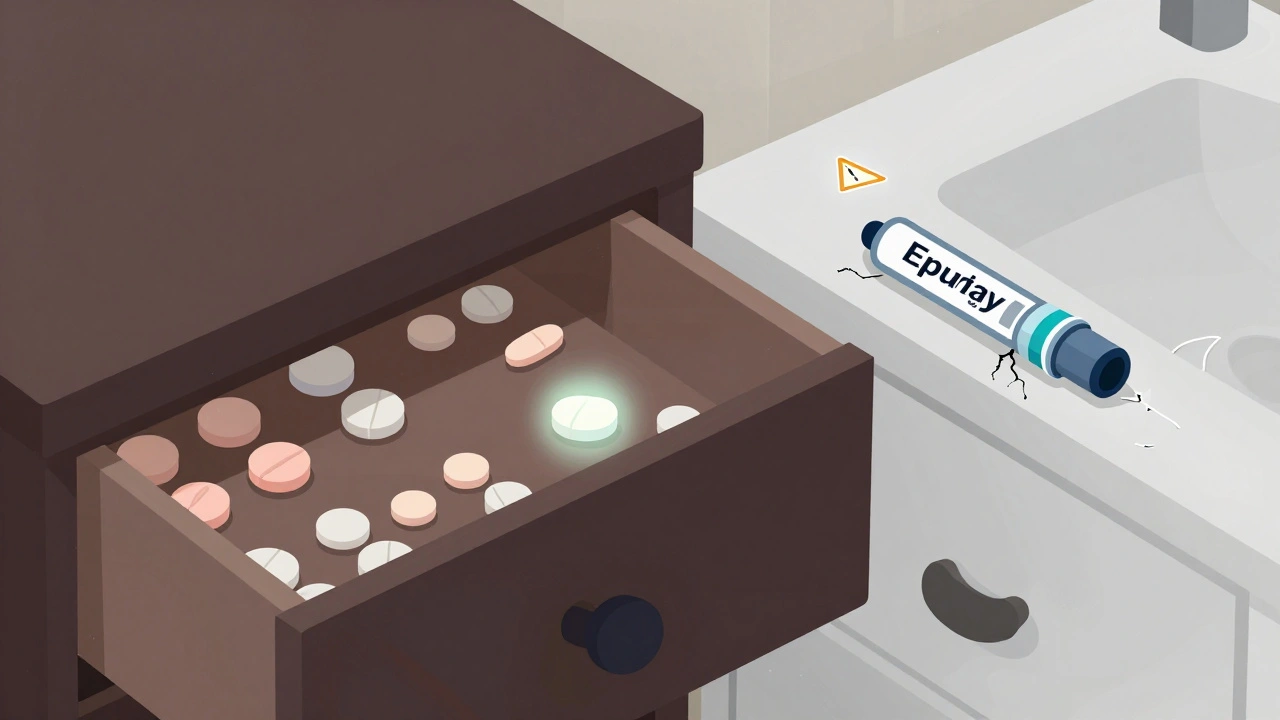
You wouldn’t leave chocolate in a hot car. So why leave your medicine in the bathroom? The bathroom is one of the worst places to store pills. Every time you shower, humidity spikes. That moisture seeps into the bottle. Over time, it breaks down the active ingredients. Studies show humidity and heat in bathrooms can speed up degradation by 30-50% compared to a cool, dry drawer.The best spot? A bedroom shelf, away from sunlight and moisture. A drawer in your dresser works better than any medicine cabinet. Keep it out of reach of kids, but don’t let it sit near a window or above the radiator. Heat and light are two of the biggest enemies. Tetracycline antibiotics, for example, turn toxic when exposed to light. That’s not just a loss of potency - that’s a risk.
What the FDA and Military Know That You Don’t
The U.S. Food and Drug Administration (FDA) says: don’t use expired meds. And they’re right - for you. But here’s the twist: the military has been testing this for decades. Since 1986, the Shelf Life Extension Program (SLEP) has tested over 100 different drugs from stockpiles. About 88% of them were still effective - sometimes 10 to 15 years past their expiration date. Some of those pills were stored in cool, dry military warehouses with controlled humidity and no light exposure.So why can’t you do the same? Because your home isn’t a military depot. You leave your medicine in the car. You keep it in the bathroom. You forget about it for years. The FDA’s warning isn’t about the science. It’s about control. They can’t guarantee your meds were stored properly. And when it comes to antibiotics, heart meds, or insulin, even a 10% drop in strength can mean the difference between treatment and failure.
Between 2007 and 2012, over 400 drug lots were recalled because of degradation - not because they were fake, but because they lost potency or developed harmful impurities. That’s not a small number. That’s a pattern.
When It’s Safe to Use Expired Medicine - And When It’s Not
There’s no blanket rule. But here’s a practical guide:- Safe to consider (with caution): Pain relievers like ibuprofen, acetaminophen, antihistamines, and some allergy meds. These are low-risk if potency drops slightly. If you’ve had them for a year or two past expiration and stored them well, they’re probably still working.
- Never risk it: Antibiotics, heart medications, insulin, epinephrine (EpiPens), seizure meds, and birth control. These have narrow therapeutic windows. Too little won’t work. Too much can kill. If your EpiPen is expired, replace it. If your insulin is old, get a new one. No exceptions.
- Unclear risk: Liquid antibiotics, eye drops, and any medicine that smells funny, changes color, or looks crumbly. These are signs of breakdown. Throw them out.
There’s no home test to check if your medicine is still strong. You can’t taste it, smell it, or see it. Only a lab with HPLC-MS equipment can detect degradation products at levels as low as 0.05%. That’s why experts say: if you’re unsure, replace it.
What’s Changing in the Future
Pharmaceutical companies are starting to build smarter packaging - bottles with oxygen and moisture barriers that could extend shelf life by up to 40%. Some are even testing smart labels that change color if the drug degrades. But these are still in early stages.Right now, the system is built on caution. Manufacturers set expiration dates 1-3 years after production, based on accelerated testing. They heat pills to 40°C and flood them with humidity to simulate two years of aging in six months. That’s how they know when a drug might start failing. But real life is messier. Your garage isn’t a lab. Your medicine chest isn’t a military bunker.
One thing’s clear: the expiration date isn’t a deadline. It’s a warranty. It’s the manufacturer’s promise that your medicine will work as intended - if stored right. Beyond that? You’re on your own.
What You Can Do Today
- Check your medicine cabinet. Look for pills that are discolored, cracked, or sticky. Toss them. - Store meds properly. Keep them in a cool, dry, dark place - not the bathroom, not the car, not the kitchen window. - Don’t hoard. Buy only what you need. Expired meds aren’t savings - they’re risks. - Ask your pharmacist. They can tell you if your medication is known to degrade quickly. Some drugs are just more fragile. - Replace critical meds. EpiPens, insulin, seizure meds - don’t gamble with these. Insurance often covers replacements.Medicines aren’t like wine. They don’t get better with age. They don’t even stay the same. They slowly fall apart. And when they do, your health is the first thing that suffers.
Donna Hammond
December 14, 2025 AT 10:30I used to keep my ibuprofen in the bathroom until I read this. Now I have a little tin in my dresser drawer-dark, dry, and out of reach of my toddler. Small change, huge difference. I never realized how much humidity was eating away at my meds. Thanks for the wake-up call.
Also, my pharmacist told me amoxicillin suspension goes bad faster than milk in summer. I used to hoard it ‘just in case.’ Not anymore.
Real talk: if your medicine smells weird or looks like it’s crying, toss it. No shame in spending $12 to stay alive.
Richard Ayres
December 15, 2025 AT 21:45While the scientific basis for expiration dates is well-documented, it is worth noting that the FDA’s stance is not solely grounded in pharmacological integrity, but also in liability management. The military’s SLEP program, as referenced, demonstrates that under controlled conditions, many pharmaceuticals retain efficacy far beyond their labeled expiration. This discrepancy highlights a systemic gap between ideal storage environments and real-world consumer behavior. One must therefore distinguish between theoretical stability and practical safety.
Sheldon Bird
December 17, 2025 AT 16:49Yessss this is so important!! 🙌 I used to be lazy and just keep everything in the bathroom like a zombie. Now I’ve got a little medicine box in my closet with silica packs. Best $3 I ever spent.
Also, if you’re on thyroid meds? Don’t mess around. Even 5% less can make you feel like a zombie. I learned the hard way. Replace it. Your energy levels will thank you 😊
Karen Mccullouch
December 18, 2025 AT 05:26Of course the FDA says not to use expired meds-because they’re scared of lawsuits, not science. Meanwhile, real people in third-world countries use expired insulin and antibiotics and survive. This whole system is rigged to keep you buying. You think they care about your health? They care about your wallet.
And yeah, I keep my EpiPen in my glovebox. So what? I’ve got better things to do than babying pills.
🇺🇸 #AmericaDoesntNeedYourLaws
Rawlson King
December 19, 2025 AT 22:37It is curious that you present the Shelf Life Extension Program as evidence of extended efficacy, yet fail to acknowledge that the conditions under which these drugs were stored-climate-controlled, sealed, inert atmospheres-are fundamentally incompatible with domestic storage environments. To conflate the two is not merely misleading; it is a category error of the highest order. The fact that military-grade storage yields different results does not validate home storage practices. It merely underscores the inadequacy of the latter.
Himmat Singh
December 21, 2025 AT 07:35It is an incontrovertible fact that the pharmaceutical industry, in its pursuit of profit maximization, has engineered expiration dates as a mechanism of planned obsolescence. The data from SLEP clearly demonstrates that the majority of pharmaceutical compounds remain chemically stable beyond their labeled shelf life. The FDA’s rigid stance is therefore not a reflection of pharmacological reality, but rather a regulatory artifact designed to sustain consumer dependency. One must question the moral integrity of a system that prioritizes corporate revenue over public access to essential therapeutics.
kevin moranga
December 22, 2025 AT 18:47Man, I love this post. Seriously. I used to think expiration dates were just a scam like ‘best by’ on yogurt. But then my grandma had a stroke because her blood thinner was old-she didn’t even know it was expired. She kept it in the kitchen cabinet next to the toaster. Heat + moisture = bad news.
Now I check my meds every six months. If it looks dusty, smells like old socks, or the pills are sticking together? Gone. No second chances.
And if you’re on insulin or seizure meds? Don’t be a hero. Just get a new one. Insurance covers it. Your life doesn’t come with a reset button.
Also, if you’re storing meds in your car? That’s not ‘preparedness,’ that’s just dumb. Your car hits 130°F in July. That’s not storage. That’s a science experiment gone wrong.
My pharmacist gave me a free moisture-proof pill case. Best gift ever. I even have one for my dog’s heart meds. Yeah, I’m that guy. But hey-I’m alive, right? 😎
Alvin Montanez
December 23, 2025 AT 00:35You people are so naive. You think the government cares about your health? The FDA doesn’t test your meds. They test the samples the pharmaceutical companies send them-samples that were stored perfectly. The real drugs you buy? Made in China or India, shipped in uncontrolled containers, sitting on warehouse floors for months before hitting your pharmacy. Your ‘expiration date’ is a fairy tale. The real expiration date is when it left the factory.
And don’t get me started on ‘natural degradation.’ That’s just a fancy word for ‘we didn’t bother to make this stable.’
My uncle took expired antibiotics for a tooth infection. Got sepsis. Died. The bottle said ‘2021.’ He took it in 2023. He thought he was saving money.
Turns out, you don’t save money when you die.
So stop rationalizing. Just replace it. And stop trusting corporations that make billions off your fear.
Webster Bull
December 23, 2025 AT 21:20Meds ain’t wine. They don’t age well. They just… fade. Like your phone battery. You don’t wait till it dies to replace it. Why do it with your pills?
Also, bathroom = death zone. Duh.
And yeah, EpiPens? Replace. No debate. That’s not ‘being cheap.’ That’s playing Russian roulette with your kid’s life.
Emma Sbarge
December 24, 2025 AT 07:18So let me get this straight-our entire medical system is built on fear, corporate liability, and the illusion of control? We’re told to throw out perfectly good medicine because the FDA can’t guarantee how you stored it, but they’re fine letting companies use cheap fillers that accelerate degradation?
And yet, somehow, we’re supposed to trust that the $12 bottle from CVS is safer than the $2 one from the corner store that’s been sitting in a warehouse for two years?
It’s not science. It’s a business model wrapped in a lab coat.
Ronan Lansbury
December 26, 2025 AT 03:48Have you ever considered that the entire expiration date framework is a psychological tool designed to condition consumers into perpetual consumption? The military’s SLEP program was declassified not for transparency, but to create cognitive dissonance-so that when people question the system, they’re met with ‘but the military says it’s fine!’ as a distraction. The real agenda? Control the narrative of pharmaceutical dependency. The FDA, WHO, and Big Pharma are all nodes in the same network. They don’t want you to know that your meds can last a decade. They want you to buy new ones every year. Look at the packaging. The date is printed in the smallest font possible. Why? Because they don’t want you to read it. They want you to panic and replace.
Keasha Trawick
December 27, 2025 AT 11:14Okay, but let’s talk about the *chemistry* of this like we’re all science nerds here 🧪💥
Hydrolysis? That’s water molecules sneaking into your pill like tiny little burglars, breaking ester bonds like they’re in a heist movie. Oxidation? Oxygen’s just chillin’, doing its thing, but suddenly your epinephrine’s like, ‘oh no, not again.’ Photolysis? Sunlight’s the ultimate villain-UV rays punching holes in molecular structures like a cosmic graffiti artist.
And don’t even get me started on those sneaky excipients-polysorbate 80? Hypromellose? They’re not just ‘fillers.’ They’re chemical accomplices. One brand’s ibuprofen? Stable as a rock. Another’s? Turns into a soggy cracker in six months because the binder’s got the hydration level of a desert cactus.
This isn’t just medicine. It’s a battlefield of molecular warfare. And your bathroom? Ground zero.
Tommy Watson
December 29, 2025 AT 02:08So you’re telling me I gotta throw out my 3-year-old Zyrtec just because the bottle says so? Nah. I took it last week and I didn’t sneeze once. I’m not some lab rat. I’m a human. I’ve got instincts.
Also, why are you all so scared of expired stuff? I’ve been taking expired antibiotics since 2018. Never got sick. The real problem is you guys are too scared to think for yourself.
Sheldon Bird
December 30, 2025 AT 06:19^^^ I feel you, Tommy. I used to be like you. Then my dog got an infection and the vet said, ‘This stuff’s expired-don’t use it.’ I did anyway. He got sicker. We had to pay $800 extra. Lesson learned.
Not all meds are created equal. But some? They’re not worth the risk. Your dog’s life? Worth it. Your pride? Not so much. 🐶❤️