Travel Letters for Controlled Medications: Airport and Customs Tips
 Dec, 22 2025
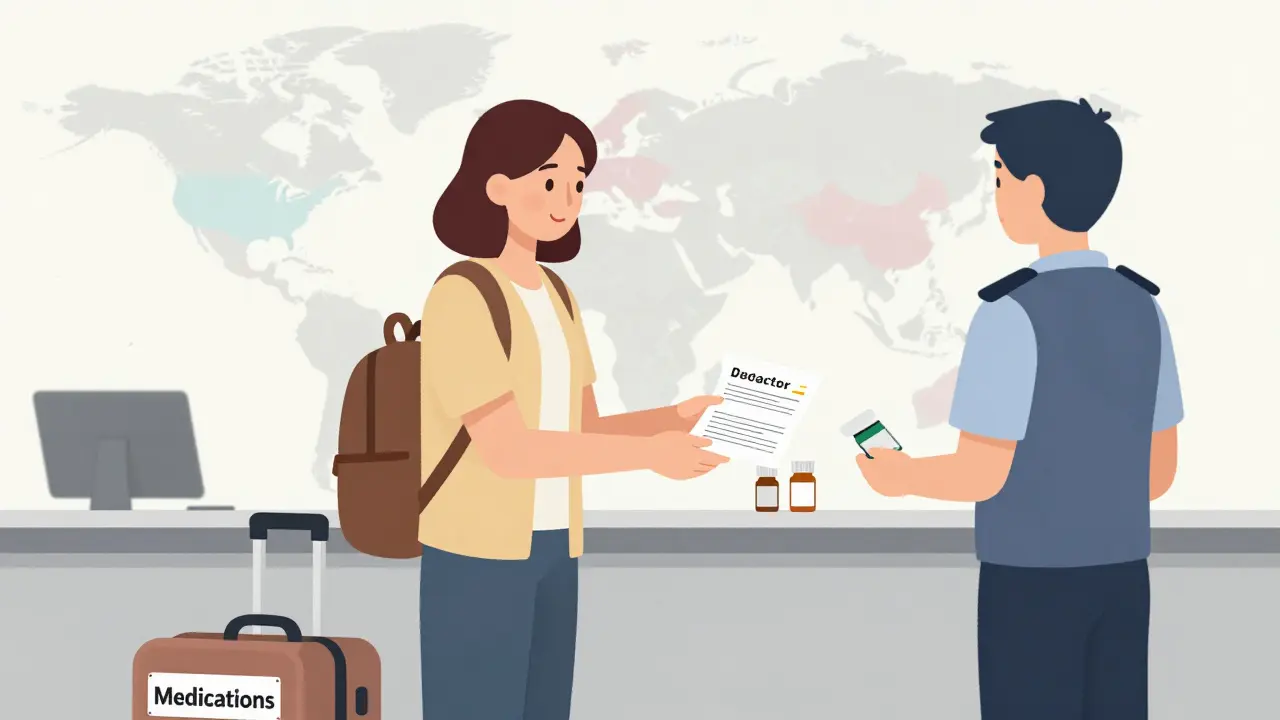
Carrying controlled medications across borders isn’t just about packing your pills. It’s about having the right papers - the kind that keep you from getting detained, delayed, or worse. If you’re flying with something like oxycodone, Adderall, Xanax, or even sleep aids like zolpidem, you’re not just a traveler. You’re carrying something governments treat like restricted goods. And without the right documentation, you could lose your meds, miss your flight, or face serious legal trouble.
Why a Travel Letter Isn’t Optional
The U.S. Food and Drug Administration (FDA) says you can bring up to a 90-day supply of prescription drugs into the country for personal use - if you have the right paperwork. But what happens when you’re leaving the U.S. and heading to Japan, the UAE, or Australia? Each country has its own rules. Japan bans Adderall entirely. The UAE treats even small amounts of benzodiazepines like illegal drugs. Australia requires pre-approval for Schedule 8 controlled substances. And if you don’t have a letter from your doctor, you’re gambling with your health and your freedom.The CDC’s 2024 Yellow Book found that 23% of travelers with controlled medications get them confiscated at borders - but only 5% of those who carried a proper doctor’s letter faced the same fate. That’s not luck. That’s preparation.
What a Travel Letter Must Include
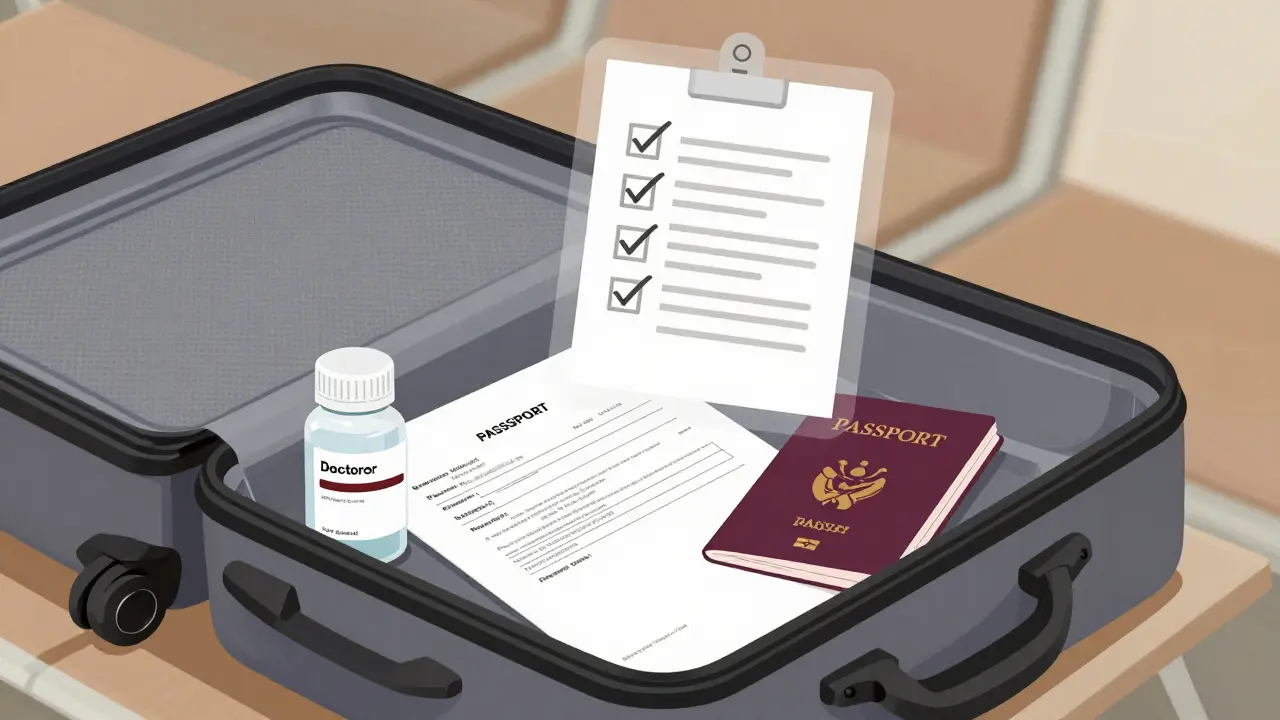
A generic note from your doctor won’t cut it. Customs officers need specifics. Your letter must have:- Your full name (exactly as it appears on your passport)
- Generic and brand names of each medication
- Dosage strength (e.g., 10 mg oxycodone)
- How often you take it (e.g., once daily)
- Total quantity you’re carrying (e.g., 60 tablets for a 30-day trip)
- Medical reason for use (e.g., chronic pain, ADHD, anxiety disorder)
- Prescribing doctor’s name, license number, phone number, and clinic address
- Date the letter was written and doctor’s signature
Some countries require the letter to be on official letterhead. Others insist it be translated into their language. Don’t assume your English letter will be enough. Always check.
Which Medications Are Most Likely to Cause Problems
Not all prescriptions are treated the same. The International Narcotics Control Board reports that six types of medications cause 67% of global border incidents:- Oxycodone and hydrocodone - Narcotic painkillers, tightly controlled everywhere
- Alprazolam (Xanax), diazepam (Valium) - Benzodiazepines, banned or restricted in Japan, Singapore, and the UAE
- Zolpidem (Ambien) - Illegal in Japan and the UAE, even with a prescription
- Adderall, lisdexamfetamine (Vyvanse) - Amphetamines, prohibited in most Asian and Middle Eastern countries
- Pseudoephedrine - Found in cold meds, used to make meth, banned in many places
- Tramadol - Classified as a controlled substance in over 50 countries
If you’re taking any of these, don’t wait until you’re at the airport. Start your paperwork now.
Country-Specific Rules You Can’t Afford to Ignore
Here’s what you need to know for key destinations:| Country | Allowed Supply | Special Requirements | Banned Medications |
|---|---|---|---|
| United States | Up to 90-day supply | Prescription + doctor’s letter | None for personal use |
| Japan | One-month supply max | Yakkan Shoumei import certificate (apply 7-10 days ahead) | Adderall, Xanax, Ambien, Vicodin |
| United Arab Emirates | 30-day supply | Pre-approval from Ministry of Health | All benzodiazepines, opioids, ADHD meds |
| United Kingdom | 3-month supply | Controlled Drug Import Certificate for narcotics | None if properly documented |
| Australia | 3-month supply | Therapeutic Goods Administration (TGA) pre-approval for Schedule 8 drugs | None if approved |
| Canada | 90-day supply | Prescription + letter | None for personal use |
Japan’s Yakkan Shoumei certificate costs about $50 and takes 7-10 business days. The UAE requires you to apply online weeks in advance. Australia’s TGA portal can take up to 20 days. Don’t wait until the day before your flight.
How to Avoid the Biggest Mistakes
Most travelers mess up in the same ways:- Repackaging pills - Never put meds in daily pill organizers. Customs agents see that as suspicious. Keep everything in original pharmacy bottles with clear labels.
- Forgetting translations - If your prescription or letter isn’t in English or the destination country’s language, get it certified. Translation services cost $25-$75, but they’re cheaper than missing your flight.
- Carrying too much - Even if you have a letter, bringing a 6-month supply will raise red flags. Stick to what you need for your trip plus a little extra for delays.
- Not carrying a copy - Always bring a printed copy of your letter and prescription. Don’t rely on your phone. Airport security might not let you use it.
- Assuming your insurance card is enough - It’s not. Insurance cards don’t prove medical necessity.
A traveler on Reddit shared how they flew to 12 countries with Adderall - and never had an issue. Their secret? A doctor’s letter with their passport number, generic and brand names, dosage, and a clear explanation of ADHD. They also got Japan’s Yakkan Shoumei certificate. That’s the level of detail that works.
What to Do at the Airport
When you reach security or customs:- Keep your meds and letter in your carry-on. Never check them.
- Be ready to show your letter and prescription to officers - even if they don’t ask.
- Stay calm and polite. Officers are trained to look for drug trafficking, not medical travelers.
- If they question your meds, hand them the letter. Say: “These are for my personal medical use. Here’s my doctor’s letter and prescription.”
- Never lie. If they find unreported meds, penalties can include fines, detention, or deportation.
One traveler at JFK in August 2023 was held for 47 minutes because they had 60 oxycodone tablets without a letter. They had to call their doctor, who faxed a letter from the airport. That delay could’ve been avoided with 10 minutes of prep.
What’s Changing in 2025
The FDA is testing a new mobile app called “Traveler Medication Pre-Clearance” - expected to launch in late 2025. It’ll let you upload your documents before you fly and get approval ahead of time. Pilot programs at Chicago O’Hare and Miami reduced inspection time by 65%.The International Narcotics Control Board is also working on a global standard travel certificate, set to roll out in 2026. For now, though, you’re still on your own. Don’t wait for the system to fix itself.
Where to Get Help
If you’re overwhelmed:- Ask your doctor for the letter. Most will write one for free or a small fee.
- Use the International Association for Medical Assistance to Travellers (IAMAT) - their “Medication Abroad” tool gives country-specific guidance with 98.7% accuracy.
- Check your destination country’s embassy website. They often list exact rules for medications.
- Call the U.S. Customs and Border Protection (CBP) at 1-877-227-5511 for questions about U.S. entry rules.
Travelers with chronic conditions are 3.2 times more likely to face delays. But those with full documentation clear customs in under 28 minutes. Without it? Two hours. That’s a full day’s travel time lost.
Final Checklist Before You Fly
Print this. Tick it off. Don’t skip a single item.
- ✅ All medications in original pharmacy bottles with labels
- ✅ Doctor’s letter with all required details (name, meds, dosage, reason, contact info)
- ✅ Copy of your prescription (English or translated)
- ✅ Country-specific approvals (Yakkan Shoumei, TGA, etc.)
- ✅ Passport and visa copies
- ✅ Printed copies of all documents (not just digital)
- ✅ Medications packed in carry-on only
- ✅ Contact info for your doctor saved on your phone and printed
If you do this, you’re not just prepared. You’re protected. And that’s worth more than any flight upgrade.
Can I bring my controlled medication in a pill organizer?
No. Always keep controlled medications in their original pharmacy bottles with clear labels. Customs agents consider repackaged pills suspicious - even if they’re yours. 53% of medication issues at U.S. borders happen because people used daily pill organizers instead of original containers.
Do I need a letter if I’m only carrying a 30-day supply?
Yes. Even if you’re within the legal limit, a doctor’s letter is your best protection. Without it, officers have no way to verify your meds are for personal use. The CDC found that 78% of confiscations happen because documentation is missing or incomplete - not because the amount was too high.
What if my doctor won’t write a letter?
Most doctors will - it’s a routine request. If yours refuses, ask if they can refer you to a travel medicine clinic. Pharmacies like CVS MinuteClinic or Walgreens Health Clinics often provide these letters for a small fee. You can also contact IAMAT or a local travel health center for help.
Can I ship my medication ahead of time?
Generally, no. The FDA only allows personal importation of medications if they’re carried by the traveler. Shipping them ahead - even to your hotel - is treated as commercial importation and will likely be seized. Always carry your meds with you in your carry-on.
Are over-the-counter meds with pseudoephedrine a problem?
Yes. Pseudoephedrine is used to make methamphetamine and is banned or restricted in many countries, including Japan, Thailand, and parts of Europe. Check the ingredients of cold and allergy meds before you pack them. Look for alternatives like phenylephrine if your destination has restrictions.
Gray Dedoiko
December 24, 2025 AT 05:42I had to fly to Japan last year with my Adderall and honestly panicked the whole way. Got the Yakkan Shoumei certificate like 10 days before - total pain but worth it. Customs guy just nodded, didn’t even ask. Saved my trip.
Don’t wait till the airport. Seriously.
Aurora Daisy
December 24, 2025 AT 09:25Of course the US thinks its prescriptions are magic tickets to everywhere. Meanwhile, my UK friend got detained in Dubai for carrying Valium - turns out, even with a letter, they treat it like smuggling heroin.
Stop pretending the world follows your rules.
siddharth tiwari
December 25, 2025 AT 22:00u think this is about meds? nah. its about control. the govts dont want you to feel better. they want you dependent on their system. why do u think japan bans adderall? because they dont want u to be productive outside their control. the pharmacy? part of the matrix.
theyll take ur pills then charge u 500$ for a 'certificate'. scam.
suhani mathur
December 27, 2025 AT 04:09Wow, someone actually wrote a useful post. Rare.
For anyone who thinks 'my doctor won't write a letter' - please, go to a MinuteClinic. They charge $40 and do it in 10 minutes. I got mine for my Xanax before I went to Thailand. No drama.
Also - stop repacking into pill organizers. I saw a guy get pulled aside at Heathrow because his 'daily dose' looked like a drug dealer’s stash.
Diana Alime
December 28, 2025 AT 02:40i just carry my meds in my pocket and hope for the best
why do i even bother with papers? i’m not a criminal. i’m just a person who needs to function.
also i lost my prescription last week and now i’m just praying no one asks me what’s in my bag. 😭
Adarsh Dubey
December 30, 2025 AT 00:47Good guide. I’ve traveled to 8 countries with tramadol and never had an issue - always had the letter, original bottles, and kept it in carry-on.
One thing missing: some countries allow meds if you declare them at customs even without pre-approval. Just be honest, calm, and polite. Most officers just want to make sure you’re not trafficking.
Bartholomew Henry Allen
December 31, 2025 AT 22:21Failure to comply with international pharmaceutical regulations constitutes a serious breach of sovereign law. The United States does not have extraterritorial authority over controlled substances. Any traveler who assumes otherwise is operating under a dangerous misconception.
Documentation is not optional. It is the baseline of lawful conduct.
bharath vinay
January 2, 2026 AT 11:16they say 'get a letter' but who wrote the letter? the same doctors who work with big pharma who profit from your addiction
the real problem is the system that makes you dependent on these pills in the first place
and why do you think the FDA is 'testing an app'? to track you. they want to know where you are when you take your pills. surveillance disguised as convenience
Chris Buchanan
January 3, 2026 AT 18:12YOU CAN DO THIS. Seriously.
I flew to Singapore with Vyvanse. Got the letter. Printed two copies. Had the prescription in the bottle. Walked up to customs, handed it over before they even asked. Smiled. Said 'thanks for your help'.
They waved me through. No drama. No stress.
It’s not hard. It’s just inconvenient. And inconvenience beats detention any day.
Wilton Holliday
January 5, 2026 AT 00:51Hey, if you're reading this and you're stressed about your meds - you're not alone.
I’ve been there. Took me 3 months to get TGA approval for my oxycodone before Australia. I cried. I called my doctor 7 times. I almost gave up.
But I did it. And now I travel without fear.
You got this. 💪 One step at a time. Start with the letter. Then the bottles. Then the printouts. You’re not just packing pills - you’re packing peace of mind.
Raja P
January 5, 2026 AT 20:37Just a heads up - some embassies have templates for the doctor’s letter. I used the one from the Indian embassy in DC for my trip to UAE. Saved me a ton of time.
Also, if you’re on Adderall, check if your dose is under 20mg/day. Some countries are chill if it’s low-dose. Not a guarantee, but worth asking.
Delilah Rose
January 7, 2026 AT 15:34I just want to say how much this post means to people like me who live with chronic pain and anxiety and have to travel for work or family emergencies - it’s not just about convenience, it’s about dignity. The fear of being treated like a criminal because you need medication to get out of bed? That’s real. And it’s exhausting. I’ve had officers stare at me like I’m holding contraband when I just have my 10mg oxycodone for my spinal injury. And yes, I had the letter. And yes, I still got asked 12 questions. But I didn’t cry. I didn’t yell. I just handed them the paper and said, 'This is my life.' And they let me go. So thank you for making this guide. It’s not just information - it’s armor.
And if you’re reading this and you’re scared - you’re not weak. You’re brave. Keep going.
Bret Freeman
January 8, 2026 AT 01:33My cousin got arrested in Dubai for carrying 10 Xanax pills. He had a letter. They still threw him in jail for 3 weeks. Said the letter was 'not official enough'.
Turns out, the UAE requires a notarized letter from a US doctor AND a translated Arabic version AND a stamped copy from the Ministry of Health in Abu Dhabi.
And you think a doctor’s note is enough? Nah. You’re not prepared. You’re just lucky so far.
And now he’s on antidepressants. Because of a pill organizer.
niharika hardikar
January 8, 2026 AT 15:32It is imperative to underscore the non-negotiable nature of pharmaceutical compliance under the United Nations Single Convention on Narcotic Drugs, 1961, as amended, and its subsequent protocols. The possession of Schedule IV and V substances across international borders without adherence to the Convention’s Article 31 provisions constitutes a prima facie violation of international treaty obligations.
Furthermore, the efficacy of the Yakkan Shoumei certificate is predicated upon Article 12 of Japan’s Narcotics and Psychotropics Control Act, which mandates pre-import authorization for all psychotropic agents, irrespective of therapeutic intent. Failure to comply therewith triggers automatic confiscation under Section 62(1) of the Act, with potential penal consequences under Article 73.
Therefore, the assertion that a 'doctor’s letter' is sufficient is not merely inaccurate - it is dangerously misleading.