Sulfonamide Allergies and Cross-Reactivity: What Medications to Avoid
 Dec, 16 2025
Sulfonamide Safety Checker
Is Your Reaction an Allergy?
This tool helps determine if your sulfonamide reaction is likely a true allergy or a non-allergic reaction. Based on medical evidence, most "sulfa allergies" are mislabeled.
More than 1 in 10 people say they’re allergic to sulfa drugs. But here’s the truth: sulfonamide allergy is often misdiagnosed. Most of the time, it’s not a real allergy at all. It’s a rash that showed up a week after taking an antibiotic, or a stomach upset that had nothing to do with the drug. Yet, that label sticks - and it can cost you real health risks.
What Actually Causes a True Sulfonamide Allergy?
The term ‘sulfa allergy’ usually points to antibiotics like sulfamethoxazole (in Bactrim) or sulfadiazine. These are antimicrobial sulfonamides - and they’re the only ones that commonly trigger true allergic reactions. The problem isn’t the sulfonamide group itself. It’s the specific chemical structure around it: an arylamine group attached at the N4 position and a nitrogen-containing ring at N1. These parts break down into reactive molecules that bind to proteins in your body, tricking your immune system into thinking they’re invaders.
That’s why reactions happen. But not everyone who gets a rash on these drugs has an allergy. Studies show only 0.3% to 0.5% of people have a real IgE-mediated reaction - the kind that causes hives, swelling, or anaphylaxis. The rest? Most had side effects, viral rashes, or reactions that weren’t immune-driven at all. Yet, once labeled ‘sulfa allergic,’ that tag follows you for life.
Here’s What You Can Still Take - Even With a ‘Sulfa Allergy’
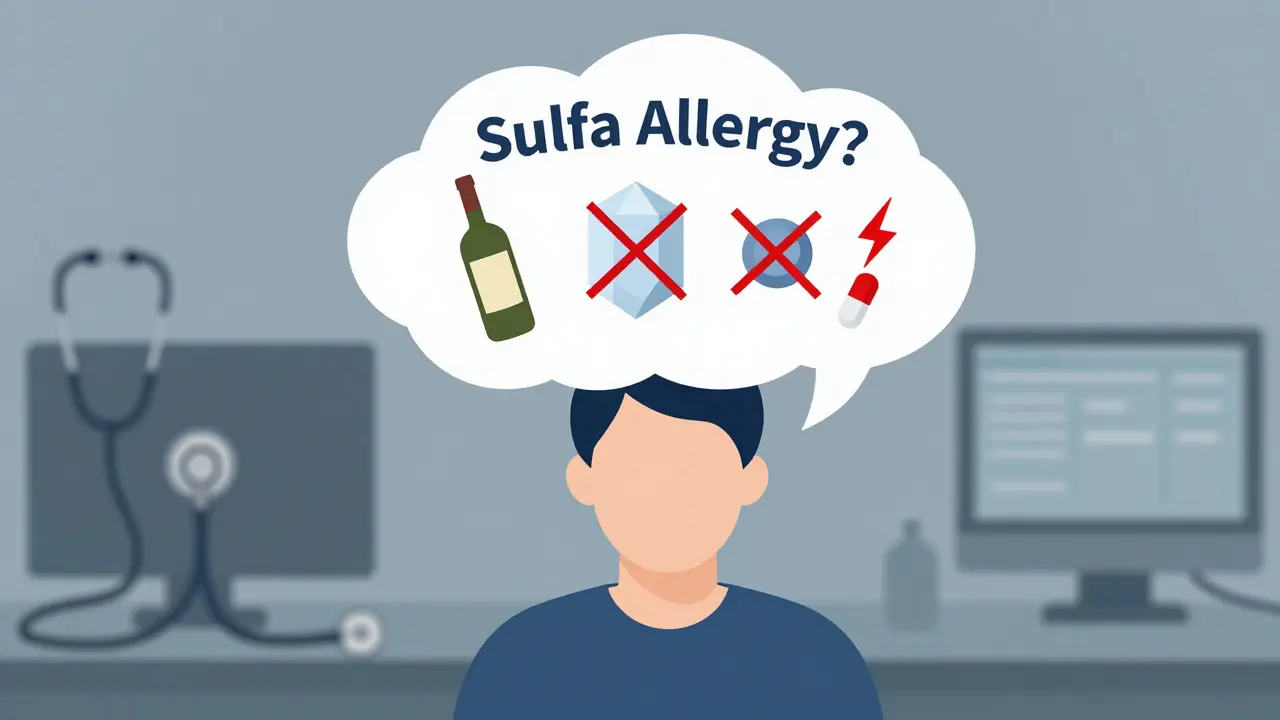
Let’s clear up the biggest myth: having a sulfonamide antibiotic allergy doesn’t mean you can’t take any drug with ‘sulf’ in the name. Sulfur, sulfates (like magnesium sulfate), and sulfites (in wine or dried fruit) are chemically unrelated. You can safely take them. Many doctors still get this wrong - a 2020 survey found nearly half of primary care providers thought sulfites were dangerous for people with sulfa allergies. They’re not.
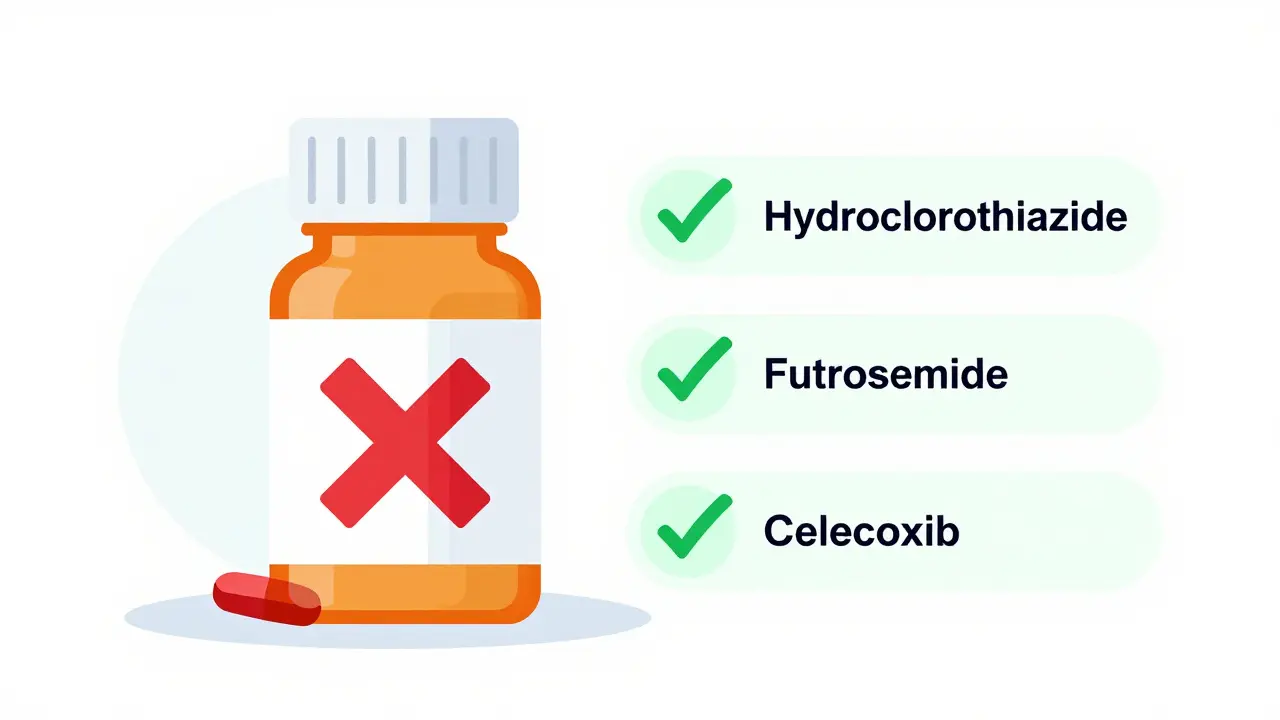
Even more surprising: most nonantimicrobial sulfonamides are safe. These include:
- Hydrochlorothiazide (for high blood pressure)
- Furosemide (Lasix, for fluid retention)
- Acetazolamide (for glaucoma or altitude sickness)
- Celecoxib (Celebrex, for arthritis)
A 2022 review of 10,000+ patients found the risk of reacting to hydrochlorothiazide if you have a sulfonamide antibiotic allergy is just 1.1% - almost the same as people with no history of sulfa reactions. The same goes for furosemide and acetazolamide. The FDA now requires these drugs to state clearly on their labels: ‘This product does not contain the structural elements associated with sulfonamide antibiotic allergies.’
What You Should Still Avoid
There’s one major exception: dapsone. It’s used to treat leprosy, certain skin conditions, and to prevent Pneumocystis pneumonia in people with HIV. Dapsone shares the same N4-arylamine structure as antimicrobial sulfonamides. Studies show about 13% of people with a documented sulfonamide antibiotic allergy react to dapsone. If you’ve had a serious reaction like Stevens-Johnson syndrome to a sulfa antibiotic, avoid dapsone unless under close medical supervision.
Also avoid other antimicrobial sulfonamides: sulfamethoxazole-trimethoprim (Bactrim, Septra), sulfadiazine, sulfacetamide (eye drops), and sulfasalazine (for ulcerative colitis). These are the drugs that caused the original reaction - and they’re the ones you should steer clear of.
Why This Mislabeling Hurts You
When doctors avoid sulfonamide antibiotics because of a mislabeled allergy, they turn to alternatives. Often, those alternatives are broader-spectrum antibiotics like fluoroquinolones (Cipro, Levaquin). These drugs carry black box warnings from the FDA for tendon rupture, nerve damage, and aortic aneurysm. They’re more expensive. And they fuel antibiotic resistance.
One 2021 study found that patients labeled with ‘sulfa allergy’ received broader antibiotics 32.7% of the time - even when sulfonamides were the best choice. That’s not just a medical mistake. It’s a public health risk. The CDC estimates this mislabeling increases resistance rates in common bacteria like E. coli and Staphylococcus aureus by 8-13% annually.
And it’s not just about antibiotics. A 68-year-old man in Melbourne spent 15 years on ineffective blood pressure meds because his doctor refused hydrochlorothiazide. He had a mild rash from sulfamethoxazole at age 12. After a supervised challenge, he tolerated it perfectly. His blood pressure stabilized. His side effects vanished.
How to Get Your Label Fixed
If you’ve been told you have a ‘sulfa allergy,’ ask yourself: What exactly happened? When? How bad was it?
- If it was a mild rash that started more than 72 hours after taking the drug - it’s likely not a true allergy.
- If you had hives, swelling, trouble breathing, or a fever within minutes or hours - that’s a red flag.
- If you had Stevens-Johnson syndrome or toxic epidermal necrolysis - avoid all antimicrobial sulfonamides and talk to an allergist.
For low-risk reactions, your doctor can do an oral challenge in the clinic. You take a small dose of the antibiotic under observation. Studies show this is 99.2% safe. For higher-risk cases, an allergist can do skin testing and graded challenges. In one study, 94.7% of people labeled with ‘sulfa allergy’ passed the challenge - meaning they never had an allergy to begin with.
Ask your doctor to update your record. Don’t write ‘sulfa allergy.’ Write: ‘Mild maculopapular rash 5 days after sulfamethoxazole-trimethoprim - likely non-allergic.’ That specificity changes everything.
What’s Changing in 2025
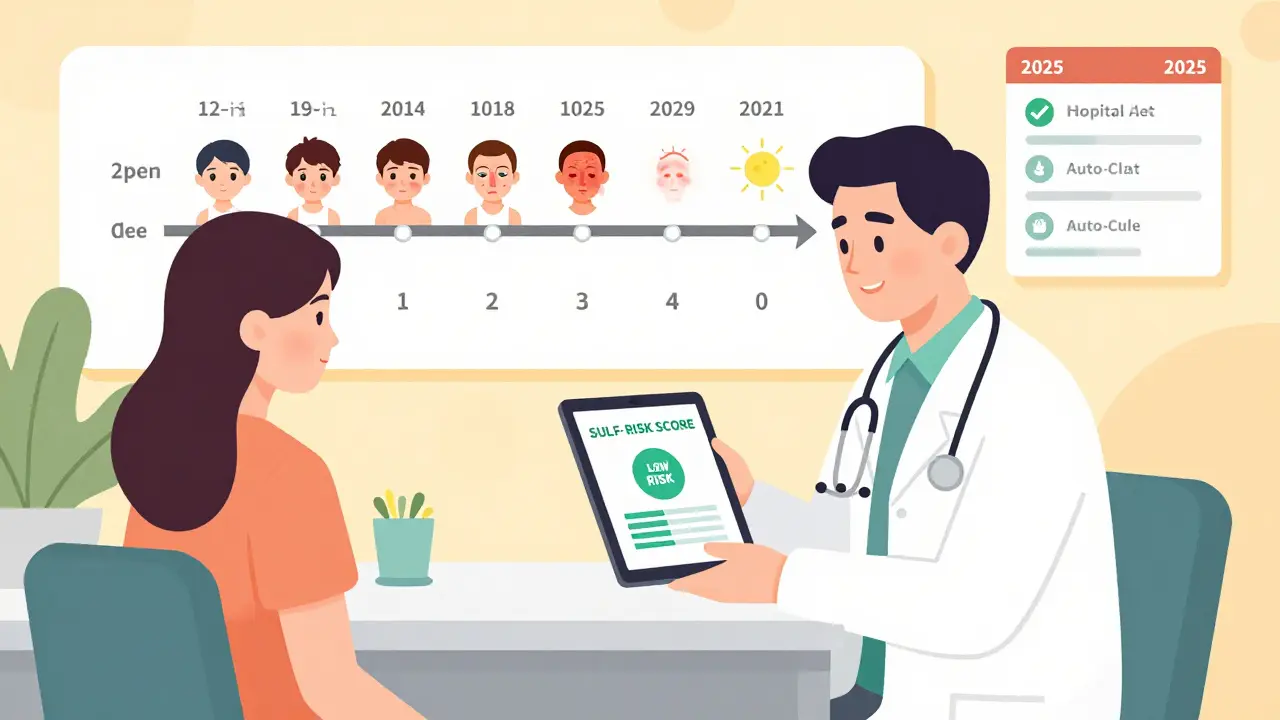
Big health systems are finally catching up. The Sulfonamide Allergy De-labeling Initiative, launched in 2023 by the AAAAI and Infectious Diseases Society of America, gives clinics step-by-step tools to review and remove incorrect allergy labels. Electronic health records now have built-in alerts: if you’re labeled ‘sulfa allergic,’ the system flags nonantimicrobial sulfonamides as safe and suggests alternatives only when truly needed.
There’s even a new tool called the SULF-RISK score. It uses your age, reaction type, and timing to predict whether your allergy is real - with over 90% accuracy. And by 2025, 75% of major hospitals in the U.S. and Australia are expected to use automated systems to flag and correct these mislabels.
There’s also a new blood test in development - a sulfamethoxazole-specific IgE assay. Early trials show it correctly identifies true allergies in nearly 90% of cases. It’s not widely available yet, but it’s coming.
Real Stories, Real Consequences
On Reddit, users with ‘sulfa allergies’ share the same frustration: denied hydrochlorothiazide, denied celecoxib, denied acetazolamide. One user wrote: ‘My doctor refused to prescribe anything with sulf in it for 10 years. I ended up with heart palpitations from a different diuretic. Turns out I never had an allergy.’
Another patient with HIV needed Pneumocystis prophylaxis. She was told she couldn’t take dapsone. She ended up on pentamidine - a drug that causes pancreatitis, low blood sugar, and kidney damage. After testing, she was cleared for dapsone. Her side effects disappeared.
These aren’t rare cases. A 2022 study followed 47 patients with ‘sulfa allergy’ who needed sulfonamide antibiotics. After supervised challenges, 91.5% tolerated them without issue.
Bottom Line: Don’t Assume - Get Checked
If you’ve been told you have a sulfa allergy, don’t live in fear. Most of the time, you’re safe to take common nonantimicrobial sulfonamides. You’re not allergic to sulfur, sulfates, or sulfites. And you may not even be allergic to the antibiotics you think you are.
Ask your doctor: ‘Was my reaction really an allergy? Can we test it?’ If they say no - ask for a referral to an allergist. Getting this right doesn’t just mean fewer pills. It means better blood pressure control, fewer side effects, and a lower chance of ending up on a dangerous antibiotic you don’t need.
The label ‘sulfa allergy’ is outdated. It’s time to update it - for your health, and for everyone else’s.
Peter Ronai
December 17, 2025 AT 14:16Oh wow, another one of those ‘you’re not really allergic’ takes. Let me guess - you’re the guy who told your cousin she’s not ‘really diabetic’ because her A1c was 6.2? This isn’t a blog post, it’s a cult. People don’t get labeled ‘sulfa allergic’ because they like the sound of it. They got hives. They got hospitalized. You don’t get to erase trauma because your PubMed stats look pretty.
And don’t even get me started on ‘oral challenges.’ Yeah, sure, let’s just give a guy who almost died from SJS a pill and say ‘all good!’ I’m sure the ER staff loved that one. This isn’t science - it’s arrogance with a white coat.
Radhika M
December 18, 2025 AT 22:10Hi! If you think you have sulfa allergy, don't panic. Many people think they are allergic but they are not. Simple rash after antibiotic? Probably not allergy. Blood pressure medicine with sulfa? Usually safe. Ask your doctor to check. No need to avoid all sulfa drugs. Many safe options exist. You can live better without fear.
It’s not magic. Just science.
Philippa Skiadopoulou
December 19, 2025 AT 20:35While the article presents a compelling argument based on current clinical evidence, it is imperative to distinguish between self-reported allergies and verified immunological reactions. The conflation of non-immune adverse events with true IgE-mediated hypersensitivity remains a persistent issue in primary care, leading to suboptimal therapeutic choices.
It is not merely a matter of reclassification; it is a systems-level failure in allergy documentation. The proposed de-labeling protocols, when implemented with appropriate clinical oversight, represent a necessary evolution in patient safety and antimicrobial stewardship.
Pawan Chaudhary
December 20, 2025 AT 03:40This is actually really good news! I thought I couldn’t take any diuretic because I got a rash years ago - turns out I was fine. My blood pressure is way better now. If you’ve been told you’re allergic, don’t just accept it. Ask your doctor about testing. It’s not scary, I promise. You might be surprised how much better you feel.
Also, no, sulfites in wine are not the same thing. You can still have wine. 😊
Anna Giakoumakatou
December 21, 2025 AT 15:20Oh, so now we’re just going to ‘de-label’ inconvenient truths because they’re inconvenient for Big Pharma’s formulary? How quaint. You know what’s more dangerous than a misdiagnosed allergy? A doctor who thinks he’s smarter than your immune system because he read a 2022 review.
Let’s not forget: the body doesn’t care about your EHR alerts or your SULF-RISK score. It remembers. And if you’ve ever had a blistering rash that peeled off like a sunburn, you don’t get to be ‘probably not allergic’ - you get to be respected. Your optimism is toxic, and your ‘science’ is just corporate rebranding with footnotes.
CAROL MUTISO
December 22, 2025 AT 07:40Look, I used to be the person who refused every antibiotic with ‘sulfa’ in the name - until I ended up with a UTI that wouldn’t quit and my doctor finally said, ‘Let’s try it.’
Turns out my ‘allergy’ was a mild rash from a viral infection that coincidentally happened after Bactrim. I got the challenge. No hives. No swelling. No drama. Just relief. And now I take hydrochlorothiazide like it’s my morning coffee.
But here’s the thing - the real villain isn’t the label. It’s the lazy doctor who won’t dig deeper. The one who says ‘sulfa allergy = no sulfa anything’ and calls it a day. That’s not medicine. That’s autopilot. And it’s killing people with worse drugs because they were too scared to ask, ‘What exactly happened?’
So yes - get checked. Not because the internet says so. Because your body deserves better than a checkbox.
Erik J
December 23, 2025 AT 20:02Is there any data on how often patients are re-tested after being labeled ‘sulfa allergic’? I’m curious about the actual rate of de-labeling in real-world practice, not just in studies. Also, what percentage of those who pass a challenge later develop a reaction to the same drug? It feels like the article assumes the challenge is definitive, but immune memory is tricky.
Just wondering - not arguing. Just… curious.
BETH VON KAUFFMANN
December 24, 2025 AT 09:39Let’s be real: this is just a pharmacoeconomic optimization play dressed up as patient advocacy. You want to reduce antibiotic resistance? Fine. But the real driver here is cost-cutting. Hydrochlorothiazide is a nickel-a-pill generic. Fluoroquinolones? Not so much. And if you can get 90% of patients off ‘sulfa allergy’ labels, you’ve just unlocked a billion-dollar formulary.
The science is convenient. The data is cherry-picked. And the ‘oral challenge’ protocol? Practically nonexistent outside academic centers. Most patients aren’t getting tested - they’re just being told, ‘You’re fine.’ That’s not medicine. That’s triage with a smile.
And don’t get me started on the ‘SULF-RISK score.’ It’s not a diagnostic tool - it’s a risk-assessment algorithm designed to reduce liability, not improve outcomes. The real story here isn’t about allergies. It’s about how healthcare commodifies fear.