OTC Cold Medicine Safety in Children: Age Limits and Risks
 Dec, 24 2025
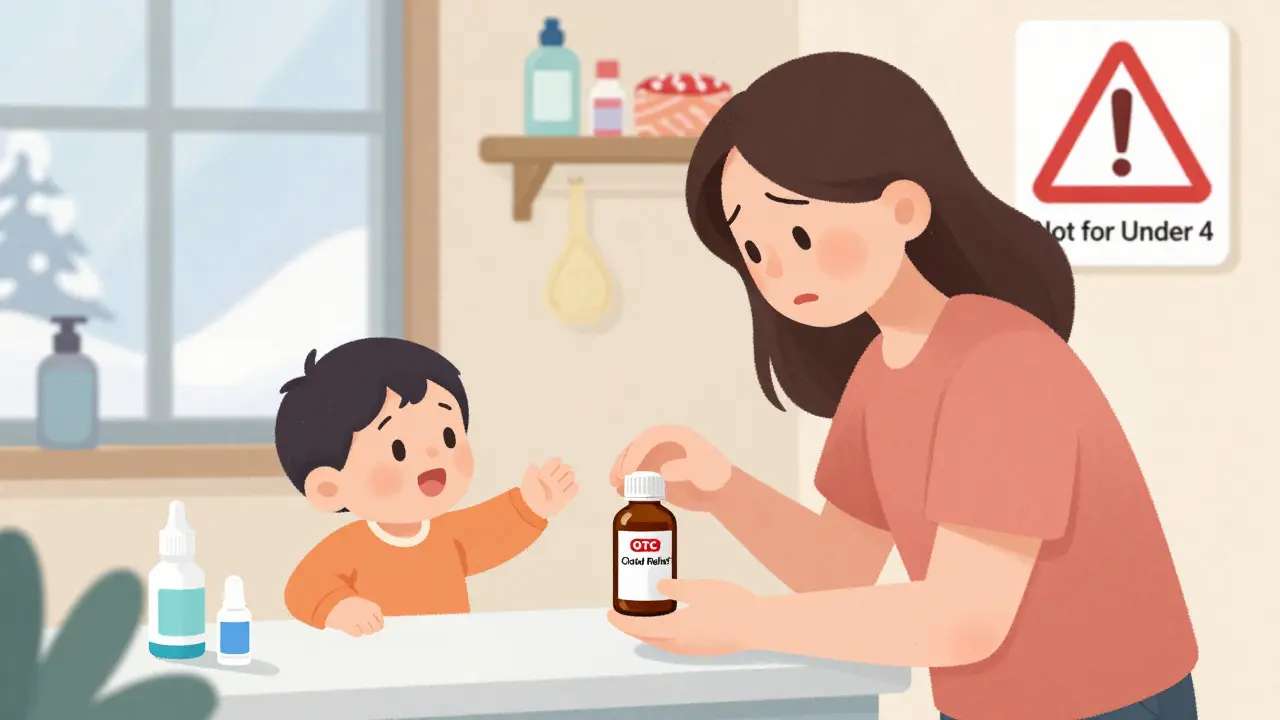
Every winter, parents reach for the medicine cabinet when their child starts coughing and sniffing. It’s natural to want to help them feel better. But here’s the hard truth: OTC cold medicine is not safe for young children, and giving it to them can do more harm than good.
Why OTC Cold Medicine Isn’t Safe for Kids Under 4
The U.S. Food and Drug Administration (FDA) and the American Academy of Pediatrics (AAP) have been clear since 2008: don’t give over-the-counter cough and cold medicines to children under 4. That’s not a suggestion-it’s a safety rule backed by real data.
These medicines often contain a mix of ingredients: antihistamines like diphenhydramine, decongestants like pseudoephedrine, cough suppressants like dextromethorphan, and expectorants like guaifenesin. On paper, they sound helpful. In reality, they don’t work well for kids, and they carry serious risks.
Between 2004 and 2015, over 1,500 children were hospitalized because of reactions to these medicines. Most were under 2 years old. Symptoms included rapid heartbeat, extreme agitation, trouble breathing, and seizures. In rare but tragic cases, children died from accidental overdoses.
Here’s what makes it worse: kids don’t weigh the same at age 2, even if they’re the same age. One 2-year-old might weigh 25 pounds; another might weigh 35. Age-based dosing doesn’t account for that. A teaspoon meant for a 2-year-old could be too much for a smaller child-and too little for a bigger one. Studies show this leads to dosing errors in 23% to 37% of cases.
What Happens When Kids Take Too Much?
Most overdoses aren’t intentional. A curious toddler grabs a bottle left on the counter. A parent misreads the label and gives two doses thinking it’s not working. Or worse-gives two different products, not realizing both contain the same active ingredient.
That’s the biggest trap: multi-ingredient cold medicines. One product might have dextromethorphan and pseudoephedrine. Another might have diphenhydramine and guaifenesin. Give both thinking you’re covering all symptoms? You’re doubling the dose of something dangerous.
According to Poison Control, nearly 40% of calls about children’s cold medicine exposures involve kids aged 1 to 2. That’s the peak danger zone. And 90% of these incidents happen when kids get into medicine without supervision.
Even a small overdose can cause serious problems. Dextromethorphan can slow breathing. Antihistamines can make kids hyper, confused, or have seizures. Decongestants can spike heart rate and blood pressure. In young children, whose bodies are still developing, these effects are unpredictable and potentially deadly.
What About Kids 4 to 12? Is It Safe Then?
Some parents think, “Okay, under 4 is dangerous, but what about my 6-year-old?” The answer is still: proceed with extreme caution.
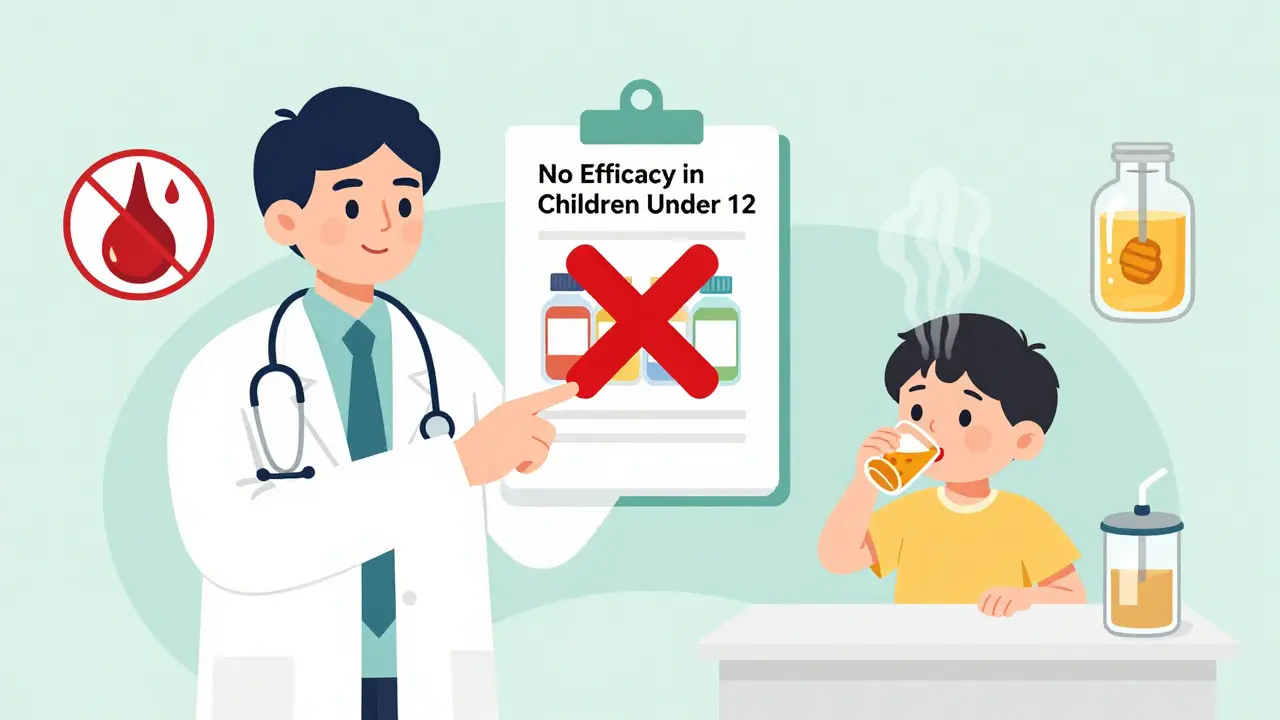
The FDA says there’s no solid proof these medicines work for children under 12. That’s not just a guess-it’s based on clinical trials that showed no meaningful improvement in cough or congestion compared to a placebo.
Some doctors may still suggest a single-ingredient product like dextromethorphan for older kids (6-11) with a bad cough. But even then, the benefit is small. One review found it might reduce coughing slightly at night-not enough to make a real difference in sleep or recovery.
And the risks don’t disappear. A 2022 study found that 68% of dosing errors happened because parents used kitchen spoons instead of the dosing cup that came with the medicine. A regular tablespoon holds 15 mL. The recommended dose for a 6-year-old might be 5 mL. That’s a 300% overdose risk if you guess wrong.
That’s why the AAP recommends using only the dosing device that comes with the product. Never use a kitchen spoon. Never mix medicines. Never give more than one cold medicine at a time.

What Should You Do Instead?
You don’t need medicine to help your child feel better. In fact, most colds get better on their own in 7 to 10 days. Here’s what actually works:
- Saline nasal drops: Put 2-3 drops in each nostril, then gently suction with a bulb syringe. This clears mucus and helps babies breathe better during feeding and sleep.
- Honey: For children over 1 year old, give 2.5 mL (half a teaspoon) of honey before bed. A 2018 Cochrane review found it reduced nighttime coughing better than placebo-and it’s safer than any OTC syrup.
- Hydration: Offer water, breast milk, or formula often. Extra fluids thin mucus and help the body fight the virus. Aim for about 50 mL per kilogram of body weight per day, on top of normal intake.
- Humid air: Run a cool-mist humidifier in the room. Moist air soothes irritated airways. Keep humidity between 40% and 60%.
- Fever and pain relief: If your child is uncomfortable, use acetaminophen (10-15 mg/kg every 4-6 hours) or ibuprofen (5-10 mg/kg every 6-8 hours) for children over 6 months. Always dose by weight, not age.
These methods are proven, safe, and free of side effects. No one dies from too much saline drops. No one has a seizure from honey. But we’ve seen too many children hurt by cold medicine.
Why Do Parents Still Give It to Kids Under 4?
It’s not because they’re careless. It’s because they’re desperate.
A 2021 survey found 38% of parents gave cold medicine to kids under 4, even though labels said not to. Why? Many said they thought their doctor recommended it. But when researchers checked medical records, only 17% had actually talked to a doctor about it.
Online forums are full of parents saying things like, “I gave my 2-year-old Robitussin because he couldn’t sleep.” They’re not ignoring warnings-they’re trying to help. But they’re being misled by outdated advice, old family habits, or misleading marketing.
Pharmacies still sell these products. Labels say “for ages 4+,” but they’re right next to candy-flavored syrups that look like treats. It’s easy to grab the wrong thing in the middle of the night when your child is coughing and you’re exhausted.
What’s Changing? What’s Next?
Regulators are pushing for change. The FDA’s 2023 draft guidance says all pediatric OTC medications need new clinical trials to prove safety and effectiveness. Final rules are expected by mid-2025.
Some experts are calling for weight-based dosing cups with built-in flow restrictors that only allow 5 mL per use. Research shows this could cut overdose risk by 82%.
In Europe, OTC cold medicines have been banned for children under 6 since 2009. Switzerland banned dextromethorphan in kids entirely in 2022. The U.S. is catching up, but slowly.
Meanwhile, the market is shifting. Sales of pediatric cold medicines dropped from $1.2 billion in 2007 to $840 million in 2022. Manufacturers are moving toward adult products and natural alternatives like saline sprays-which are now the fastest-growing segment in pediatric care.
What to Do Right Now
If your child is under 4: Do not give any OTC cough or cold medicine. Not even “just a little.” Not even once. The risks aren’t worth it.
If your child is 4 or older: Only use single-ingredient products if needed. Always read the label. Never mix medicines. Use the dosing tool that comes with it. Never use a kitchen spoon.
If you’re unsure: Call your pediatrician. Or call Poison Control at 1-800-222-1222. They’re available 24/7 and can tell you if what you’re seeing is normal or dangerous.
Your child’s cold will pass. But the damage from a wrong dose of medicine? That can last a lifetime.
Can I give my 3-year-old children’s Tylenol Cold?
No. Children’s Tylenol Cold and similar multi-ingredient products are not safe for children under 4. These products contain cough suppressants, decongestants, and antihistamines that can cause serious side effects like seizures, rapid heart rate, or breathing problems in young children. Even if you give a small dose, the risk is not worth it. Use saline drops, honey (if over 1 year), and hydration instead.
Is honey really safe for toddlers with coughs?
Yes, honey is safe and effective for children over 1 year old. A half-teaspoon (2.5 mL) before bed can reduce nighttime coughing better than many OTC syrups. Honey coats the throat and soothes irritation. But never give honey to babies under 1 year-it can cause botulism, a rare but dangerous illness.
What if my child accidentally swallowed cold medicine?
Call Poison Control immediately at 1-800-222-1222. Do not wait for symptoms to appear. Even if your child seems fine, some effects can be delayed. Have the medicine bottle ready when you call so you can tell them the exact ingredients and amount swallowed. Do not try to make your child vomit-this can cause more harm.
Why do drug labels say “for ages 4+” if the medicine isn’t safe?
The “4+” label is a compromise. Manufacturers added it after the FDA’s 2008 recommendation to reduce legal liability. It doesn’t mean the medicine is safe or effective for 4-year-olds-it just means the risk is lower than in younger kids. Many experts now say the limit should be 6 or even 12. The label is the bare minimum, not a green light.
Are natural remedies like vapor rubs safe for kids?
Vapor rubs containing camphor, menthol, or eucalyptus oil can be irritating to young children’s airways. The AAP advises against using them on children under 2. For older kids, use sparingly on the chest or neck-not the face or nostrils. Saline sprays and humidifiers are safer and just as effective for clearing congestion.
Can I give my child an adult cold medicine if I cut the dose in half?
Never. Adult cold medicines have higher concentrations of active ingredients and are not formulated for children. Even cutting the dose in half can lead to dangerous overdose. Always use products labeled for children and only if they’re approved for your child’s age. When in doubt, skip it.
Michael Dillon
December 24, 2025 AT 23:29Look, I get the FDA wants to be safe, but my kid coughed for a week straight and I gave him a quarter teaspoon of Children's Robitussin-just a tiny bit-and he slept for six hours straight. That’s not a miracle, that’s medicine working. You want to tell me honey is better? My kid thinks honey is a toy. He tried to lick the jar clean. At least the syrup made him stop screaming.
Sophie Stallkind
December 25, 2025 AT 20:37While I appreciate the thoroughness of the clinical data presented, I must respectfully emphasize that the emotional burden on caregivers cannot be overlooked. The decision to administer medication is rarely made lightly, but rather in moments of profound exhaustion and helplessness. The societal expectation that parents should instinctively know medical guidelines, without access to consistent pediatric guidance, places undue strain on families.
sagar patel
December 27, 2025 AT 09:27OTC cold meds are dangerous for kids. No debate. I’m from India and we never used them. Honey, steam, salt water drops. Done. Your culture is over-medicated. Stop blaming the label. Blame your fear of letting a child be sick.
Linda B.
December 27, 2025 AT 14:44Of course the FDA says not to give it to kids under 4… they also said aspartame was fine until they banned it in 1987 then un-banned it in 1992 after Big Pharma sued them. This is just another corporate loophole. The real reason these drugs are still sold is because the FDA is owned by the same companies that make them. You think they’d ban something that makes billions if they actually cared about kids?
Christopher King
December 29, 2025 AT 01:40Let’s be real-this whole thing is a psyop. The government doesn’t want you to know that cold medicines actually work. They’re terrified of what happens when parents start seeing results. That’s why they bury the studies. That’s why they call it ‘ineffective’-because if parents realized these drugs calm their child’s cough, they’d stop trusting pediatricians. And if parents stop trusting doctors? Chaos. That’s the real agenda.
Katherine Blumhardt
December 29, 2025 AT 02:13i just gave my 3yo a tsp of cold med bc she was coughing so hard she puked and now she’s asleep and i feel like a monster but also like i just saved her life?? 😭
Lindsay Hensel
December 30, 2025 AT 22:05Honey works. Saline works. Humidifiers work. The fact that we need to be told this in 2025 is heartbreaking.
Terry Free
December 30, 2025 AT 22:09So you’re telling me a parent who gives a child a teaspoon of medicine out of desperation is a criminal? Meanwhile, Big Pharma makes billions selling these products next to gummy vitamins. Who’s the real villain here? The exhausted mom or the corporation that designed the packaging to look like candy?
Jason Jasper
December 31, 2025 AT 15:17I’ve seen two pediatricians in the last five years who recommended OTC cold meds for my 5-year-old. One said ‘it’s fine if you’re careful.’ The other said ‘it’s useless but won’t hurt.’ I didn’t know who to believe. The system is failing parents. Not the parents failing the system.
Oluwatosin Ayodele
January 1, 2026 AT 05:07In Nigeria, we use ginger tea, warm water with lemon, and rest. We do not have pharmacies on every corner selling syrup that looks like soda. We do not have parents giving children medicine because they can’t sleep. We have community care. You need to go back to basics, not buy more labels.
Rick Kimberly
January 2, 2026 AT 20:42It is imperative to recognize that the absence of evidence is not evidence of absence. While clinical trials may not demonstrate statistically significant efficacy for OTC cold medications in children under 12, the absence of such data does not conclusively negate the potential for individual therapeutic benefit. The ethical imperative to alleviate suffering must be weighed against population-level risk assessments.
Zabihullah Saleh
January 4, 2026 AT 09:19My grandfather used to say, ‘A cold is a teacher. It teaches you patience.’ We didn’t have medicine cabinets full of syrups. We had soup, blankets, and silence. Now we treat coughs like emergencies. We’ve lost the art of waiting. Maybe the real danger isn’t the medicine-it’s our fear of stillness.
Ben Harris
January 5, 2026 AT 09:40Why do we still allow these products to be sold? Why are they next to candy? Why do pharmacies even stock them? This isn’t negligence-it’s intentional. They want you to make the mistake. Then you blame yourself. They profit from guilt. That’s capitalism. That’s the system.
Gary Hartung
January 7, 2026 AT 02:48Oh, so now we’re all supposed to be herbalists? Honey? Saline? You might as well tell me to chant over my child’s fever. I’m not a witch-I’m a parent who works 60 hours a week and needs something that works. The FDA doesn’t live in my house. My kid doesn’t care about clinical trials-he just wants to stop coughing so he can breathe.
Justin James
January 7, 2026 AT 05:01Let me ask you this: if you were told your child’s cough medicine might cause seizures, would you give it? Of course not. But what if you didn’t know? What if the label said ‘for ages 4+’ and the bottle looked like juice? What if the pharmacist didn’t say anything? What if your doctor didn’t mention it? What if your mom gave it to you when you were a kid and you turned out fine? What if everyone around you is doing it? What if you’re sleep-deprived and your child is screaming and you’ve tried everything and you’re just… desperate? That’s not ignorance. That’s survival. And the system that lets this happen? That’s the real poison.