Levothyroxine Generics: When to Monitor TSH After Switching Products
 Jan, 24 2026
Switching from one generic levothyroxine brand to another might seem like a simple pharmacy swap-same drug, same dose, same pill color. But for millions of people managing hypothyroidism, that switch can trigger real, sometimes confusing, changes in how they feel. Fatigue, heart palpitations, unexplained weight gain or loss-these aren’t just side effects. They might be signs your body is reacting to a change in the formulation, even if the dose hasn’t changed. The big question isn’t whether generics work-it’s when you need to check your TSH after switching.
Why Levothyroxine Is Different
Levothyroxine isn’t like taking an ibuprofen or a statin. It’s a narrow therapeutic index (NTI) drug, meaning tiny differences in how much hormone reaches your bloodstream can push you out of the safe zone. Your target TSH level? Usually between 0.4 and 4.0 mIU/L. Go too low, and you risk heart rhythm problems or bone loss. Go too high, and you’re back to feeling exhausted, cold, and sluggish.
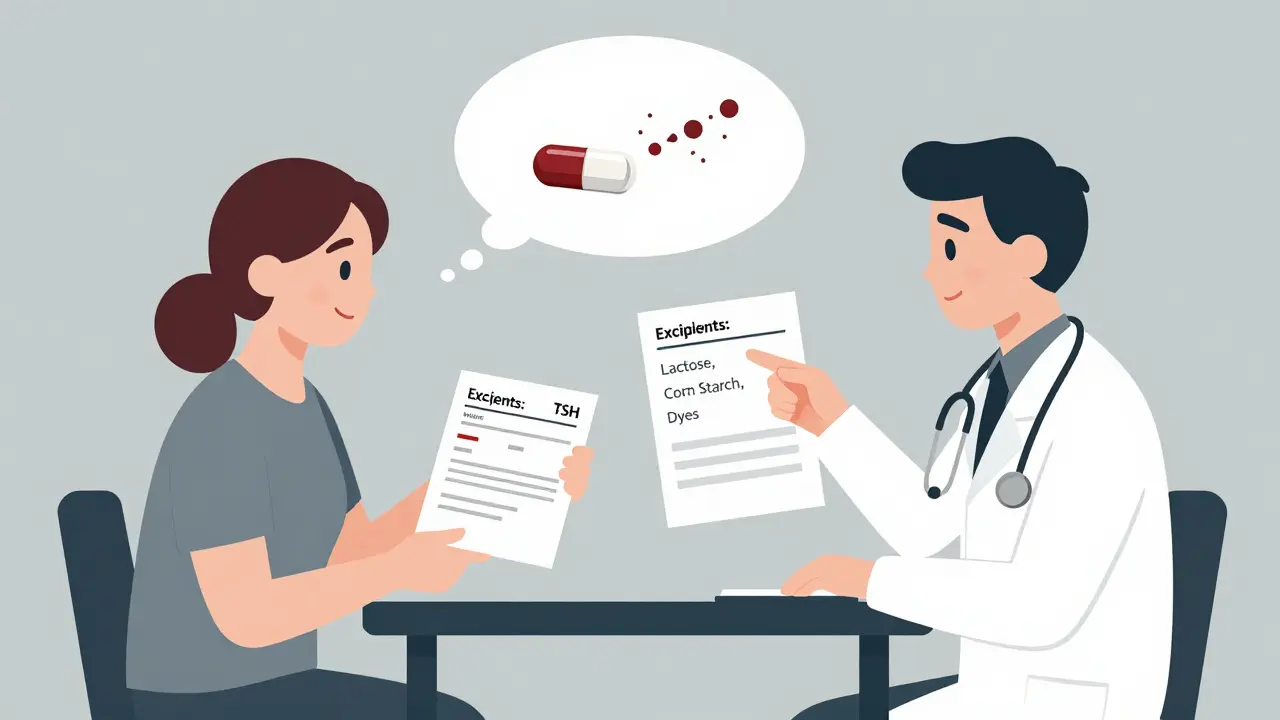
The active ingredient-levothyroxine sodium-is identical across all brands. But the fillers, dyes, binders, and coating? Those vary. One manufacturer might use corn starch, another might use lactose. For most people, that doesn’t matter. But for a small group, even a small change in how the pill dissolves can alter absorption. That’s why some patients report feeling worse after a switch, even though their doctor says the dose is correct.
What the FDA Says
The FDA says generic levothyroxine products are interchangeable. Their standards require each generic to deliver between 80% and 125% of the brand-name drug’s absorption-same as most other generics. In 2022, a massive study of over 15,000 patients found no meaningful difference in TSH levels between those who switched generics and those who didn’t. The average TSH stayed steady at 2.7 mIU/L for both groups. The FDA’s 2024 labeling update now says: “For most patients, switching between different levothyroxine products does not require additional TSH monitoring beyond routine follow-up.”
That’s a big shift. Just a few years ago, guidelines told doctors to test TSH six weeks after any switch. Now, the FDA’s position is: if you’re stable, you’re probably fine.
What the Experts Still Warn
But not everyone agrees. The American Thyroid Association (ATA) and the American Association of Clinical Endocrinologists (AACE) used to recommend TSH testing after every switch. Their concern? A few patients really do react. A 2021 Dutch study found that 63% of patients on doses over 100 mcg developed abnormal TSH levels after switching, compared to just 24% of those who stayed on the same product. And the UK’s Medicines and Healthcare products Regulatory Agency (MHRA) logged over 1,200 reports of symptoms linked to product switches between 2015 and 2021-fatigue, palpitations, weight changes.
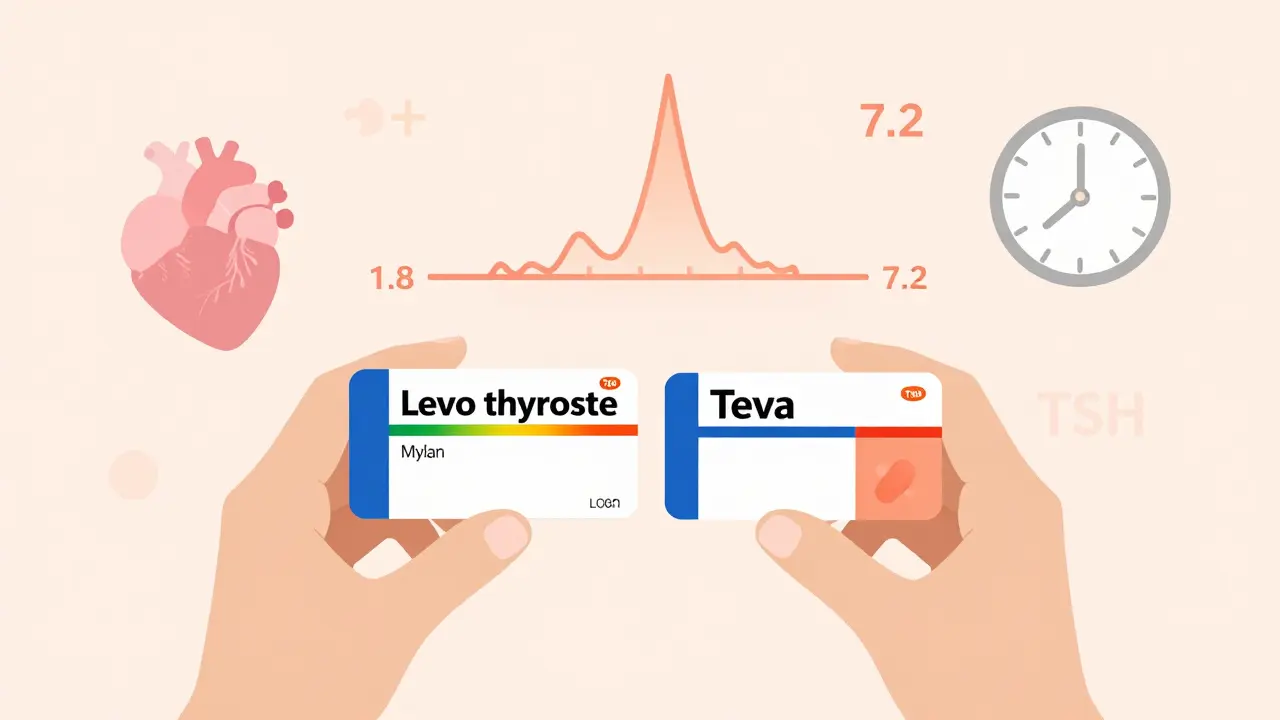
Some patients are just more sensitive. One Reddit user switched from Mylan to Teva and saw their TSH jump from 1.8 to 7.2 in eight weeks. Another switched three times in two years and felt nothing. There’s no universal rule. It’s about your body, not your pharmacy’s inventory.

Who Should Get Tested After a Switch?
You don’t need a TSH test every time your generic changes. But you should test if you fall into one of these groups:
- Thyroid cancer survivors: You need precise hormone control. Even a 0.5 mIU/L shift can matter.
- Pregnant women: Thyroid hormone needs increase during pregnancy. A change in absorption could affect your baby’s brain development.
- People over 65 with heart disease: Too much thyroid hormone can trigger atrial fibrillation or angina.
- Anyone who’s had unstable TSH levels before: If your numbers bounced around in the past, you’re more likely to react to formulation changes.
- Anyone who feels different after a switch: Fatigue, anxiety, racing heart, unexplained weight gain-don’t ignore it. Get tested.
For everyone else? Stick to your regular six-month or annual checkup. No need to rush in just because your pill looks different.
What the Data Shows About Switching
A 2022 study in JAMA Internal Medicine followed 2,780 matched pairs of patients-half switched generics, half didn’t. Results? No difference in normal TSH levels (64.3% vs. 63.8%). No difference in dangerously high or low levels either. That’s powerful evidence that most people are fine.
But here’s the catch: those studies look at populations. They don’t tell you about you. The 8-12% of patients who react? They’re real. And they’re often the ones who get dismissed because “the data says it’s fine.”
Some researchers think genetics might explain why. A variant in the DIO2 gene-found in less than 1% of people-can mess with how your body converts T4 to T3, the active hormone. If you have it, even small absorption changes can throw you off. Excipients like lactose or dyes might also trigger reactions in people with sensitivities. These are rare, but they matter.
What to Do If You Switch and Feel Off
If you’ve switched generics and now feel worse, don’t wait. Don’t assume it’s “just stress” or “aging.” Here’s what to do:
- Track your symptoms. Write down when they started, how bad they are, and what you’re doing differently.
- Call your doctor. Say: “I switched my levothyroxine brand and now I’m feeling X, Y, Z. Can we check my TSH?”
- Get a blood test. Don’t rely on how you feel alone. TSH is the most reliable indicator.
- If your TSH is out of range, your doctor might adjust your dose-or switch you back.
- If your TSH is normal but you still feel bad? Ask about excipients. You might need a brand with fewer fillers.
Some pharmacies can special-order a specific generic brand if you’ve had a bad reaction. It’s not always easy, but it’s possible. And if your doctor says, “It’s fine,” but you still don’t feel right-get a second opinion.
Cost vs. Safety: The Real Trade-Off
Generic levothyroxine saves the U.S. healthcare system over $2 billion a year. That’s huge. But for the small number of patients who need consistency, that savings comes at a cost-more doctor visits, more blood tests, more anxiety.
Brand-name Synthroid still costs about $45 for a 90-day supply. Generic versions? Around $4. That’s not a typo. Most insurers push generics hard. But if you’re one of the 10% who react, that $41 difference might be worth paying out-of-pocket to avoid the fatigue, the panic attacks, the missed workdays.
Some patients find that sticking with one generic brand-even if it’s not the cheapest-gives them stability. If your pharmacy switches you without warning, ask for a prescription that says “Dispense as written” or “Brand necessary.” It’s legal. It’s your right.
The Bottom Line
You don’t need to panic every time your pill changes. For most people, switching generics is perfectly safe. The science backs it.
But if you’re in a high-risk group-or you feel different after a switch-don’t brush it off. Get your TSH checked. Your thyroid doesn’t care about pharmacy contracts. It only cares about whether your body has enough of the right hormone.
Listen to your body. Track your symptoms. Don’t let cost savings override your health. And if your doctor dismisses your concerns? Find one who won’t.
Do I need to check my TSH every time I switch generic levothyroxine brands?
No, not for most people. If you’re stable, have no symptoms, and aren’t in a high-risk group (like thyroid cancer, pregnancy, or heart disease), routine TSH checks at your regular appointments are enough. The FDA and major studies show no significant change in TSH levels for the majority after switching generics. Only test if you feel different or if your doctor recommends it based on your medical history.
Can switching levothyroxine brands cause weight gain or loss?
Yes, but indirectly. Levothyroxine affects your metabolism. If a switch changes how much hormone your body absorbs-even slightly-it can push your TSH out of range. A higher TSH means your thyroid is underactive, which can lead to weight gain, fatigue, and cold intolerance. A lower TSH means you’re getting too much hormone, which can cause weight loss, anxiety, or heart palpitations. The pill itself doesn’t cause weight change; your hormone levels do.
Which generic levothyroxine brands are most likely to cause problems?
There’s no single brand that’s consistently worse. Problems aren’t tied to the manufacturer-they’re tied to the individual. Some people react to Mylan, others to Teva or Sandoz. It’s about your body’s response to the specific fillers or coating in that version. If you’ve had a bad reaction to one, stick with the same one. Don’t assume all generics are the same for you.
Is it safe to switch back and forth between generics?
It’s not ideal. Each switch carries a small risk of TSH fluctuation. If you’re stable on one brand, staying on it reduces unnecessary risk. Frequent switching can lead to inconsistent hormone levels, which may cause symptoms or make it harder for your doctor to find the right dose. If your pharmacy keeps changing your brand, ask for a prescription that specifies a particular generic or brand-name version.
Can I ask my doctor to prescribe only one brand of generic levothyroxine?
Yes. You can ask your doctor to write “Dispense as written” or “Brand necessary” on your prescription. This tells the pharmacy not to substitute. It’s legal and common for patients who’ve had reactions. Some insurers may require prior authorization, but many approve it if you explain you’ve had symptoms with previous switches. Your health comes first.
What should I do if my TSH changes after switching?
If your TSH goes out of range after a switch, your doctor will likely adjust your dose-either up or down-to bring it back to target. In some cases, they may switch you back to your previous brand. Don’t try to adjust your dose yourself. Even a 12.5 mcg change can make a big difference. Always follow up with blood tests after any dose change to make sure you’re back in the safe zone.
What’s Next?
The science is evolving. More studies are looking at genetic markers to identify who’s likely to react to formulation changes. In the next few years, we might see personalized recommendations-like genetic tests for DIO2 variants-to guide which levothyroxine brand is best for you.
Until then, the rule is simple: if you’re fine, stay on what you’re on. If you’re not fine, speak up. Your thyroid isn’t a commodity. It’s part of your body’s core function. And you deserve to feel like yourself-not a cost-saving statistic.
Napoleon Huere
January 25, 2026 AT 17:39It’s wild how we treat hormones like they’re just another grocery item you swap out for a cheaper brand. Your thyroid isn’t a lightbulb. You can’t just screw in a new one and expect the room to stay lit the same way. The FDA says it’s fine, but they’re not the ones waking up at 3 a.m. with a heart pounding like a bass drum. Science is great until it ignores the person in the chair.
Shweta Deshpande
January 26, 2026 AT 07:35Oh my goodness, this post made me cry a little 😭 I switched generics last year and thought I was just getting older-fatigue, brain fog, weight gain… I felt like a ghost in my own body. Then my endo finally listened and tested my TSH-jumped to 8.9! We switched me back and I’m back to hiking, cooking, laughing again. To anyone reading this: if you feel off, don’t let anyone tell you it’s ‘all in your head.’ Your body is screaming. Listen. You deserve to feel alive.
Aishah Bango
January 26, 2026 AT 19:33People who complain about switching generics are just lazy. If you can’t handle a $4 pill instead of $45, maybe you shouldn’t be on thyroid meds at all. The system works. Your body will adapt. Stop treating yourself like a fragile china doll. Everyone else manages. Why can’t you?
Simran Kaur
January 28, 2026 AT 19:22From India, I just want to say-I’ve seen so many people here suffer silently because thyroid meds are either too expensive or they get switched without warning. My aunt was on Synthroid for years, then switched to a local generic and started having panic attacks. She thought it was menopause. Took six months before someone connected the dots. Please, if you’re reading this and you’re in a country where meds are rationed or changed without consent-speak up. Even if it’s just to your pharmacist. You are not alone. And your health? It matters more than the cost.
Neil Thorogood
January 29, 2026 AT 11:18So let me get this straight… you’re telling me that for $41 a month, I can avoid feeling like a zombie, a panic attack waiting to happen, and a walking sack of potatoes? 🤡 I’ll take the $45 pill, thanks. Also, my pharmacy switched me to a new generic and I swear I aged 10 years in two weeks. I’m not ‘imagining it.’ I’m just a human with a thyroid. And yes, I’m paying out of pocket now. 💸✨ #ThyroidWarrior
Jessica Knuteson
January 31, 2026 AT 03:40The data shows no difference so your feelings are irrelevant. You’re not special. Your symptoms are noise. The system is optimized. Stop personalizing population averages. You’re not a case study. You’re a data point. Get over it.
Robin Van Emous
February 1, 2026 AT 00:01I get both sides. The science says most people are fine. And I believe that. But I also know someone who lost her job because she couldn’t focus after a switch-and her doctor told her to “just try harder.” That’s not fair. Maybe the answer isn’t ‘everyone should get tested’ but ‘everyone should be heard.’ If someone says they feel different, we should listen first, test second. That’s basic human respect.
Angie Thompson
February 1, 2026 AT 10:49Y’all. I switched from Teva to Mylan and suddenly I could feel my brain again. Like… I remembered what it felt like to read a book without falling asleep after two paragraphs. 🤯 I didn’t know I was that tired. Now I’m on a mission to find the ONE generic that works for me-even if it’s not the cheapest. My energy is worth more than $41. And if you’re reading this and you’re tired all the time? Don’t wait for permission to ask for help. You’re not being dramatic. You’re being alive.
Karen Droege
February 1, 2026 AT 19:09As a nurse practitioner who’s managed thyroid patients for 18 years-I’ve seen this a hundred times. The FDA’s stance is technically correct for population data. But here’s the truth: some people have receptors that are hypersensitive. Some have gut issues that affect absorption. Some have DIO2 variants. And some just need consistency. I tell my patients: if you feel better on one brand, STAY ON IT. Your quality of life isn’t a cost-benefit analysis. It’s your life. And if your pharmacy switches you without warning? Call them. Call your doctor. File a complaint. You have rights. And your thyroid? It’s not a commodity. It’s your rhythm. Protect it.