Hyperkalemia in CKD: Diet Limits and Emergency Treatment
 Mar, 2 2026
When your kidneys aren't working right, even simple foods can become dangerous. For people with chronic kidney disease (CKD), too much potassium in the blood - a condition called hyperkalemia - can trigger heart rhythm problems, muscle weakness, or even cardiac arrest. It’s not rare. In advanced CKD, nearly half of patients experience it. The good news? We now have better ways to manage it than ever before - but only if you know what to do, when to do it, and why.
Why Potassium Turns Dangerous in CKD
Your kidneys normally keep potassium in balance. When they fail, potassium builds up. A normal level is 3.5 to 5.0 mmol/L. Once it hits 5.5 mmol/L or higher, your heart’s electrical system starts to glitch. ECG changes like tall, peaked T-waves or a widened QRS complex aren’t just lab results - they’re warning signs your heart is in trouble. The problem gets worse because of the drugs we rely on. Medications like ACE inhibitors, ARBs, and mineralocorticoid receptor antagonists (MRAs) protect your heart and kidneys. But they also reduce potassium excretion. In the past, doctors would lower or stop these drugs when potassium rose. Now we know that’s risky. Studies show cutting RAASi therapy increases heart attack risk by 28% and speeds up kidney decline. So the goal isn’t to avoid these drugs - it’s to manage potassium while keeping them.Dietary Limits: What You Can and Can’t Eat
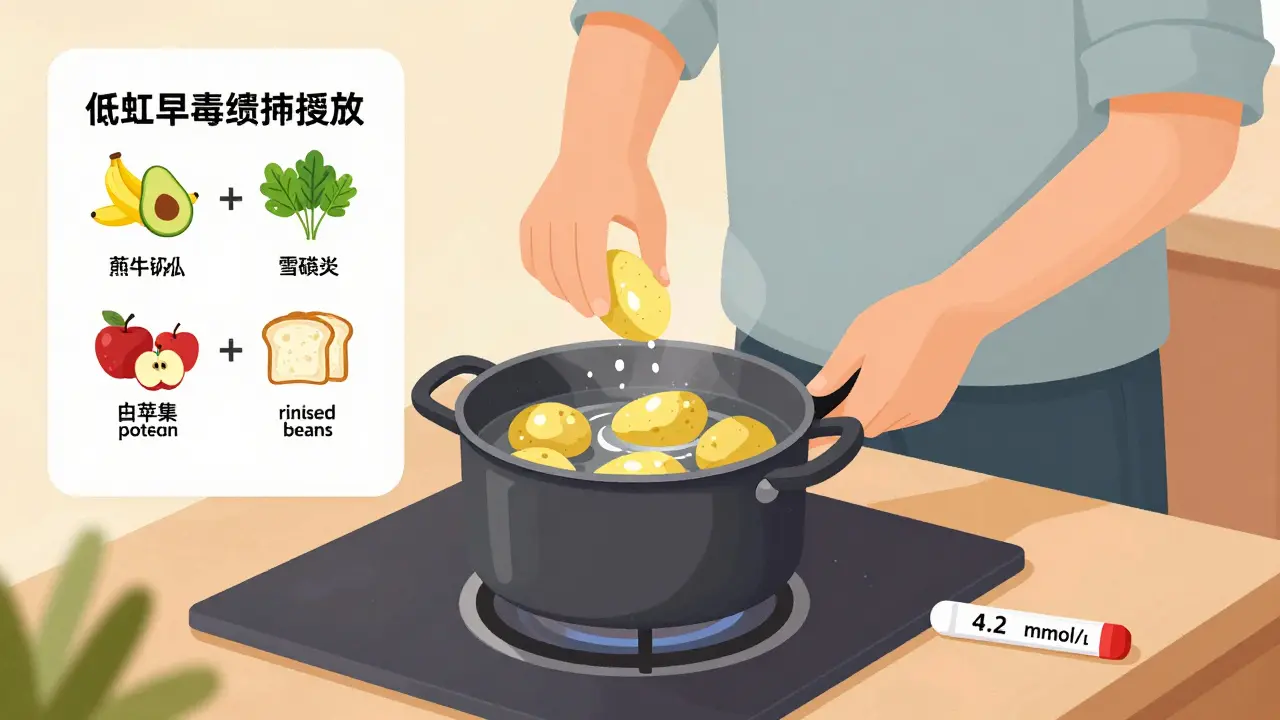
Diet is the first line of defense. But it’s not about cutting out all potassium-rich foods - it’s about smart control. The 2022 Renal Association Guidelines recommend:- Stages 1-3a CKD: No strict limits - just avoid excessive intake.
- Stages 3b-5 (not on dialysis): Keep potassium under 3,000 mg per day (about 77 mmol).
- Bananas: 422 mg per 100g
- Oranges and orange juice: 181 mg per 100g
- Potatoes (especially baked): 421 mg per 100g
- Spinach, tomatoes, avocados, beans, and dried fruit: all high
Emergency Treatment: What Happens When Potassium Spikes
If your potassium hits 6.0 mmol/L or higher - especially with ECG changes - you need immediate treatment. This isn’t a waiting game. Here’s what works:- Calcium gluconate (10 mL of 10% solution IV): Given over 2-5 minutes. It doesn’t lower potassium - it protects your heart muscle from the effects. Onset: 1-3 minutes. Lasts 30-60 minutes. Essential if you have chest pain, palpitations, or abnormal ECG.
- Insulin + glucose (10 units regular insulin + 50 mL of 50% dextrose): Moves potassium into cells. Lowers levels by 0.5-1.5 mmol/L within 15-30 minutes. Watch for low blood sugar - this happens in 10-15% of cases.
- Sodium bicarbonate (50-100 mmol IV): Only if you have acidosis (bicarbonate <22 mmol/L). Works in 5-10 minutes. Less effective alone, but helps when combined with insulin.

Chronic Management: The New Generation of Potassium Binders
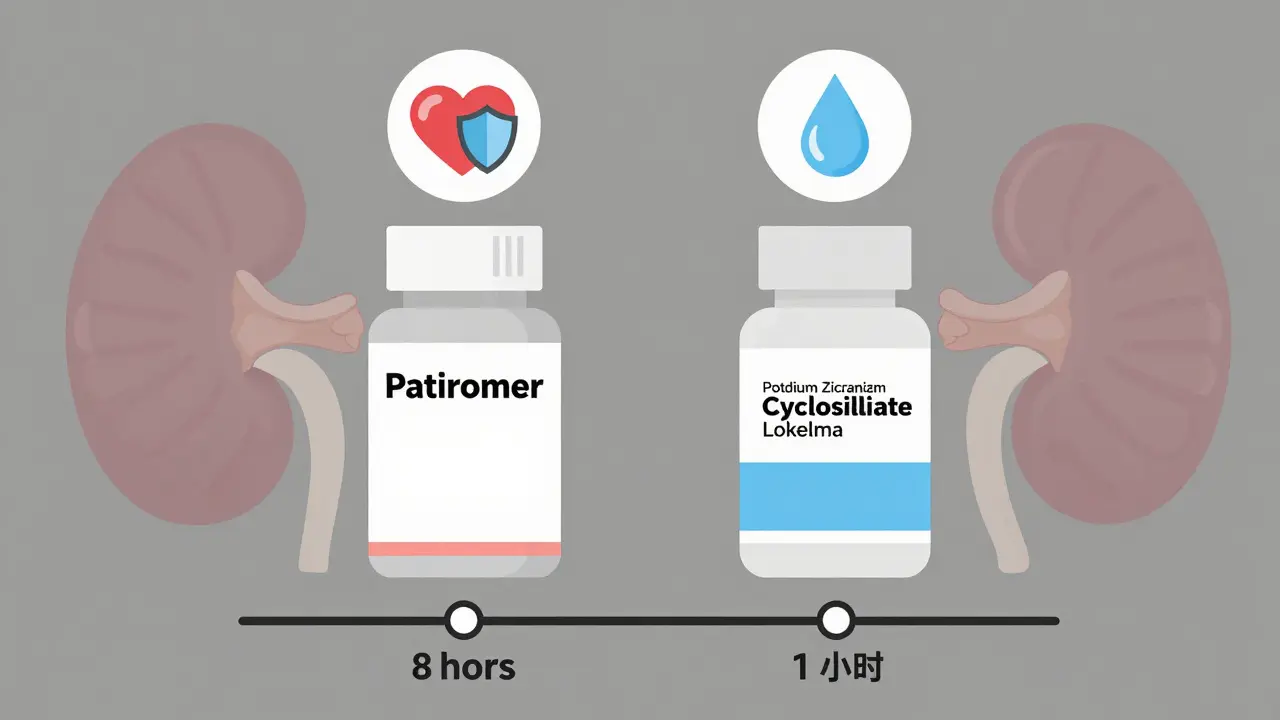
For long-term control, we’ve moved far beyond old-school treatments. Sodium polystyrene sulfonate (SPS), the traditional binder, has major problems: it can cause colonic necrosis (0.5-1% risk), sodium overload (11 mmol of sodium per gram), and requires three daily doses. Most nephrologists now avoid it. Two newer drugs have changed everything:- Patiromer (Veltassa): Taken once daily. Works in the colon, binding potassium and excreting it in stool. Reduces potassium by 0.6-0.8 mmol/L in 4-8 hours. Side effects: constipation (14.2%), low magnesium (18.7%). It’s sodium-free - great for heart failure patients. Costs around $635/month in the U.S.
- Sodium zirconium cyclosilicate (SZC, Lokelma): Works faster. Lowers potassium by 1.0-1.4 mmol/L within 1 hour. Taken twice daily. But it adds sodium - about 1.2g/day - which can worsen swelling in heart failure patients (12.3% vs 4.7% with patiromer). Costs $635/month, too.
- For acute spikes (like after a missed dose or illness), SZC is often preferred because of speed.
- For chronic management, patiromer wins for patients who need to avoid extra sodium.
Monitoring and Real-World Challenges
You can’t manage what you don’t measure. Guidelines say:- Check potassium 1-2 weeks after starting or increasing RAASi.
- Test every 3-6 months if stable.
- Test immediately if you feel weak, dizzy, or have heart fluttering.
What’s Next: Precision and Innovation
The future is personalized. Trials are testing urinary potassium measurements to tailor diets - not guess them. Apps that scan food barcodes and calculate potassium content are already in pilot use. Early results show a 32% improvement in diet adherence. New drugs are coming. Tenapanor, approved for phosphate control, is showing promise for potassium too. Encapsulated binding polymers in phase 2 trials can drop potassium by 1.2 mmol/L in 24 hours - all without systemic absorption. By 2027, experts predict 75% of CKD patients on RAASi will also be on a potassium binder. That’s not just progress - it’s the new standard.Key Takeaways
- Hyperkalemia in CKD isn’t a reason to stop life-saving heart and kidney meds - it’s a signal to manage potassium better.
- For stages 3b-5 CKD, aim for under 3,000 mg of potassium daily. Boil, rinse, and swap high-potassium foods.
- Emergency treatment? Calcium gluconate first, then insulin/glucose. Don’t delay.
- Patiromer and SZC are now first-line for chronic management. Choose based on sodium needs and speed required.
- Monitoring every 3-6 months saves lives. Automated alerts in clinics are making a real difference.
What is the safest potassium level for someone with CKD?
For most non-dialysis CKD patients, the ideal range is 4.0-4.5 mmol/L. Levels above 5.0 mmol/L increase risk of heart rhythm problems, and above 6.0 mmol/L can cause life-threatening cardiac arrest. Staying in the 4.0-4.5 range allows you to keep your RAASi medications at full dose without risking hyperkalemia.
Can I still eat bananas if I have CKD?
Bananas are high in potassium - about 422 mg per 100g. If you’re in stage 3b or higher CKD, you should limit them. A small banana (100g) could take up a large portion of your daily potassium budget. If you really want one, eat half and avoid other high-potassium foods that day. Boiling or soaking high-potassium foods can help reduce their content.
Do potassium binders really work, or are they just expensive?
Yes, they work - and the evidence is strong. Patiromer and SZC reduce serum potassium reliably. More importantly, they let patients stay on RAASi medications, which cut heart attack risk by 28% and slow kidney decline. While they cost $600+ per month, avoiding one hospitalization for hyperkalemia (average $12,450) pays for them in months. For many, the benefit outweighs the cost.
Why can’t I just take a diuretic like furosemide to lower potassium?
Loop diuretics like furosemide work well in early CKD, but once your kidney function drops below an eGFR of 30 mL/min, they lose effectiveness. Your kidneys can’t respond to them anymore. That’s why binders are now the standard - they work directly in the gut, regardless of kidney function.
What should I do if I miss a dose of my potassium binder?
If you miss one dose, take it as soon as you remember - unless it’s close to your next scheduled dose. Don’t double up. Monitor for symptoms like muscle weakness, palpitations, or dizziness. If you’re concerned, get your potassium checked. Missing doses increases the chance of spikes, especially if you’re also on RAASi or MRAs.
Justin Rodriguez
March 3, 2026 AT 01:48For anyone managing CKD, the boiling trick for potatoes and carrots is a game-changer. I’ve been doing this for years-boil them in a big pot of water, dump the water, then re-cook them. Cuts potassium by half, tastes fine, and you don’t feel like you’re on a starvation diet. Also, rinsing canned beans for a full minute under running water makes a measurable difference. Small steps, huge impact.
Renee Jackson
March 4, 2026 AT 17:33Thank you for sharing this clear, evidence-based overview. As a nephrology nurse, I’ve seen too many patients discontinue life-saving RAAS inhibitors out of fear of high potassium. The data is unequivocal: keeping these medications on board, while using potassium binders and dietary adjustments, leads to far better cardiovascular and renal outcomes. Education, not elimination, is the path forward.
RacRac Rachel
March 5, 2026 AT 01:14POV: You just found out your potassium is 5.8 and you’re panicking 😵💫
But then you read this and realize: hey, it’s manageable.
Calcium gluconate isn’t magic-it’s a shield.
Insulin + glucose? It’s like a secret elevator for potassium to go downstairs.
And yes, boiling potatoes works. I did it. My heart is still beating. 🙌
Jane Ryan Ryder
March 5, 2026 AT 04:30So let me get this straight-government doctors want us to eat more processed white bread instead of whole grain because the potassium’s too high? And we’re supposed to be grateful? This is why people don’t trust the medical system anymore. You’re not fixing the problem-you’re just making us eat cardboard.
Levi Viloria
March 6, 2026 AT 01:46Living in the US with CKD is weird. You’ve got all these fancy meds and guidelines, but half the people I know can’t afford a renal dietitian. The boiled potato trick? Lifesaver. But what about folks who don’t have a stove? Or access to fresh produce? This info is gold, but it’s only useful if the system supports it.
Jeff Card
March 7, 2026 AT 19:08My dad’s on dialysis now, but before that, he had a potassium level of 6.2. They gave him calcium gluconate in the ER and he was fine within minutes. I didn’t understand why they didn’t just lower his meds until I read this. He’s still on his ACE inhibitor, and he’s had zero heart issues since they started using kayexalate and dietary tweaks. Knowledge really does save lives.
Matt Alexander
March 9, 2026 AT 11:54Simple rule: if it’s a fruit or veggie and it’s orange, brown, or leafy-watch out. Bananas, potatoes, spinach, beans-limit. White bread, apples, grapes, rice-safe. Boil the starchy stuff. Rinse the canned stuff. That’s 90% of what you need to know.
Gretchen Rivas
March 10, 2026 AT 09:04Emergency potassium >6.0? Calcium gluconate first. Always. It’s not a treatment-it’s a stopgap. Then insulin/glucose. Then binders. Never skip the calcium. I’ve seen patients code because they waited too long. This isn’t theoretical. It’s real.
Stephen Vassilev
March 11, 2026 AT 23:24Wait-so you’re telling me the pharmaceutical industry, the FDA, and the nephrology guild are all pushing a narrative that potassium is dangerous… while simultaneously promoting drugs that raise it? This is classic chemical manipulation. Did you know that potassium chloride is used in lethal injections? Coincidence? Or is this a slow, systemic poisoning disguised as treatment?
John Cyrus
March 11, 2026 AT 23:57People don’t realize that if you’re eating real food, potassium isn’t the issue-it’s the sugar and carbs. You think your kidneys are failing because of bananas? No. It’s the soda, the chips, the bread. Cut the processed junk and your potassium naturally drops. Stop blaming food. Blame the system.
John Smith
March 13, 2026 AT 03:30Yo, I had a potassium spike last year and they threw calcium at me like it was holy water. Felt like a superhero-heart’s still thumpin’, no drama. But honestly? The real MVP was ditching the banana smoothie and swapping my baked potato for rice. No fancy dietitian needed. Just common sense and a little discipline. Stay sharp, stay low.
Sharon Lammas
March 13, 2026 AT 09:57It’s funny how we treat potassium like a villain. But it’s just a molecule doing its job-until the system breaks. The real tragedy isn’t hyperkalemia. It’s that we’ve built a system where managing a natural electrolyte imbalance requires a PhD, a dietitian, and a pharmacy. Maybe the question isn’t how to control potassium… but why we let our kidneys fail in the first place.