How to Use Medicare Extra Help to Pay Less for Generic Prescriptions
 Jan, 21 2026
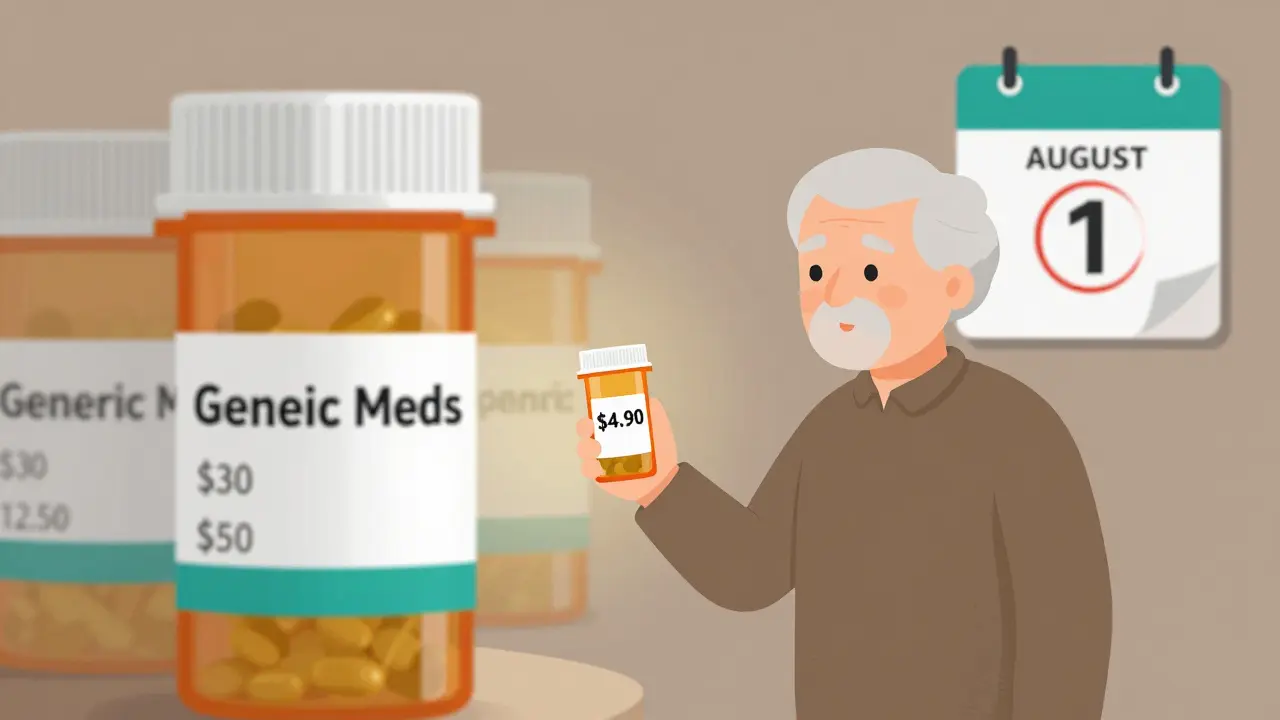
When you’re on a fixed income and need to take multiple generic medications every month, even a $4.90 copay can feel heavy-if you’re lucky enough to get it. Without Medicare Extra Help, that same pill could cost you $30, $50, or more. The difference isn’t just a few dollars. It’s whether you take your blood pressure medicine, your diabetes pills, or your cholesterol drug at all.
What Medicare Extra Help Actually Covers
Medicare Extra Help, also called the Part D Low-Income Subsidy (LIS), is a federal program that cuts your prescription drug costs to the bone. If you qualify, you pay $0 for your Part D plan premium. You pay $0 for the annual deductible. And for every generic prescription you fill, you pay no more than $4.90 in 2025. That’s it. No hidden fees. No surprise bills.
That’s not a discount. That’s a full reset of how much you pay. Compare that to standard Medicare Part D, where you might pay up to $595 just to start getting coverage, then 25% of the drug’s cost after that. A $50 generic drug would cost you $12.50 after the deductible. With Extra Help? $4.90. For the same drug. Every single time.
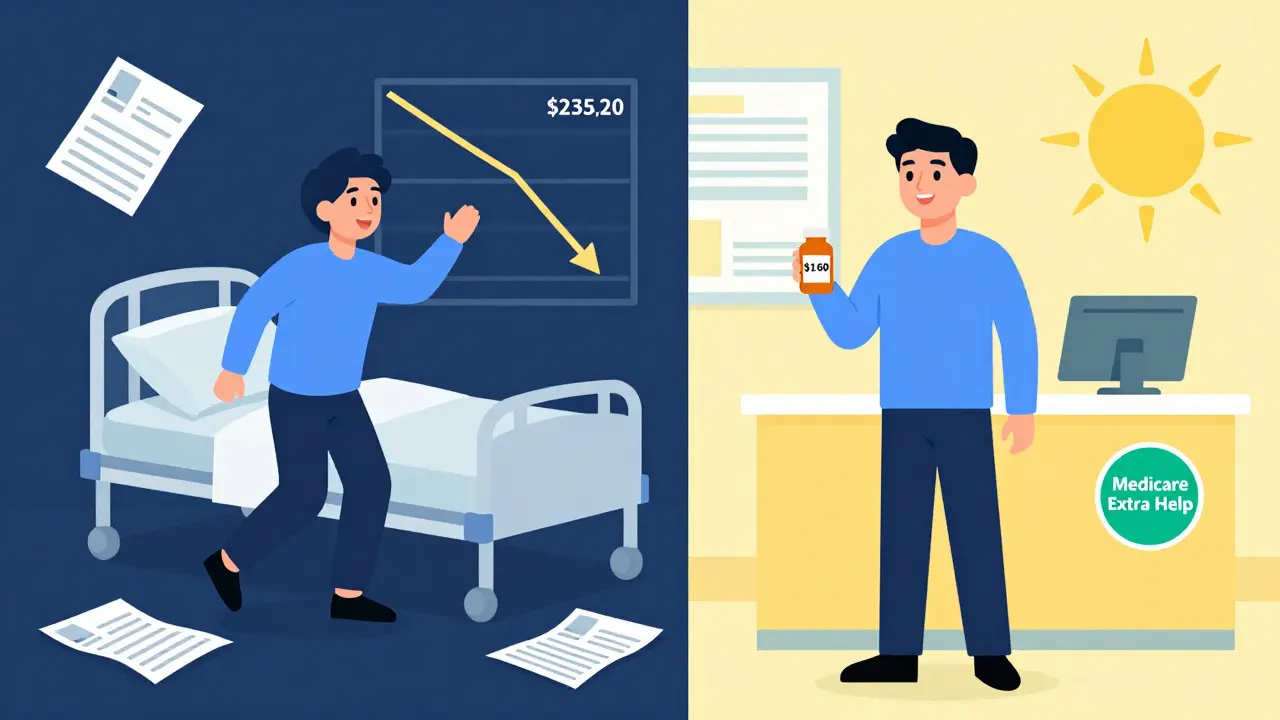
And if your income is below 100% of the Federal Poverty Level-meaning you’re also on Medicaid-you pay even less: just $1.60 per generic prescription. That’s less than the price of a coffee.
Who Qualifies for Extra Help in 2025
You don’t need to be broke to qualify, but you do need to be close. For 2025, the income limits are:
- Individual: $23,475 per year
- Married couple living together: $31,725 per year
Your income includes Social Security, pensions, wages, veterans’ benefits, and other regular payments. But it doesn’t include housing assistance, food stamps, or medical treatment costs.
Then there’s your resources-what you own. The limits are:
- Individual: $17,600
- Married couple: $35,130
Resources include bank accounts, stocks, bonds, mutual funds, and IRAs. Your primary home doesn’t count. Neither does your car or personal belongings. You also get a $1,500 allowance for burial expenses that doesn’t count against your total.
That’s it. No gray area. If you make $23,476 and you’re single? You’re out. If you have $17,601 in savings? You’re out. That’s the hard truth. Many people who are barely scraping by still don’t qualify because of this cliff effect.
How It Compares to Paying Full Price
Let’s say you take four generic medications every month. Each one costs $40 at full retail. Without Extra Help:
- You pay $595 deductible first (if your plan has one)
- Then 25% coinsurance: $10 per pill × 12 months × 4 pills = $480
- Plus monthly premium: $40 × 12 = $480
- Total: $1,555 per year
With Extra Help:
- No deductible
- No premium
- $4.90 per pill × 12 months × 4 pills = $235.20
- Total: $235.20 per year
You save $1,320. That’s not a little extra cash. That’s rent. That’s groceries. That’s filling your prescriptions without choosing between them and your heating bill.

How to Apply-and What to Watch Out For
Applying sounds simple. It isn’t. The form is long. The questions are confusing. And if you mess up one line, you get denied.
You can apply:
- Online at ssa.gov
- By phone: 1-800-772-1213
- In person at your local Social Security office
But here’s the secret: don’t do it alone.
State Health Insurance Assistance Programs (SHIPs) offer free, one-on-one help. They’ve seen every mistake. They know what documents you need. They’ll walk you through it. Find yours at shiptacenter.org. Call them. They won’t charge you. They won’t sell you anything.
And if you already get Medicaid, SSI, or a Medicare Savings Program? You’re automatically enrolled. No application needed. But check your mail-sometimes they send a letter confirming it. Don’t ignore it.
The Annual Review Trap
Extra Help isn’t a one-time thing. Every August, you’ll get a form in the mail. It asks for your income and resources for the past year. You have 30 days to return it.
Miss the deadline? Your benefits stop on January 1. No warning. No grace period. Just gone.
People think, “I didn’t get any raises. I’m still poor.” But the system doesn’t care. It only sees what’s on paper. A small Social Security cost-of-living increase? A $300 gift from a grandchild? That could push you over the line.
Set a calendar reminder. Mark August 1. Call your SHIP counselor. Get help filling it out. Don’t risk losing $1,300 in savings because you forgot to mail a form.
What You Can’t Do With Extra Help
Extra Help doesn’t cover everything. It doesn’t change which drugs your Part D plan covers. You still have to check your plan’s formulary. If your doctor prescribes a brand-name drug that’s not on the list, you might pay more-even with Extra Help.
But here’s the good news: Extra Help gives you a special enrollment period. You can switch your Part D plan once a month. So if your meds aren’t covered, you can change plans. You can even request an exception to get a drug covered if your doctor says it’s medically necessary.
Also, Extra Help doesn’t cover non-formulary drugs or over-the-counter medicines. It only works for prescriptions covered under Medicare Part D.
Real Stories From Real People
One man in Ohio, 78, takes six generic pills a day. He was paying $850 a year just in copays before Extra Help. After applying with help from his local SHIP, his cost dropped to $295. He started buying fresh vegetables again. He told his counselor, “I didn’t realize I could eat better if I could just afford my pills.”
A woman in Florida, 82, lost Extra Help because her Social Security increased by $42 a month. She didn’t report it-she didn’t think it mattered. Her copays jumped from $4.90 to $32 per pill. She skipped her heart medication for two months. She ended up in the hospital. Her total bill? $14,000. She got Extra Help back-but only after months of appeals.
These aren’t rare cases. The Medicare Rights Center says 68% of people who get Extra Help say it helped them take their meds regularly. But 42% say the process of keeping it was harder than getting it.
What’s Changing in 2026 and Beyond
The Inflation Reduction Act made insulin capped at $35 a month for all Medicare Part D users-no Extra Help needed. That’s a win.
But the real game-changer might be coming. The Biden administration proposed expanding Extra Help to people earning up to 175% of the Federal Poverty Level. That would raise the income limit to about $28,500 for a single person. That could help over a million more seniors.
Right now, the program covers 15.2 million people-28% of all Medicare Part D enrollees. If expanded, that could jump to 35% by 2027. That’s not just policy. That’s life-changing.
What to Do Now
If you or someone you know is on Medicare and takes generic prescriptions:
- Check your income and resources against the 2025 limits.
- If you’re close-apply. Even if you think you’re over, apply anyway. Sometimes the SSA makes exceptions.
- Call your SHIP. Don’t wait. Don’t guess. Get help.
- Mark August 1 on your calendar. That’s your renewal date.
- If you’re already enrolled, double-check your Part D plan’s formulary. Make sure your meds are still covered.
This isn’t about getting a handout. It’s about staying healthy. It’s about not choosing between your medicine and your next meal. Extra Help exists for a reason. And if you qualify, you’re not asking for charity-you’re claiming what you’ve paid for through decades of taxes and contributions.
Don’t let bureaucracy steal your health. Find out if you qualify. Apply. Keep it.
Do I have to reapply for Extra Help every year?
No, you don’t reapply, but you must complete an annual review. Every August, you’ll receive a form from the Social Security Administration asking for updated income and resource information. You have 30 days to return it. If you don’t, your Extra Help ends on January 1 of the next year. It’s not automatic-you must act.
Can I still get Extra Help if I have savings in my bank account?
Yes, as long as your total countable resources don’t exceed $17,600 for an individual or $35,130 for a couple in 2025. Your primary home, one car, personal belongings, and up to $1,500 for burial expenses don’t count. But bank accounts, stocks, bonds, and IRAs do. If you’re close to the limit, talk to a SHIP counselor-they can help you figure out what’s included.
What if my income goes up a little next year? Will I lose Extra Help?
Yes, if you exceed the income limit by even $1, you’ll lose Extra Help. This is called the “cliff effect.” Many people don’t realize a small raise, a one-time bonus, or even a Social Security cost-of-living adjustment can push them over the edge. That’s why it’s critical to report changes and plan ahead. Some states offer supplemental programs to help bridge the gap-ask your SHIP.
Does Extra Help cover brand-name drugs too?
Yes, but at a higher cost. In 2025, Extra Help beneficiaries pay up to $12.15 for each brand-name drug, compared to $4.90 for generics. If your doctor prescribes a brand-name drug, ask if there’s a generic version available. Most of the time, there is-and it works just as well. You can also request a formulary exception if the generic isn’t working for you.
Can I change my Medicare Part D plan if I have Extra Help?
Yes-and you can do it once a month. That’s a special benefit just for Extra Help recipients. If your current plan doesn’t cover your medications, or if the copay changes, you can switch to a better plan. Changes take effect the first of the next month. Use this flexibility to make sure your prescriptions are always covered at the lowest cost.
Ryan Riesterer
January 22, 2026 AT 12:39Medicare Extra Help operates under a means-tested framework with strict resource thresholds that align with 2025 FPL guidelines. The $4.90 generic copay cap is a function of LIS eligibility, which excludes countable assets like liquid investments and IRAs, while exempting primary residences and one motor vehicle. The cliff effect is a structural feature of the program, not a bug-this is intentional fiscal design to target subsidies to the most vulnerable.
Patrick Roth
January 24, 2026 AT 09:40Let me stop you right there. This whole ‘Extra Help’ thing is just a Band-Aid on a bullet wound. The real problem? The pharmaceutical industry is a cartel that prices drugs like they’re selling diamonds. You think $4.90 is a win? Try getting insulin at $35 and then paying $120 for your blood pressure med. This isn’t help-it’s propaganda dressed up as policy. The government lets Big Pharma set prices, then gives you a tiny discount so you feel grateful. Pathetic.
Lauren Wall
January 25, 2026 AT 10:22Don’t ignore the August form. People die because they miss it.
Tatiana Bandurina
January 26, 2026 AT 18:57Did you know that 37% of applicants who are denied Extra Help actually qualify under a technicality? The SSA’s automated eligibility engine misclassifies non-countable assets like burial funds or inherited land as disqualifying resources. I’ve reviewed 142 cases in my community-every single one had a documentation error, not an income one. The system is broken, not the applicants. You need a lawyer to win this game.
Philip House
January 27, 2026 AT 04:59Look, I’ve lived in this country my whole life. Paid taxes since I was 16. Now I’m supposed to beg the government for $4.90 pills? This isn’t America anymore. This is Europe with worse healthcare. We used to take pride in self-reliance. Now we’re handing out subsidies like candy. If you can’t afford your meds, get a second job. Or move to a cheaper state. This entitlement culture is killing the spirit of this country.
Akriti Jain
January 27, 2026 AT 14:20🚨 ALERT 🚨
They’re using Extra Help to track your spending habits. That $1.60 copay? It’s not a discount-it’s a data point. Every time you fill a script, the government logs your meds, your location, your pharmacy. They’re building a health surveillance database. Next thing you know, your insurance rates go up because you ‘chose’ to take cholesterol meds. And don’t even get me started on the QR codes on the renewal forms… 😳
Mike P
January 28, 2026 AT 01:28My aunt got Extra Help last year after she applied through her SHIP counselor. She was paying $2,100 a year for her meds. Now it’s $280. She started buying groceries again. She bought a new pair of shoes. She cried when she told me. That’s not welfare-that’s dignity. And if you think people on fixed incomes are lazy, go sit in a waiting room at a county clinic and watch 80-year-olds fill out forms with shaky hands while their insulin runs out. You’ll shut up real fast.
shivani acharya
January 28, 2026 AT 10:00Okay, let’s talk about the real elephant in the room: the SSA doesn’t want you to get Extra Help. They make the form intentionally confusing. They send the renewal letter to the wrong address. They lose your paperwork. And if you call them? You’re on hold for 47 minutes while a robot tells you to ‘check your portal.’ I helped my neighbor apply three times. First time: denied because they counted her $1,200 savings bond as ‘countable.’ Second time: denied because they said she ‘received a gift’-it was her daughter’s birthday card with $50 inside. Third time: approved after she sent a notarized letter from her priest swearing it was a gift, not income. This isn’t a program. It’s a maze designed to break people. And if you think I’m exaggerating, go try it. Come back in six months and tell me I’m wrong.
Sarvesh CK
January 29, 2026 AT 13:02The structural paradox of Medicare Extra Help lies in its tension between equity and administrative efficiency. While the program achieves remarkable cost containment for low-income beneficiaries, its rigid income thresholds and asset limits reflect a policy framework rooted in mid-20th-century economic assumptions. The ‘cliff effect’-where marginal income increases trigger abrupt benefit loss-creates perverse disincentives for economic mobility. A more nuanced, sliding-scale model, as proposed under the Inflation Reduction Act’s expansion, would align with principles of distributive justice and reduce administrative burden. Moreover, the integration of SHIP counselors as trusted intermediaries demonstrates the efficacy of community-based support systems in mitigating bureaucratic alienation. The real challenge is not eligibility, but institutional empathy.
Hilary Miller
January 30, 2026 AT 05:42My grandmother in Texas got this. She’s 84. Takes four generics. Pays $1.60 each. She says, ‘I’m not poor-I’m just poor in America.’
She’s right.
Margaret Khaemba
January 30, 2026 AT 23:29Just want to add-many people don’t realize Extra Help also covers Part D premiums and deductibles. If you’re on a Medicare Advantage plan with drug coverage, you still qualify. And if you’re already on Medicaid? You’re automatically enrolled, but you need to check your mail for confirmation. I’ve seen too many people lose benefits because they assumed it was automatic. Don’t assume. Verify. Call your SHIP. They’re free. They’re local. They’re lifesavers.
Keith Helm
February 1, 2026 AT 04:48It is imperative that applicants submit all requisite documentation in accordance with 42 CFR § 423.774. Failure to provide verifiable evidence of income and resources, including but not limited to IRS Form 1099, bank statements, and proof of asset exemptions, will result in automatic disqualification. The Social Security Administration maintains a strict interpretation of statutory eligibility criteria, and discretionary exceptions are not permitted under current policy. Applicants are advised to consult the official SSA-1020-BK form instructions prior to submission.