How to Talk to Your Doctor About Generic Medications
 Jan, 11 2026
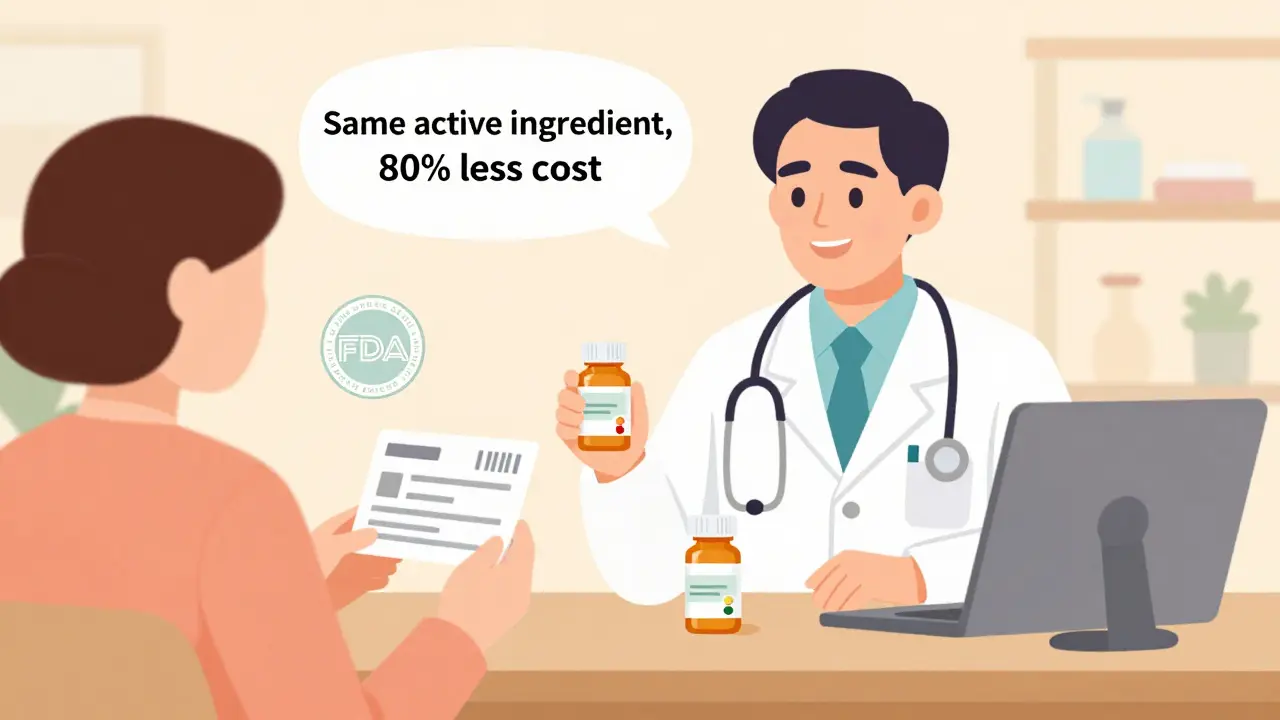
Many people assume that generic medications aren’t as good as brand-name drugs. They see the lower price and think, ‘If it’s cheaper, it must be weaker.’ But that’s not true. The FDA requires generic drugs to work the same way as their brand-name counterparts-same active ingredient, same strength, same dosage form. The only differences are in color, shape, or inactive ingredients like fillers or dyes. These don’t affect how the drug works. Yet, nearly 7 out of 10 patients still worry that generics won’t help them as much. If you’ve ever felt unsure about switching to a generic, you’re not alone. But here’s the truth: generics save patients an average of $659 per prescription every year, and studies show people who take them stick to their treatment plans better.
Why You Should Ask About Generics
Generic drugs aren’t a backup plan-they’re the standard. In the U.S., 9 out of 10 prescriptions filled are for generics. That’s because they’re just as safe and effective, but cost 80-85% less. A 2020 study in JAMA Internal Medicine looked at 47 clinical trials comparing generics and brand-name heart medications. The results? No meaningful difference in how well they worked. Patients on generics had the same blood pressure control, same cholesterol reduction, same fewer heart attacks. The only difference? Their wallets.But here’s the catch: if you don’t understand why your doctor is suggesting a generic, you might stop taking it. That’s a real problem. When people believe generics are inferior, they’re more likely to skip doses or quit altogether. This isn’t just about money-it’s about health. A 2011 study of 11 million people found that those on generics for chronic conditions like high blood pressure or diabetes were 8-12% more likely to take their meds consistently than those on brand-name drugs. Why? Because they could afford them. And when you take your medicine as prescribed, your condition stays under control.
What the FDA Really Says
The FDA doesn’t approve generics lightly. Before a generic drug hits the shelf, the manufacturer must prove it delivers the same amount of active ingredient into your bloodstream at the same rate as the brand-name version. This is called bioequivalence. The FDA requires that the difference in absorption be no more than 20%-and even then, it’s tightly controlled within an 80-125% range. That’s not a guess. It’s science. The same labs that test brand-name drugs test generics. The same factories follow the same strict rules. In fact, many brand-name companies make their own generics under different labels.Generics must meet 36 quality standards set by the FDA, covering everything from how quickly the pill dissolves to how stable it is over time. And they’re inspected just as often as brand-name drugs. In 2023, 98.7% of generic manufacturing facilities passed FDA inspections. That’s higher than the pass rate for many other industries.
Some people worry about where generics are made. Most are made in the U.S., India, and China-but all must meet the same U.S. standards. The FDA sends inspectors to those facilities regularly. If a plant doesn’t pass, the FDA blocks its products from entering the country. So, no, your generic isn’t made in a basement lab. It’s made under the same rules as your brand-name pill.
What You Might Notice-And Why It Doesn’t Matter
You might notice your generic pill looks different. Maybe it’s a different color, shape, or size. Or maybe it has a different name printed on it. That’s normal. These changes are due to inactive ingredients-things like starch, dye, or coating. They help the pill hold together or make it easier to swallow. But they don’t change how the drug works.Some patients report feeling different after switching. A small number say they get more side effects, or the drug doesn’t seem to work as well. In most cases, this is the nocebo effect-when your brain expects something to go wrong, so it feels like it does. But there are rare exceptions. For drugs with a narrow therapeutic index-like warfarin, levothyroxine, or some epilepsy meds-the body is very sensitive to small changes. Even a tiny shift in how the drug is absorbed can matter. That’s why the FDA requires tighter bioequivalence testing for these. If you’re on one of these, your doctor will monitor you closely. But even then, most patients switch without issue.
How to Start the Conversation
You don’t need to wait for your doctor to bring it up. You can start the conversation yourself. Here’s how:- Ask: ‘Is there a generic version of this medication?’
- Tell: ‘I’m concerned about the cost, and I’ve heard generics might be cheaper. Can you tell me if it’s safe?’
- Ask again: ‘Can you explain how it’s the same as the brand-name drug?’
This simple three-step method-called ‘Ask-Tell-Ask’-is used by doctors and pharmacists who want to make sure patients truly understand. It takes just two or three extra minutes. But it cuts medication errors by 37%, according to a 2022 study. And it helps you feel more in control.
If your doctor says no, ask why. Is it because the generic hasn’t been approved yet? Or because your condition needs a specific brand? Sometimes, yes. But often, it’s just because they didn’t think to mention it. Don’t be afraid to push back. You have the right to know your options.
What to Do If You’re Still Unsure
If you’re still hesitant, ask for the FDA’s Medication Guide. By law, your pharmacist must give you one for certain high-risk drugs-whether generic or brand. These guides explain the risks, side effects, and how the drug works in plain language. They’re written at a 5th-7th grade reading level so anyone can understand them.You can also check the FDA’s website for the official list of approved generics. Search for your brand-name drug, and you’ll see every approved generic version. You’ll also find links to the FDA’s ‘Take With Confidence’ campaign, which features real patients talking about their experiences switching to generics.
If you’ve had a bad experience with a generic before-like nausea, dizziness, or feeling worse-tell your doctor. Don’t assume it’s ‘all in your head.’ There could be a real difference in how your body handles the inactive ingredients. In rare cases, switching to a different generic version helps. Pharmacists can often order a specific manufacturer’s version if one works better for you.
Why This Matters for Your Health
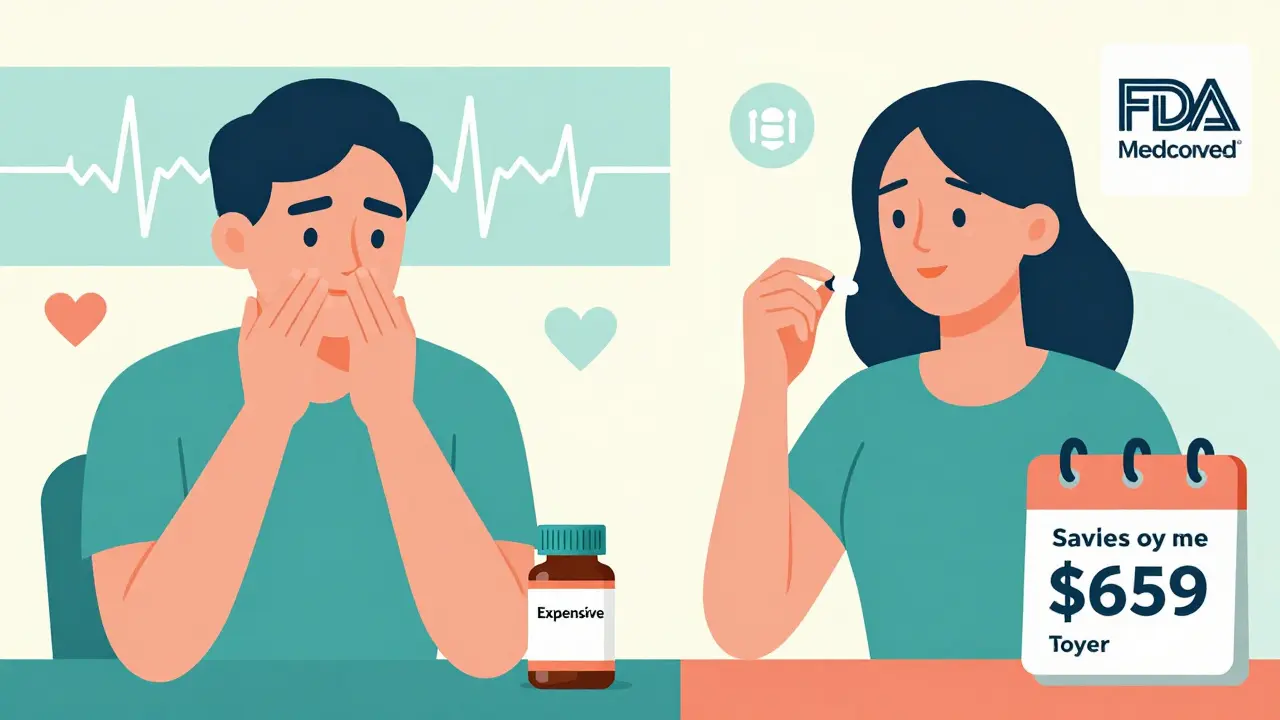
Medication non-adherence costs the U.S. healthcare system nearly $300 billion every year. That’s because people stop taking their drugs-not because they don’t need them, but because they can’t afford them, or they don’t trust them. Generics fix both problems. They make treatment affordable. And when patients understand how they work, they trust them more.A 2023 survey of 12,500 people found that 79% reported no difference in effectiveness after switching to generics. And 68% said the main reason they asked for generics was because they couldn’t afford the brand-name version. That’s not weakness. That’s smart health management.
And here’s something else to consider: starting in 2025, Medicare Part D will cover many generics with $0 cost-sharing. That means if you’re on Medicare, you could get your blood pressure or diabetes meds for free. But only if you take them. If you refuse generics because you think they’re inferior, you’re not saving money-you’re risking your health.
What Your Pharmacist Can Do
Your pharmacist is your ally. They’re trained to answer questions about generics. If you walk in with a new prescription and see a generic on the label, ask them:- ‘Is this the same as the brand-name drug?’
- ‘Why does it look different?’
- ‘Has this worked well for other patients?’
Pharmacists report that 83% of patient concerns about generics are resolved with a simple, clear explanation. They’re not trying to sell you something cheaper. They’re trying to help you stay healthy without going broke.
Some pharmacies even offer free counseling sessions just for generic switches. Ask if they have one available. It’s part of your right to informed care.
Final Thought: You’re Not Being Cheap-You’re Being Smart
Choosing a generic doesn’t mean you’re settling. It means you’re making a smart, evidence-based decision. You’re choosing a treatment that’s been tested just as rigorously, works just as well, and costs a fraction of the price. You’re not giving up quality-you’re choosing value.Doctors and pharmacists aren’t pushing generics because they’re cheaper. They’re pushing them because they work. And when patients understand that, they take their meds. And when they take their meds, they live better, longer lives.
So next time you get a prescription, ask: ‘Is there a generic?’ Don’t wait for them to ask you. You’re the one who has to take the pill every day. You deserve to know exactly what you’re taking-and why it’s safe.
Are generic drugs really as effective as brand-name drugs?
Yes. The FDA requires generics to have the same active ingredient, strength, dosage form, and route of administration as the brand-name drug. They must also prove bioequivalence-meaning they deliver the same amount of medicine into your bloodstream at the same rate. Studies of over 47 clinical trials found no meaningful difference in effectiveness between generics and brand-name drugs for conditions like high blood pressure, cholesterol, and diabetes.
Why do generic pills look different from brand-name pills?
The difference in color, shape, or size comes from inactive ingredients-like dyes, fillers, or coatings-that help the pill be made or swallowed. These don’t affect how the drug works. By law, generic manufacturers can’t copy the exact appearance of brand-name pills to avoid trademark issues. But the active ingredient is identical.
Can inactive ingredients in generics cause side effects?
In rare cases, yes. A small percentage of people may be sensitive to certain dyes or fillers used in generics. For example, some people report stomach upset or allergic reactions to specific inactive ingredients. If you notice new side effects after switching, tell your doctor. In most cases, switching to a different generic version (made by another company) solves the issue. But for 99.9% of patients, inactive ingredients cause no problems.
Are generics made in unsafe foreign factories?
No. The FDA inspects all manufacturing facilities-whether in the U.S., India, China, or elsewhere-with the same standards. In 2023, 98.7% of generic drug plants passed FDA inspections. Many brand-name drugs are also made overseas. The location doesn’t determine safety-it’s the inspection and quality control that matter.
Should I avoid generics for chronic conditions like thyroid disease or epilepsy?
Not necessarily. For drugs with a narrow therapeutic index-like levothyroxine or certain seizure meds-the FDA requires stricter bioequivalence testing (90-110% range). Most patients switch without issues. But if you’ve had problems before, your doctor may recommend sticking with a specific brand or generic version. Always monitor your symptoms and report changes. Never stop taking your medication without talking to your provider.
Will my insurance cover generics, and will it cost less?
Yes. Most insurance plans, including Medicare Part D, require you to try generics first because they’re significantly cheaper. The average cost of a generic prescription is $15.78, compared to $674.89 for brand-name drugs. Starting in 2025, many generics will be available with $0 cost-sharing under Medicare. Even without insurance, generics are often priced below $10 at major pharmacies.
Can I ask my pharmacist to give me a specific generic manufacturer?
Yes. While pharmacies often choose the lowest-cost generic, you can request a specific manufacturer if you’ve had better results with one before. Some pharmacies can order it for you, though it may take a day or two. This is especially helpful for patients on narrow therapeutic index drugs or those who react to certain inactive ingredients.
How do I know if a generic is FDA-approved?
All legally sold generics in the U.S. must be FDA-approved. You can verify this by searching the FDA’s Orange Book online, which lists all approved brand-name and generic drugs. Your pharmacist can also show you the FDA’s Medication Guide that comes with your prescription. If it’s on the shelf in a U.S. pharmacy, it’s approved.
If you’re on a long-term medication, switching to a generic could save you thousands a year-without sacrificing your health. The next time you get a prescription, ask the question. You’ve earned the right to know exactly what you’re taking-and why it’s safe.
Bryan Wolfe
January 11, 2026 AT 18:51Seriously, I switched my blood pressure med to generic last year-saved me $800 annually, and my numbers are better than ever! I used to think generics were ‘cheap knockoffs’ until I read the FDA stuff. Turns out, the same labs test them, same factories, same rules. Why pay extra when it’s literally the same pill?
Sumit Sharma
January 12, 2026 AT 21:04The bioequivalence thresholds are rigorously defined under 21 CFR 320.24-absorption profiles must fall within 80–125% Cmax and AUC confidence intervals with 90% confidence. Any deviation beyond this is statistically non-inferior. The FDA’s ANDA process mandates dissolution profiles matching the reference listed drug across pH 1.2–7.5. This isn’t opinion-it’s pharmacokinetic science. Stop believing marketing myths.
Jay Powers
January 14, 2026 AT 05:57I get why people are nervous. I was too. I switched my levothyroxine and felt weird for a week. Turns out it was just my brain freaking out. Once I stopped overthinking it, I felt fine. My doctor said most people who think generics don’t work are just experiencing the nocebo effect. It’s not about the pill-it’s about the story we tell ourselves about it.
Lawrence Jung
January 14, 2026 AT 22:40People cling to brand names like security blankets. They fear change. They fear being tricked. But the truth? You’re not getting ripped off-you’re being liberated from corporate greed. The pharmaceutical industry profits from your ignorance. Generics aren’t a compromise. They’re a rebellion. The system wants you to believe you need the expensive version. You don’t. You just need to think for yourself.
Alice Elanora Shepherd
January 15, 2026 AT 01:50Just wanted to add-my pharmacist gave me a printed FDA Medication Guide when I switched to a generic statin. It had side effects, storage info, even a QR code to the FDA’s database. I didn’t even know those existed. If your pharmacist doesn’t offer one, ask. They’re legally required to give it. And yes, the generic looked different-but my cholesterol didn’t care.
Christina Widodo
January 16, 2026 AT 08:01Wait-so if generics are so good, why do some people say they feel worse after switching? I had this weird dizziness after my doctor switched me to a generic antidepressant. I thought it was me, but then I read about inactive ingredients. Is that a real thing? Or am I just overreacting?
Prachi Chauhan
January 16, 2026 AT 10:45My aunt took generic thyroid meds and got super tired. She thought it was her age. Then she switched back to brand-and boom, energy came back. So maybe not all generics are same? I mean, if your body reacts, you gotta listen. Not everything is about money. Sometimes it’s about how your body feels. And that’s real.
Katherine Carlock
January 16, 2026 AT 23:56OMG YES. I was scared to switch my diabetes med to generic because I thought it’d be ‘weaker.’ But my pharmacist sat with me for 10 minutes, showed me the FDA page, and even pulled up a chart comparing blood sugar logs from patients on both. My A1c didn’t budge. And I saved $120/month. I’m telling everyone now. It’s not about being cheap-it’s about being smart.
Sona Chandra
January 17, 2026 AT 16:20They say generics are safe-but have you seen the factories in India? They’re literally dumping chemicals into rivers while making your pills. And the FDA? They inspect once every 5 years. You think they care? They’re paid by the same pharma giants that make the brand names. This is a scam. You’re being poisoned for profit.
Jennifer Phelps
January 17, 2026 AT 23:24My pharmacist lets me pick which generic brand I get. I tried three before finding one that didn’t give me stomach cramps. Turns out, different fillers = different reactions. No one told me I could ask. If you’ve had a bad experience, don’t give up-just ask for a different maker. It’s not your fault. It’s just chemistry.