How to Set Achievable Adherence Goals and Track Progress for Medication Compliance
 Jan, 5 2026
Getting your meds on time isn’t just about remembering to take them-it’s about building a habit that sticks. For people managing chronic conditions like diabetes, high blood pressure, or asthma, missing even a few doses can lead to hospital visits, worsening symptoms, or long-term damage. But most people don’t fail because they’re lazy. They fail because the plan is too vague. "Take your pills daily" doesn’t cut it. You need something concrete. Something you can see, measure, and celebrate.
Why Vague Goals Fail
"I’ll take my medicine better" is a wish, not a plan. Studies show that when patients are told to "be more adherent," they overestimate their own compliance by 30-40%. That’s because memory is unreliable. You might think you took your pill yesterday, but did you? Did you skip it because you were in a rush? Forgot because it wasn’t tied to a routine? That’s where structured goal-setting changes everything.
Research from Vozo Health in 2023 found that patients using clear, structured goals improved adherence by up to 35%. That’s not magic. It’s science. The key is using the SMART framework-not just as a buzzword, but as a practical tool. SMART stands for Specific, Measurable, Achievable, Relevant, and Time-bound. When you apply it to medication, it turns confusion into clarity.
How to Build a SMART Medication Goal
Let’s say you’re on a blood pressure pill. Your doctor says, "Take it every day." That’s not enough. Here’s how to turn that into a real goal:
- Specific: What exactly are you doing? Not just "take my pill." It’s: "I will take my 10mg lisinopril tablet at 8 a.m. every morning after brushing my teeth." Now you’ve answered: Who? You. What? Take the pill. When? 8 a.m. Where? At home after brushing. Why? To keep my blood pressure stable.
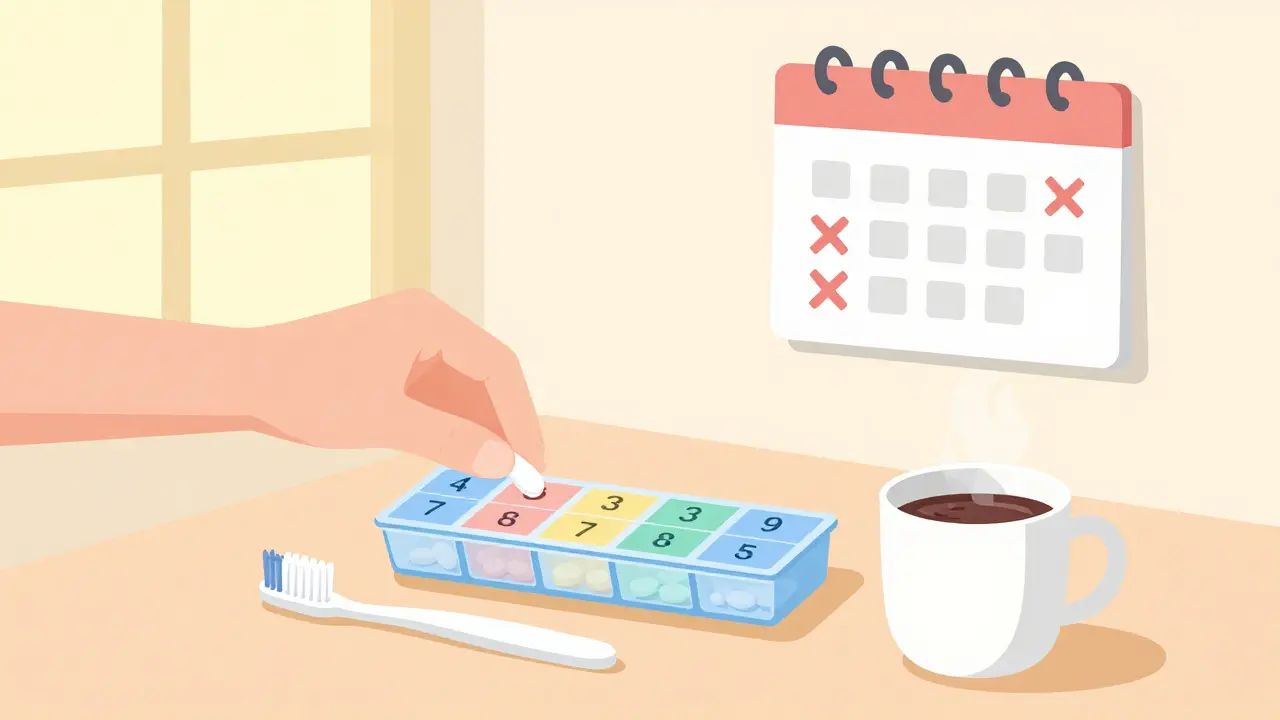
- Measurable: How will you know you did it? Use a pill organizer with days of the week. Track it in a notebook. Or use a smart bottle that logs when it’s opened. Some apps like Medisafe send reminders and log doses automatically. The goal isn’t to feel good-it’s to have proof.
- Achievable: Can you actually do this? If you work night shifts, taking a pill at 8 a.m. won’t work. Adjust it to when you wake up. If you hate pills, ask your doctor if there’s a once-daily version. If cost is an issue, talk about generics. Goals must fit your life, not the other way around.
- Relevant: Why does this matter to YOU? Not your doctor. Not your family. You. Maybe you want to avoid another stroke. Maybe you want to play with your grandkids without feeling dizzy. Tie the goal to something personal. That’s what keeps you going when it’s hard.
- Time-bound: When will you check in? Don’t wait until your next doctor visit. Set a weekly check: every Sunday night, review your tracker. Did you miss any doses? Why? Adjust next week’s plan based on what happened.
That’s it. No fancy tech needed. Just clarity.
How to Track Progress Without Overcomplicating It
Tracking doesn’t mean spending hours on an app. It means knowing, at a glance, if you’re on track.
Here are three simple ways:
- Pill count: Fill a 7-day or 30-day organizer. At the end of the week, count how many pills are left. If you’re supposed to take one a day and you have 8 left on day 7, you missed a dose.
- Pharmacy refill records: Your pharmacy tracks when you pick up your meds. If you’re supposed to refill every 30 days but you wait 45, that’s a red flag. Call your pharmacy and ask for your Medication Possession Ratio (MPR). If it’s below 80%, you’re falling behind.
- Digital tools: Apps like Medisafe, MyTherapy, or even Apple Health can log doses and send reminders. Smart pill bottles (like Hero or AdhereTech) open only when you take your pill and send alerts to your phone or family if you miss one. For asthma, inhalers with sensors (like Propeller) track usage and give feedback on technique.
One study showed that patients using sensor-based inhalers improved adherence by 27% compared to those using regular ones. For diabetes, e-injection pens like NovoPen Echo record every dose with 99.2% accuracy. These aren’t luxuries-they’re tools that turn guesswork into data.

What If You Keep Missing Doses?
Missing a dose isn’t failure. It’s feedback.
Ask yourself:
- Was the goal too ambitious? Maybe you tried to take three pills at once and got overwhelmed. Break it down.
- Did you forget because it wasn’t tied to a habit? Link it to something you already do: after coffee, before brushing your teeth, right after lunch.
- Is the pill too big? Do you hate swallowing it? Ask your doctor about liquid or crushed versions (if safe).
- Are you running out? Is the cost too high? Talk to your pharmacy about patient assistance programs.
- Do you feel like it’s not working? Maybe your symptoms haven’t changed. Talk to your doctor-sometimes adherence improves when you understand why the medicine matters.
One nurse practitioner in Texas shared that 60% of her patients missed initial deadlines-not because they didn’t care, but because they didn’t know how to start. She started asking: "What’s the one thing that makes taking your pill hard?" That simple question changed everything.
Use Visual Progress to Stay Motivated
Humans respond to visuals. A chart. A sticker. A calendar with X’s.
A diabetes educator in Melbourne told the story of Mrs. Johnson, who struggled to stick to her diet and medication plan. They started a simple chart: every time she weighed herself and took her meds, she got a sticker. First week: two weigh-ins. Second week: five. By month two, she was doing it daily. She didn’t just lose weight-she regained control.
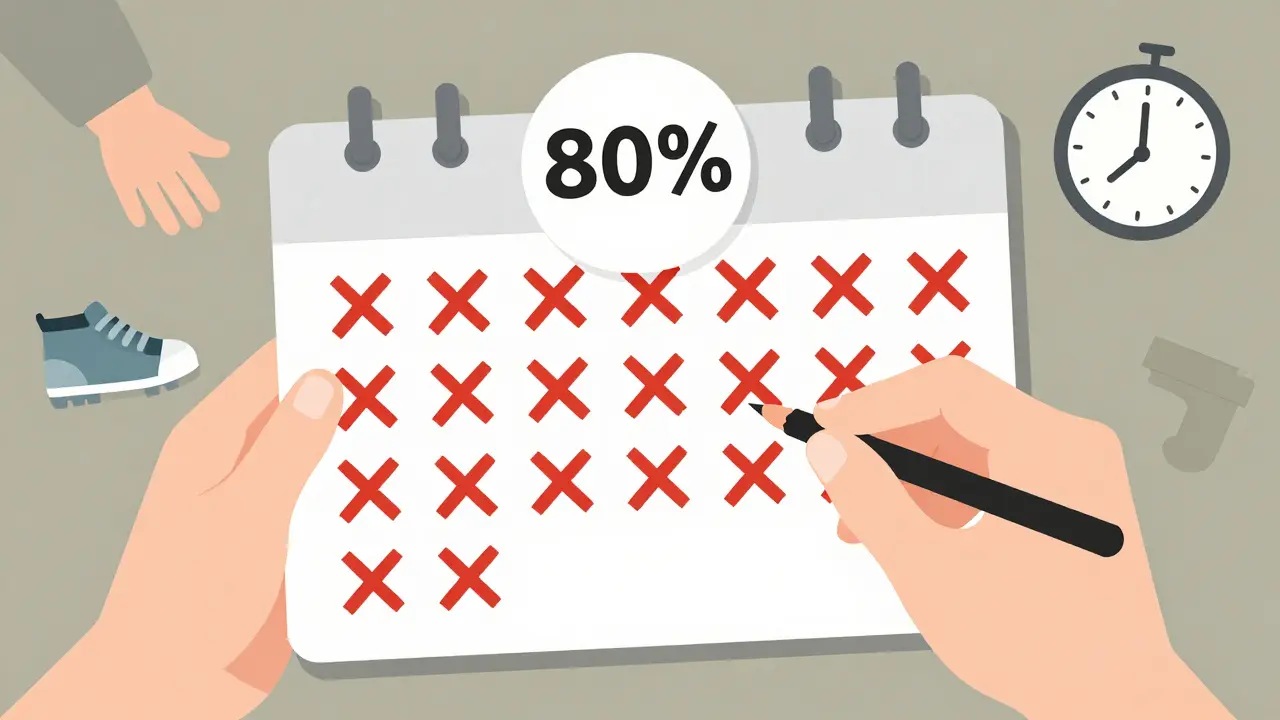
You don’t need an app. Print a calendar. Put it on the fridge. Put a red X for every day you take your meds. After 7 days, you’ve got a streak. After 30, you’ve got a habit.
Patients who use visual trackers are 29% more likely to stay on course, according to PatientBetter’s 2023 survey. And for older adults? Simpler is better. Digital tools often get abandoned within 30 days. A paper chart? It lasts.
When Technology Helps-And When It Doesn’t
There’s a lot of buzz about AI, smart pills, and voice assistants tracking your meds. And yes, they work. Proteus Digital Health’s ingestible sensors can confirm you swallowed your pill with 94% accuracy. Amazon Halo’s voice tracking got 78% compliance in pilot studies.
But here’s the catch: not everyone needs-or wants-tech.
Patients over 65 are 52% more likely to stop using apps after a month. Why? Too many steps. Confusing interfaces. Fear of privacy. If you’re not tech-savvy, a pill box and a calendar work better than an app that asks for your email, password, and health history.
The best tools are the ones you’ll actually use. If you love your phone? Use Medisafe. Hate screens? Use a paper log. Your goal isn’t to be high-tech. It’s to be consistent.
What Providers Should Do (And What You Can Ask For)
Doctors and pharmacists aren’t ignoring this. In fact, Medicare and Medicaid now require adherence tracking for chronic conditions under the 2024 Quality Payment Program. But many still don’t have the time or tools to help.
Here’s what you can ask for:
- "Can we write down one clear goal for my meds today?"
- "Can you show me how to use a pill organizer?"
- "Is there a free app or tracker you recommend?"
- "Can I get a refill reminder text?"
- "If I miss a dose, what should I do?"
Providers who use SMART goals reduce documentation time by 37% and improve care coordination. You’re not asking for extra work-you’re asking for better care.
Small Wins Build Big Changes
Don’t wait for perfection. Aim for 80%.
Missing one dose a week? That’s 86% adherence. That’s better than most. Celebrate it. Then aim for 88% next week. Then 90%. Progress isn’t linear. It’s messy. But every time you take your pill, you’re choosing your health over your chaos.
The goal isn’t to be flawless. It’s to be consistent. And consistency? That’s what keeps you out of the hospital, off the IV drip, and living your life.
Start Today
Right now, grab your medication bottle. Look at the label. Write down:
- What you take
- When you take it
- Why it matters to you
- How you’ll track it (paper, app, pill box)
- When you’ll check in (Sunday night? Every Friday?)
That’s your SMART goal. No apps needed. No fancy training. Just you, your medicine, and a plan that fits your life.
Adherence isn’t about discipline. It’s about design. Design your days so taking your pill is the easiest thing you do.
Brian Anaz
January 7, 2026 AT 09:36This whole article is just corporate fluff dressed up as science. People don't miss meds because they didn't get a SMART goal-they miss them because they're poor, overworked, or don't give a damn about their health. Stop pretending behavior change is just about sticky notes and pill boxes. It's about systemic failure. Fix the system, not the patient.
Venkataramanan Viswanathan
January 9, 2026 AT 00:10While the framework presented is logically sound, it lacks cultural context. In rural India, many patients rely on family members to remind them. A pill organizer is useless if no one is home to open it. The concept of 'weekly check-ins' assumes access to calendars, literacy, and quiet time-luxuries not everyone has. Practicality must be rooted in reality, not American clinic brochures.
Vinayak Naik
January 10, 2026 AT 12:22Yo this is legit fire 🔥 I been takin’ my blood pressure junk since last year and honestly? The sticker chart on my fridge changed my whole vibe. No app, no fancy tech-just me, a Sharpie, and a stupid little star every day I don’t flake. Now I got 47 in a row. My grandma even started one for her insulin. It’s dumb, it’s simple, and it WORKS. Stop overthinkin’ it. Just do the damn thing.
Saylor Frye
January 11, 2026 AT 01:42How quaint. The SMART framework? Please. You’re treating medication adherence like a productivity hack for middle-class suburbanites. Meanwhile, the real problem is pharmaceutical pricing, lack of access to primary care, and the fact that most patients are being prescribed polypharmacy cocktails they don’t understand. This is therapeutic narcissism wrapped in bullet points.
Kiran Plaha
January 11, 2026 AT 14:45I appreciate the effort behind this. I’ve seen friends struggle with meds and I know it’s rarely about laziness. Maybe next time we could also talk about how stigma plays a role? Like when people hide their pills because they’re embarrassed to be seen as 'sick'? Just a thought.
Matt Beck
January 12, 2026 AT 05:41Consistency… is… the… ultimate… form… of… rebellion… against… chaos… isn’t it?… Every… pill… you… swallow… is… a… silent… scream… into… the… void… saying… 'I… am… still… here…'… and… that… my… friends… is… the… quiet… heroism… of… daily… survival… 💪🩺✨
Cam Jane
January 13, 2026 AT 00:03YES. This. I’ve worked with patients for 12 years and the #1 thing that works? Making it stupid simple. No apps. No guilt. Just: 'What’s the one thing that makes it hard?' Then we fix that. One tiny thing. Maybe it’s the bottle’s too big. Maybe it’s the taste. Maybe it’s the fear of side effects. We don’t fix the whole plan-we fix the one brick that’s crumbling. And then we celebrate that. Every single time. You don’t need discipline-you need a teammate. And you’re not alone.
Jeane Hendrix
January 14, 2026 AT 16:27Interesting approach but I’m curious about the MPR metric-how reliable is that when patients get early refills due to insurance gaps or split prescriptions? Also, do you have data on adherence correlation with health literacy levels? I’ve seen patients who perfectly track doses but still don’t understand why they’re on the med-so compliance is mechanical, not internalized.
Katelyn Slack
January 15, 2026 AT 14:27my phone died last week and i totally forgot my pills for 3 days… then i remembered i had a pillbox and felt like a genius. paper ftw. also, why does everyone assume we want to use apps? i just wanna live my life without being nagged by tech.