How to Read FDA Drug Labels: Understanding Key Information Sections
 Jan, 20 2026
FDA Drug Label Analyzer
Enter a drug name to analyze key sections of the FDA label. This tool demonstrates how to identify critical safety information.
How This Tool Works
Based on FDA labeling standards, this tool identifies:
- Boxed Warnings (critical safety alerts)
- Dosage guidelines for special populations
- Drug interactions with common medications
- Key patient counseling points
Results Will Appear Here
Enter a drug name and click "Analyze Label" to see key sections
Reading an FDA drug label isn’t like reading a product manual for a toaster. It’s a dense, highly regulated document designed to keep you safe - but only if you know where to look. Many people assume the small print on the pill bottle tells them everything they need to know. It doesn’t. The real details are in the FDA drug label, a document healthcare providers use to make life-or-death decisions. If you’re a patient, caregiver, or even just someone trying to understand what’s in your medicine, learning how to read it can change everything.
What You’re Really Looking At
The official FDA drug label is called the United States Prescribing Information (USPI). It’s not something you’ll find on the box - it’s a full document published online by the FDA and used by doctors, pharmacists, and hospitals. Every prescription drug sold in the U.S. must follow this exact format, set by the FDA’s Center for Drug Evaluation and Research (CDER) in 2006 and updated regularly since. The goal? Reduce errors. A 2020 analysis found over half of medication mistakes happened because the label was unclear about dosage, timing, or who should take the drug. This system was built to fix that.The label has three main parts: the Highlights, the Table of Contents, and the Full Prescribing Information (FPI). The Highlights are just half a page - short, bold, and meant to grab your attention. But here’s the catch: it’s incomplete. The FDA requires it to say so right at the top. Don’t rely on it alone. The real answers are in the FPI - 17 numbered sections that break down every detail you need to know.
Section 1: Indications and Usage
This is where you find out what the drug is actually approved to treat. It’s not just "for high blood pressure." It might say: "Indicated for the treatment of hypertension in adults, as monotherapy or in combination with other antihypertensive agents." That "in combination" part matters. Some drugs only work well with others. If your doctor prescribes it for something not listed here, that’s called off-label use - common, but not the same as FDA approval.Also look for the Established Pharmacologic Class (EPC). This tells you how the drug works. For example, "angiotensin II receptor blocker" tells you it blocks a hormone that tightens blood vessels. Knowing the mechanism helps you understand why side effects happen and why it might interact with other meds.
Section 2: Dosage and Administration
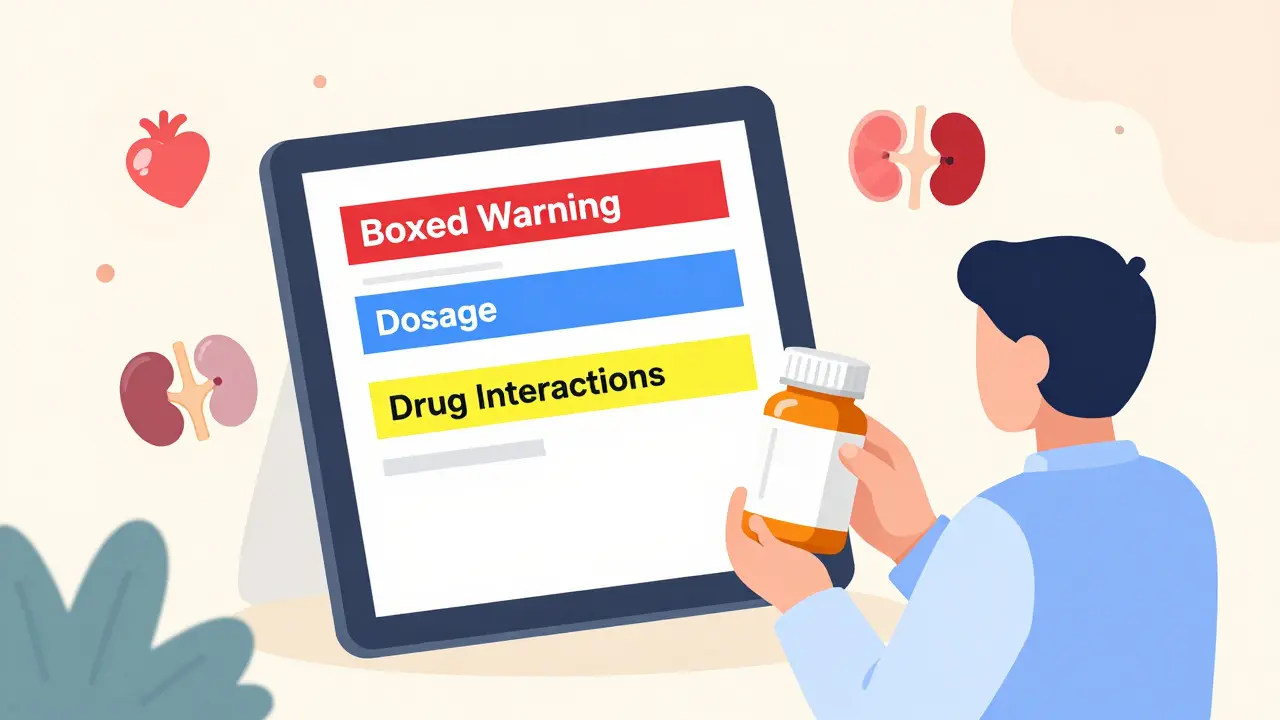
This is the most critical section for patients. It tells you how much to take, how often, and how to take it - with food? On an empty stomach? Swallowed whole or crushed? But it doesn’t stop there. It also breaks down dosing for special groups: seniors, kids, people with kidney or liver problems. If you’re over 65 or have diabetes, the dose might be lower. Many people take the same dose as a healthy 30-year-old - and that’s dangerous.Look for phrases like "reduce dose in patients with creatinine clearance below 30 mL/min." That’s kidney function. If you don’t know your numbers, ask your doctor. The FDA updated this section in March 2024 to make these instructions clearer. Still, 42% of physicians say they struggle to find this info quickly during emergencies.
Section 5: Warnings and Precautions - Especially the Boxed Warning
This is where the FDA puts its strongest warnings. And it doesn’t hide them. The most serious risks get a Boxed Warning - a thick black border around the text, right at the top of the label. It’s there for a reason. These are risks that can cause death or permanent injury: liver failure, suicidal thoughts, heart rhythm problems, severe allergic reactions.For example, a diabetes drug might have a Boxed Warning for lactic acidosis. A psychiatric drug might warn of increased suicide risk in young adults. If you see this, don’t ignore it. Talk to your doctor. Ask: "Is this risk real for me?" The FDA requires these warnings to be based on real clinical data - not guesses.
Section 6: Adverse Reactions
This section lists side effects - but not all of them. Only those seen in clinical trials. Common side effects (like headache or nausea) appear with percentages: "Nausea occurred in 18% of patients." Rare ones? They’re listed as "less than 1%" or "reported post-marketing." That’s important. Just because something isn’t listed doesn’t mean it can’t happen. The FDA collects reports of side effects after the drug is on the market. That’s why you’re encouraged to report problems to MedWatch.One thing to watch: frequency matters. If a side effect happens in 1 in 10 people, it’s common. If it’s 1 in 1,000, it’s rare. Don’t panic over rare risks - but do know them.
Section 7: Drug Interactions
This is where many people get hurt. The drug might be fine on its own, but when mixed with another medication, supplement, or even grapefruit juice, it becomes dangerous. The label lists interactions by severity. "Contraindicated" means never mix them. "Use with caution" means monitor closely. "No clinically significant interaction" means it’s probably safe.Common offenders: blood thinners, antibiotics, antidepressants, and herbal supplements like St. John’s Wort. If you take five different meds, check this section. Pharmacists use this part daily to catch dangerous combos. You should too.
Section 8: Use in Specific Populations
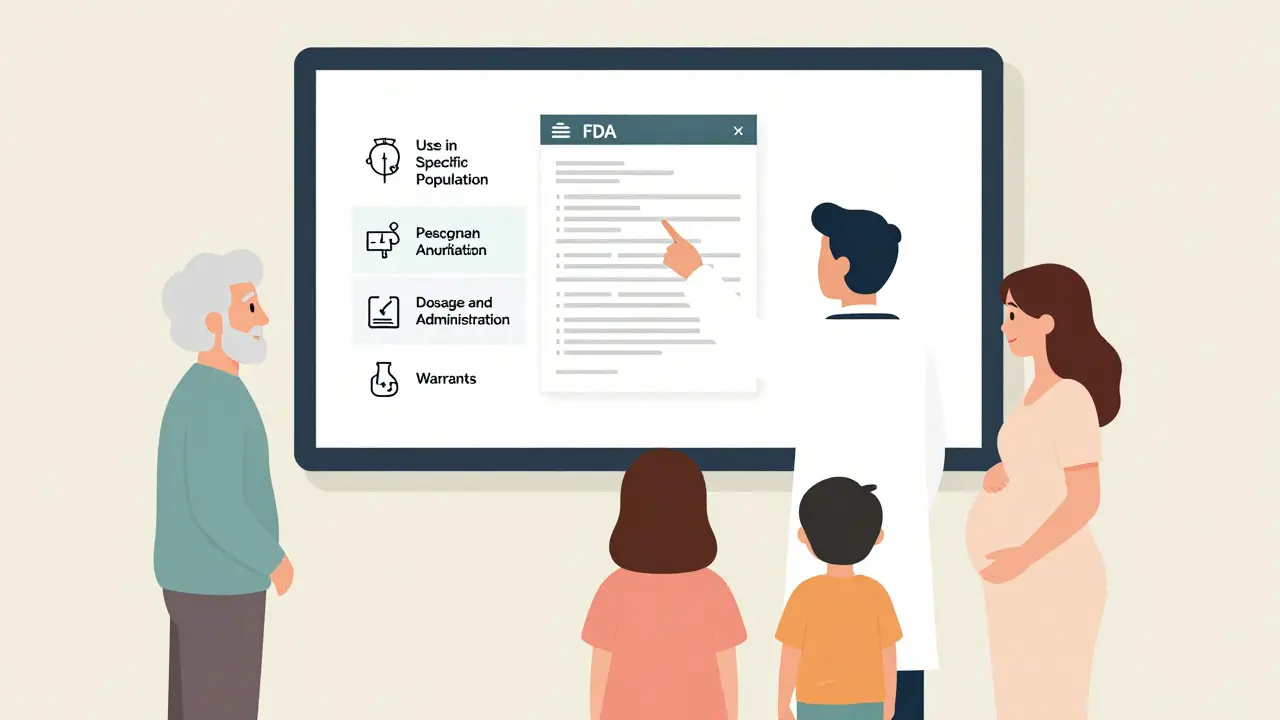
Pregnant? Breastfeeding? Elderly? Pediatric? This section tells you if the drug is safe - or if there’s not enough data. For example, some drugs are labeled "Category C" for pregnancy - meaning animal studies showed harm, but human data is limited. That doesn’t mean avoid it - it means discuss risks with your doctor.Older adults often need lower doses because their bodies process drugs slower. Kids? Dosing is often based on weight, not age. Don’t guess. This section has the numbers.
Section 16: How Supplied / Storage and Handling
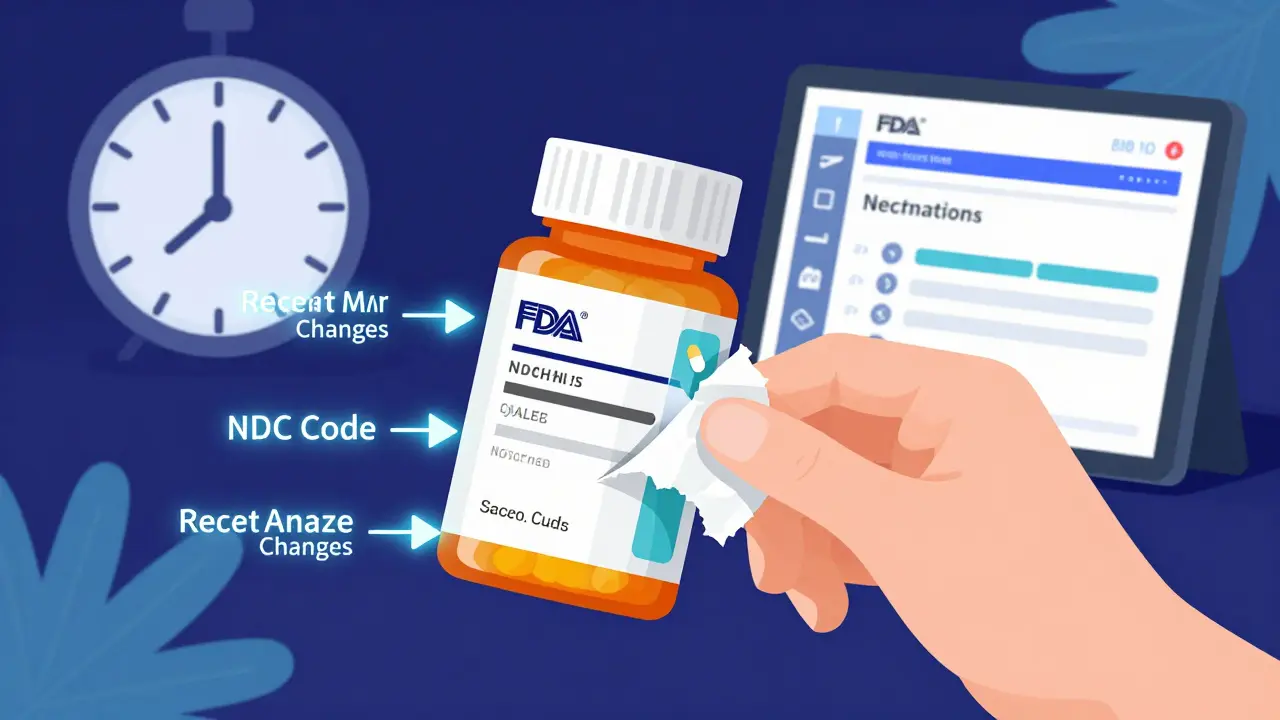
This is the NDC code section. The 10-digit number on your bottle? That’s it. It breaks down into three parts: labeler code (who made it), product code (what the drug is), and package code (how many pills in the bottle). This helps pharmacies and insurers track exactly what you got. If you get a different-looking pill from the same drug, check the NDC. It might be a generic, or worse - a counterfeit.Also here: storage instructions. "Store at room temperature" or "Refrigerate." Don’t leave insulin in the car. Don’t keep pills in the bathroom. Heat and moisture ruin them.
Section 17: Patient Counseling Information
This section is written for doctors to read aloud to patients. It includes simple, clear talking points: "Take this with food to avoid stomach upset," "Avoid alcohol while taking this," "Do not stop suddenly." Yet, only 38% of providers actually use it. That’s a missed opportunity. Ask your doctor: "Is there anything in the Patient Counseling section I should know?" You might hear something your pill bottle doesn’t say.The Hidden Section: Recent Major Changes
Every label has a section listing updates from the last six months. This isn’t fluff. If a new warning was added about heart rhythm problems last month, it’s here. The FDA says this section has cut the time between safety updates and doctor awareness by 35%. Always check this before starting a new drug or refilling a prescription. A label from 2021 might not reflect what’s known today.How to Use This in Real Life
For patients: Don’t just look at the bottle. Go to the FDA’s website. Search the drug name. Download the full label. Print it. Highlight the Boxed Warning, the dosing info, and the interactions. Bring it to your next appointment. Ask: "Is this still accurate?"For caregivers: If you’re managing meds for someone else, this is your checklist. Keep a copy. Know the signs of serious side effects. Don’t assume the pharmacist told you everything.
For healthcare providers: Use the three-step method. Start with the Boxed Warning. Then check Indications, Dosage, and Drug Interactions. Only then go deeper. And always check the Recent Major Changes. Labels aren’t static. They evolve with new data.
What’s Changing? The Future of Drug Labels
The FDA isn’t done. In 2024, they launched a pilot program with 15 drugmakers testing interactive digital labels. Imagine clicking a link to see a video on how to take your pill, or getting a pop-up alert if your EHR system flags a bad interaction. By 2027, two-thirds of new drugs may include these digital extras.They’re also working on making labels more patient-friendly. Right now, they’re written for doctors. The goal? To add plain-language summaries without losing precision. Early studies show this could cut medication errors by nearly 30%.
But until then - you have the power. The FDA label isn’t meant to confuse you. It’s meant to protect you. You just need to know how to read it.
Is the FDA drug label the same as the package insert?
Yes, the FDA drug label is the official version of the package insert. The term "package insert" is older and less precise. Today, the FDA calls it the Prescribing Information, and it’s formatted exactly the same way for every drug. It’s the only version that meets federal requirements.
Can I trust the information on the pill bottle?
The pill bottle has basic info - name, dose, instructions. But it’s not complete. It won’t tell you about rare side effects, drug interactions, or warnings for kidney disease. The full label on the FDA website has all the details. Always double-check online.
Why do two versions of the same drug look different?
That’s likely a generic version. Brand-name and generic drugs have the same active ingredient, but different inactive ingredients (like fillers or dyes). The FDA requires generics to be equivalent - but the label might look different. Always check the NDC code. If it’s different from your last refill, ask your pharmacist why.
What if my doctor prescribes a drug for something not listed on the label?
That’s called off-label use. It’s legal and common - especially for cancer, psychiatric, and pediatric conditions. But the FDA hasn’t reviewed the drug for that use. Ask your doctor: "Is this approved for this condition? If not, what’s the evidence?" They should be able to explain.
How often are drug labels updated?
On average, every 14.3 months. The FDA requires manufacturers to update labels within 30 days of new safety data. But delays happen - 28% of updates are late. That’s why you should always check the "Recent Major Changes" section before taking a drug you’ve used before.
Kelly McRainey Moore
January 22, 2026 AT 06:59So I printed out the full label for my blood pressure med last week after reading this. Turned out my doc prescribed it at the max dose, but the label says to cut it in half if you're over 65. I had no idea. Now I'm asking for a lower dose next visit. Thanks for the heads-up!
Also, the Boxed Warning about dizziness? Yeah, that's why I nearly fell down the stairs last month. Should've read this sooner.
Amber Lane
January 22, 2026 AT 13:53My grandma didn't know her diabetes med had a boxed warning for lactic acidosis. She thought 'rare side effect' meant 'won't happen to me.' It almost did. This post saved her life.
Ashok Sakra
January 23, 2026 AT 21:22THE FDA IS LYING TO US!!!
They only update labels when they're forced to! I found a drug that had a warning about heart attacks added 3 years after 12 people died! The companies hide stuff! They don't want you to know! I've seen it with my own eyes!
They even change the NDC codes to trick you into thinking it's the same pill! It's all a scam!
lokesh prasanth
January 24, 2026 AT 20:58if u think the label is the truth u r naive. drugs are made for profit not health. the fda is a puppet of big pharma. they only test on young healthy people. old people, pregnant women, and minorities are left out. then they sell it to us anyway. capitalism is killing us.
Samuel Mendoza
January 25, 2026 AT 12:15Actually, the FDA doesn't require the label to be readable. It just requires it to exist. Most patients can't understand it anyway. The real problem is that doctors don't explain it. Stop blaming the label. Blame the system.
shubham rathee
January 26, 2026 AT 18:12you know what's wild the patient counseling section is literally written for doctors to read to you but only 38 use it
so they just hand you the bottle and say take one daily
what if you cant read english
what if you're blind
what if you're 80 and forgetful
the system is broken and nobody cares
MAHENDRA MEGHWAL
January 27, 2026 AT 11:09Thank you for this comprehensive breakdown. As a healthcare professional in India, I have observed that patients often rely solely on the pill bottle information, unaware of the depth of data available in the official prescribing information. The emphasis on the Recent Major Changes section is particularly valuable. I will encourage my patients to access the FDA label directly, especially given the global nature of pharmaceutical supply chains and the potential for miscommunication in translation or interpretation.
Kevin Narvaes
January 28, 2026 AT 02:22bro the fda label is just a legal shield for pharma companies
they put all the scary stuff in there so they can say 'we told you' if someone dies
but no one reads it
and the ones who do? they panic and quit their meds
it's a lose lose
we need better communication not more paperwork