How to Prevent Early Refills and Duplicate Therapy Mistakes in Pharmacy Practice
 Jan, 28 2026
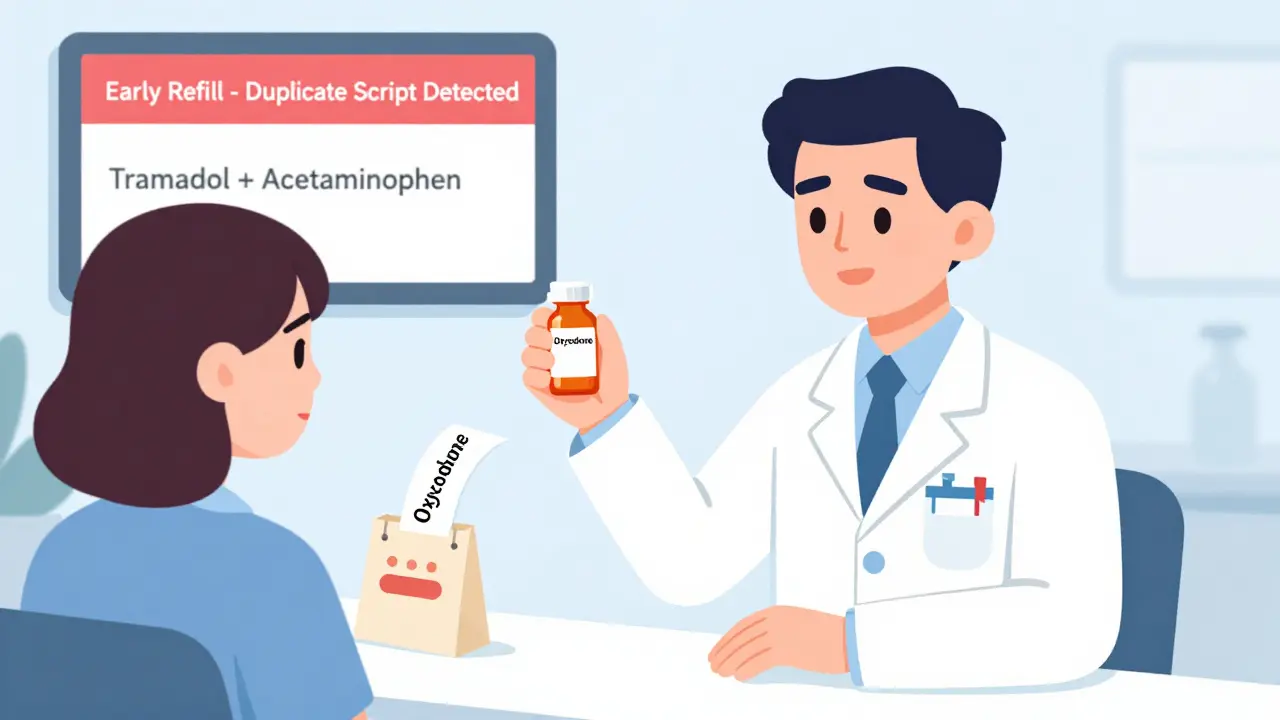
Every month, pharmacists face the same frustrating scenario: a patient walks in two weeks early for a 30-day prescription of oxycodone, claiming their doctor said it was fine. Another patient shows up with two different scripts for the same painkiller from two different doctors. These aren’t just inconveniences-they’re red flags for early refills and duplicate therapy, two of the most dangerous medication errors in community pharmacy today.
According to the CDC, medication misuse contributes to over 12,000 opioid-related deaths annually in the U.S. Many of these cases start with someone getting early refills or stacking prescriptions from multiple providers. Pharmacists are often the last line of defense-but too many still treat refill requests as routine, not clinical decisions.
Why Early Refills Are a Red Flag, Not a Request
Let’s clear up a common myth: just because your insurance lets you refill a 30-day script five days early doesn’t mean you should. That five-day window exists for legitimate reasons-like travel, lost pills, or a pharmacy delay. But patients who do it every month? That’s not a convenience. That’s a pattern.
The DEA strictly prohibits refills on Schedule II drugs like oxycodone, fentanyl, or Adderall. No exceptions. Not even if the patient says, “My doctor wrote it.” Not even if they offer to pay cash. Pharmacists who ignore this risk legal action, license suspension, and worse-helping enable addiction.
One pharmacy in Melbourne reported that 37% of early refill requests for controlled substances came from patients who had already filled the same script at another pharmacy within the last 14 days. That’s not bad luck. That’s drug diversion.
Duplicate Therapy: When Two Prescriptions Do More Harm Than Good
Duplicate therapy happens when a patient gets two or more drugs with the same active ingredient-or drugs that do the same thing. Think: two different brands of ibuprofen, or a prescription for tramadol paired with an over-the-counter cold medicine containing acetaminophen.
The risks? Liver failure from too much acetaminophen. Kidney damage from NSAID stacking. Serotonin syndrome from combining antidepressants and pain meds. These aren’t hypotheticals. A 2022 study in the Journal of Patient Safety found that 1 in 12 medication errors in community pharmacies involved duplicate therapy, and nearly half of those led to hospital visits.
Worse, patients often don’t realize they’re double-dipping. They see two different doctors. They fill one script at Walmart, another at Chemist Warehouse. They assume the pharmacist knows what’s already been prescribed. They’re wrong.
How to Build a Refill Protocol That Actually Works
Randomly checking refill requests won’t cut it. You need a system. The American Academy of Family Physicians (AAFP) developed a simple, proven three-tier protocol that works in real-world settings:
- Low-risk meds (like nasal steroids, thyroid pills): Can be refilled automatically every 90 days if the patient has had a visit in the last 6 months.
- Chronic condition meds (like blood pressure or diabetes drugs): Allow a 90-day supply with one follow-up visit every 3 months. No early refills unless lab results are current.
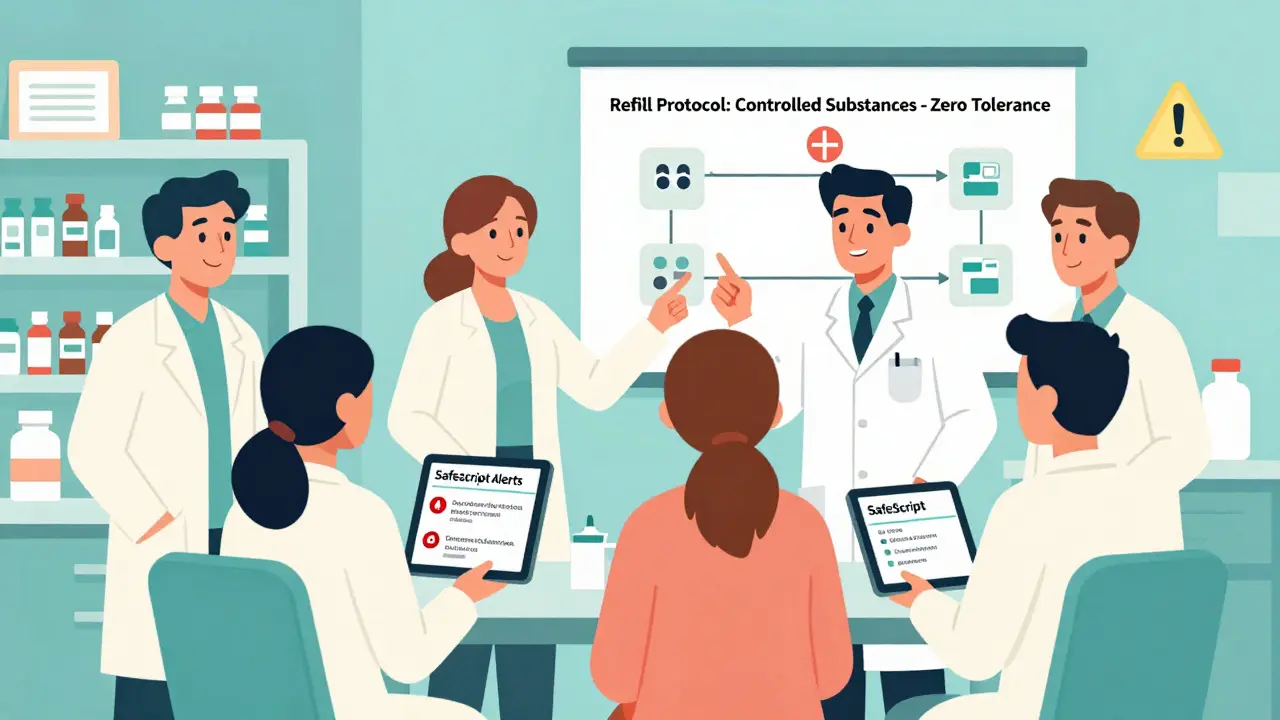
- Controlled substances: Zero tolerance for early refills. No exceptions unless there’s documented, urgent clinical need-and even then, it requires direct provider approval.
These aren’t suggestions. They’re safety standards. One clinic in Sydney cut early refill requests by 68% after implementing this system. Staff spent less time arguing with patients and more time doing clinical work.
Use Technology-Don’t Just Rely on Memory
Trying to remember every script a patient has filled across five different pharmacies? Impossible. That’s why clinical viewers and state prescription drug monitoring programs (PDMPs) are non-negotiable.
In Australia, the SafeScript system gives pharmacists real-time access to a patient’s controlled substance history across the country. If someone’s filled two oxycodone scripts in the last 10 days? The system flags it. You don’t have to guess. You don’t have to hope. You have data.
Electronic Health Records (EHRs) can help too. Set up alerts in your system to notify you when:
- A patient requests a refill before the expected date.
- A new prescription matches an existing one in their profile.
- A patient has filled the same drug at multiple pharmacies in the last 30 days.
These aren’t fancy features. They’re basic safety tools. If your pharmacy doesn’t have them, ask why.
Train Your Team to Speak Up-Not Just Scan
Pharmacy technicians aren’t just order fillers. They’re frontline safety officers. Train them to recognize the warning signs:
- Patient says, “I need it now-I’m out.” (But they just filled it 10 days ago.)
- Patient insists, “The insurance lets me get it early.” (That’s not how it works.)
- Patient refuses to let you call their prescriber. (Big red flag.)
- Patient is vague about why they need the med. (They don’t know, or they’re lying.)
Empower your staff to say: “I need to check with the pharmacist before I can fill this.” That’s not being difficult. That’s being responsible.
One pharmacy in Adelaide started holding weekly 15-minute huddles where staff reviewed flagged refill requests. Within three months, they identified three patients who were doctor shopping. They reported them to SafeScript. Those patients were referred to addiction services. No overdoses. No arrests. Just better care.
How to Handle the Difficult Patient
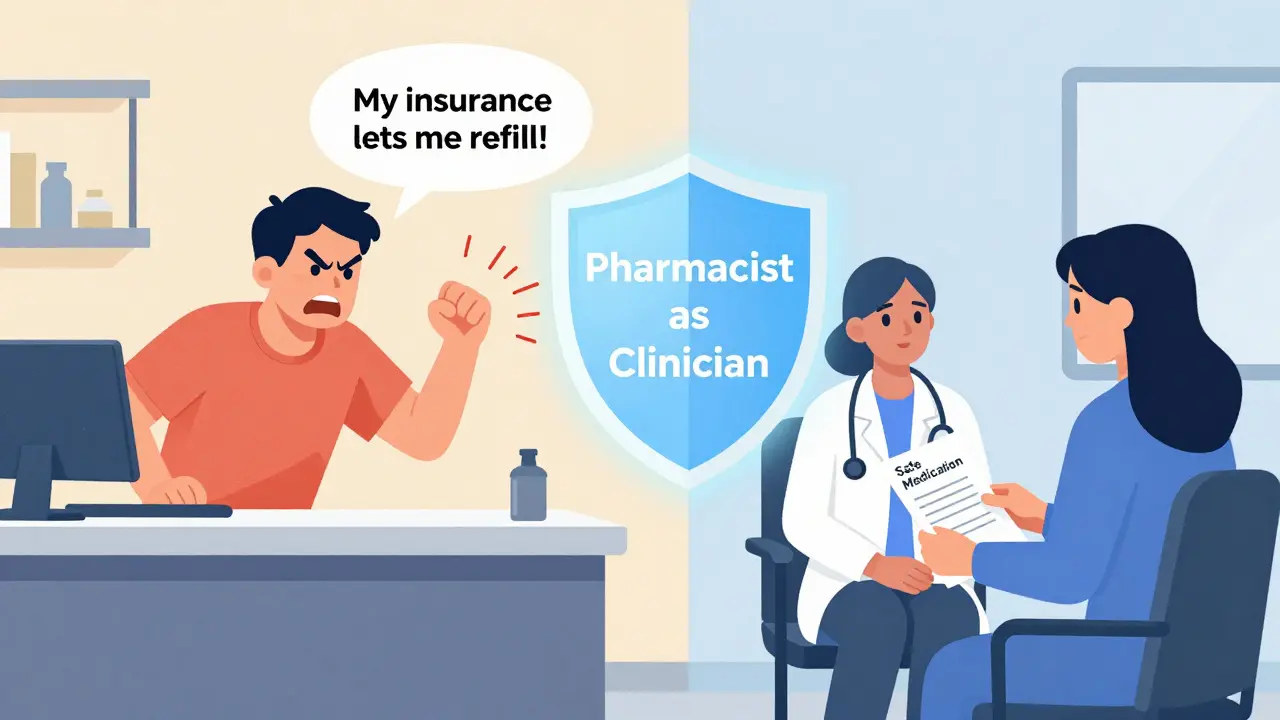
Some patients will get angry. They’ll yell. They’ll threaten to go elsewhere. That’s normal. What’s not normal is giving in.
Here’s what to say instead of “I can’t”:
- “I want to make sure you’re getting the safest care possible. Let me check with your doctor to see if we can adjust your prescription.”
- “I see you’ve filled this twice in the last two weeks. Is everything okay? I’m here to help.”
- “I’m required by law to verify this refill. I’ll call your prescriber right now.”
Never say, “The insurance allows it.” That’s not your job. Your job is to protect the patient.
And if the patient refuses to cooperate? Document everything. Call the prescriber. Report to SafeScript. You’re not being a gatekeeper. You’re being a clinician.
What Happens When You Don’t Act
Ignoring early refills and duplicate therapy doesn’t just hurt patients. It hurts your pharmacy.
Pharmacies that fail to monitor refill patterns risk:
- DEA investigations and fines
- Licensing board sanctions
- Loss of insurance contracts
- Reputation damage
- Being named in a lawsuit after an overdose
One community pharmacy in Queensland lost its DEA registration after repeatedly filling early oxycodone refills. The owner was fined $250,000. The pharmacist lost their license. And the patient? They died of an overdose two weeks later.
This isn’t scare tactics. It’s reality.
Make Prevention Part of Your Culture
Preventing early refills and duplicate therapy isn’t about being strict. It’s about being smart.
Start small. Pick one high-risk medication-like a controlled painkiller-and apply your new protocol to it. Track how many early requests you deny. Talk to your team. Celebrate when you catch a potential problem before it becomes a crisis.
Then expand. Add another drug. Then another. Eventually, you’ll have a system that protects patients, reduces stress, and keeps your pharmacy out of legal trouble.
Medication safety isn’t a checklist. It’s a mindset. And if you’re not actively preventing these errors, you’re part of the problem.
Can I refill a Schedule II drug early if the patient says their doctor approved it?
No. DEA regulations strictly prohibit any refills on Schedule II controlled substances, regardless of what a prescriber says. Even if the doctor called in a new prescription, you cannot fill it before the original script’s end date. Always verify through official channels like SafeScript or the prescriber’s electronic system. Never rely on verbal claims.
How do I know if a patient is doctor shopping?
Use your state’s Prescription Drug Monitoring Program (PDMP)-in Australia, that’s SafeScript. Look for patterns: multiple prescribers, multiple pharmacies, frequent early refill requests, or overlapping prescriptions for the same drug class. If a patient is getting oxycodone from Dr. Smith on Monday and hydrocodone from Dr. Jones on Wednesday, that’s a red flag. Document and report it.
What if a patient claims their insurance allows early refills?
Insurance policies may allow a 5-day early refill window for logistical reasons, but that doesn’t override clinical or legal guidelines. Patients often misunderstand this as permission to use up their medication early and then refill. Your responsibility is to the patient’s safety, not the insurance policy. Always follow clinical protocols and DEA rules, not insurance terms.
Can I refuse to fill a prescription if I suspect misuse?
Yes. Pharmacists have the legal and ethical right to refuse to dispense a prescription if they believe it’s not in the patient’s best interest. This includes suspected drug diversion, duplicate therapy, or lack of medical necessity. Document your reasons, contact the prescriber, and report to SafeScript if necessary. You are not obligated to fill every script.
How can I prevent duplicate therapy without knowing every drug a patient takes?
Use clinical viewers and PDMPs like SafeScript to access a patient’s full medication history across pharmacies. Also, always ask: “Are you taking any other medications, including over-the-counter or supplements?” Many patients don’t realize that cold medicine can contain acetaminophen or that ibuprofen is in multiple brands. Make this part of every refill conversation.
If you’re still unsure about a refill request, call the prescriber. Ask: “Is this intended to replace an earlier script?” “Is the patient stable on this dose?” “Are there any monitoring requirements?” You’re not being a burden-you’re being a safeguard.
Medication safety doesn’t happen by accident. It happens because someone-like you-chose to look closer, ask harder, and say no when it mattered.
Ambrose Curtis
January 30, 2026 AT 07:35Man, I’ve seen this too many times. Patient walks in with a script for oxycodone, says their doctor ‘approved’ it, but the PDMP shows they got the same thing two towns over last week. And the pharmacist just shrugs? No. That’s not just negligence-that’s complicity. DEA doesn’t care if you’re ‘busy’ or ‘nice.’ You fill it, you’re on the hook. Period.
Linda O'neil
January 31, 2026 AT 02:43This is exactly why we need better training for techs. I trained my crew to say, ‘Let me check with the pharmacist’ before even scanning anything. It’s not rude-it’s routine. We’ve cut our early refill flags by 70% since last year. No drama, just safety. You don’t have to be a hero. Just be consistent.
James Dwyer
February 1, 2026 AT 13:46One time I had a guy scream at me because I wouldn’t fill his 15-day-old oxycodone script. He said I was ‘ruining his life.’ I handed him a pamphlet on pain management clinics and said, ‘Your life’s not ruined-you’re just not getting high anymore.’ He left. Two weeks later, he came back with a referral from his PCP. We helped him. He cried. I didn’t say a word. That’s the job.
jonathan soba
February 2, 2026 AT 20:40Let’s be honest: most pharmacists don’t have the time, energy, or legal backing to enforce this properly. The system is broken. You’re expected to be detective, therapist, cop, and cashier-all while being yelled at by people who think you’re the enemy. And when you do the right thing? No praise. Just paperwork. Meanwhile, the real culprits-overprescribing docs-are still collecting checks.
matthew martin
February 3, 2026 AT 09:34Y’all are talking like this is some high-stakes spy movie, but it’s just… pharmacy. People are hurting. Some are addicted. Some are just dumb. Some are straight-up scamming. You don’t have to be a villain to say no. You just have to be steady. I’ve got a little sign behind the counter now: ‘I’m not here to judge your pain-I’m here to make sure you don’t kill yourself trying to escape it.’ Works better than any protocol.
And yeah, I use PDMP like it’s my daily coffee. If the system flags something? I don’t just ‘check.’ I call the doc. I ask, ‘Is this a new plan or a backup?’ Sometimes they say, ‘Oh, yeah, we switched him to gabapentin last week.’ That’s the win. Not the refill. The conversation.
And if you’re still using paper logs? You’re not just behind-you’re dangerous. Tech isn’t optional anymore. It’s oxygen.
One of my techs found a guy filling tramadol at three different stores. Turned out he was selling it to his nephew. We called SafeScript. The nephew got rehab. The uncle? Got probation. Nobody died. That’s a good day.
Chris Urdilas
February 5, 2026 AT 06:33So let me get this straight-you’re gonna stop someone from getting their pain meds because ‘insurance lets you refill early’? Bro, that’s like refusing to give someone water because the bottle says ‘best by 2025.’ The system is rigged, and now you’re the gatekeeper? Cool. Enjoy your 3am panic attacks.
Jeffrey Carroll
February 5, 2026 AT 07:38While the procedural framework outlined in the article is commendable, it is imperative to acknowledge the systemic under-resourcing of community pharmacies. Without adequate staffing, reimbursement for clinical interventions, or legal immunity for refusal decisions, pharmacists are placed in untenable ethical positions. Protocol alone cannot compensate for institutional neglect.
Phil Davis
February 5, 2026 AT 10:20They always say ‘just call the doctor.’ But half the time, the doctor’s office is closed, the voicemail is full, and the script’s been sitting there for 20 minutes while the patient’s breathing down your neck. So you do what you gotta do. Sometimes you say no. Sometimes you say yes. And sometimes you just… look away. Don’t pretend this is black and white. It’s not. It’s just… tired.