How to Avoid Illegal Medication Purchases in Foreign Markets
 Jan, 12 2026
Buying medication abroad sounds simple-save money, get the same pills you take at home. But what if that bottle of oxycodone you ordered from a website claiming to be Canadian actually contains fentanyl? Or if the semaglutide you bought for weight loss has no active ingredient at all? This isn’t fiction. It’s happening right now, and people are dying because of it.
Why Foreign Medications Are Riskier Than You Think
Most people assume that if a drug looks legit-same packaging, same logo, same name-it must be safe. That’s the trap. Illegal sellers copy brand names perfectly. They use fake websites that look like real pharmacies. They even post fake reviews and use social media ads targeting people worried about high drug prices. The World Health Organization says 1 in 10 medical products in low- and middle-income countries are fake. But it’s not just those countries. In 2024, the European Medicines Agency found counterfeit versions of popular weight-loss drugs like semaglutide and tirzepatide flooding online markets across Europe and North America. These fake pills often contain toxic substances-like industrial chemicals or excessive fentanyl-that can kill you after one dose. And here’s the scary part: even if you think you’re buying from a "Canadian" pharmacy, you’re probably not. A 2024 study in the AMA Journal of Ethics confirmed that many websites selling "Canadian" drugs actually source them from India, Turkey, or Southeast Asia-places with weak or nonexistent drug safety rules. Canada itself doesn’t have enough supply to meet U.S. demand, and it doesn’t monitor what happens to drugs once they leave its borders.How Illegal Pharmacies Trick You
These operations aren’t amateur. They’re run like tech startups-with marketing teams, AI-generated websites, and fake customer service lines. Here’s how they fool you:- They don’t require a prescription-even for controlled substances like oxycodone or alprazolam.
- They list prices in foreign currency and offer deals like "50% off" or "free shipping worldwide."
- They use logos that look like the FDA, EMA, or Health Canada-but those agencies never endorse specific websites.
- They ship in plain packaging with no labels, or labels in languages you don’t understand.
- They disappear after you pay. No customer service. No tracking. No refund.
What Makes a Pharmacy Legit?
Legitimate pharmacies follow strict rules. They’re licensed. They track every pill. They require a valid prescription. And they’re accountable. In the U.S., look for the VIPPS seal (Verified Internet Pharmacy Practice Sites). As of October 2024, only 68 online pharmacies in the entire country had this certification. That’s it. If a site doesn’t show it, walk away. In the EU, check your national medicines agency’s official list of approved online pharmacies. The EMA doesn’t recommend specific sites-but they do publish verified lists. If a site claims to be "EMA-approved," that’s a red flag. No regulatory body endorses private companies. In Australia, the TGA (Therapeutic Goods Administration) maintains a list of approved overseas suppliers. Even if you’re traveling, don’t buy meds abroad unless they’re on that list.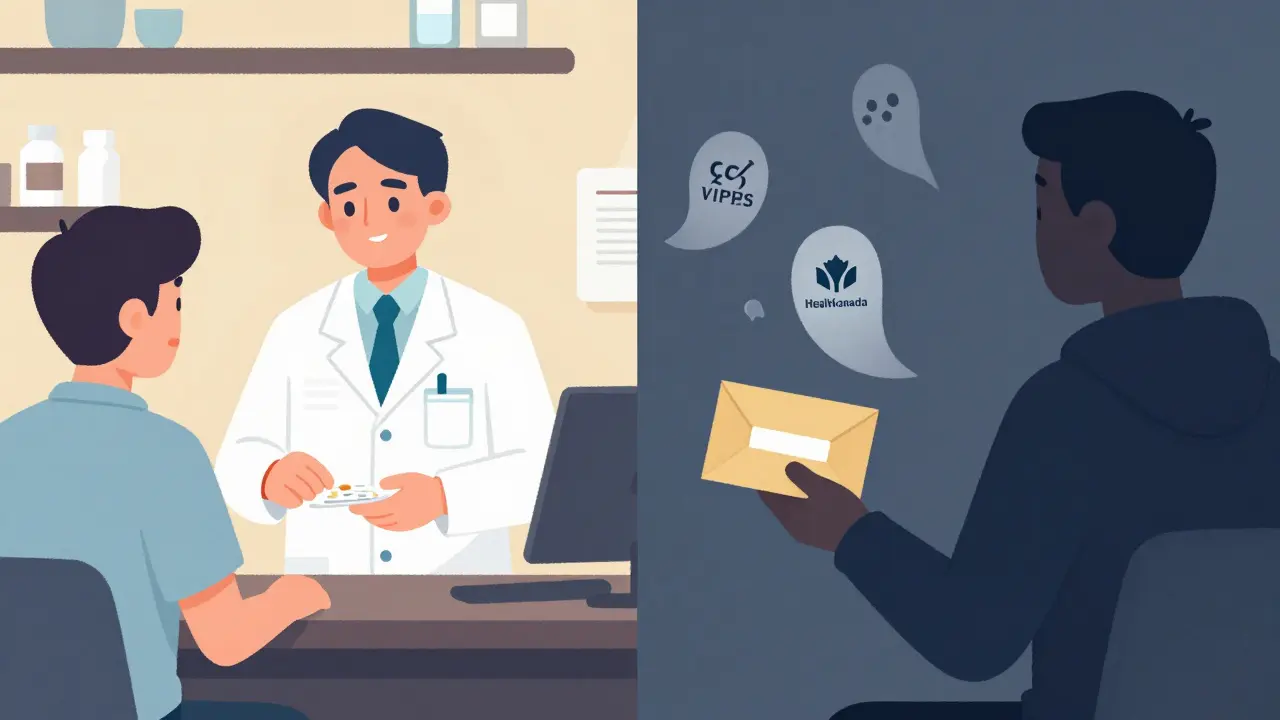
How to Spot a Fake Medicine
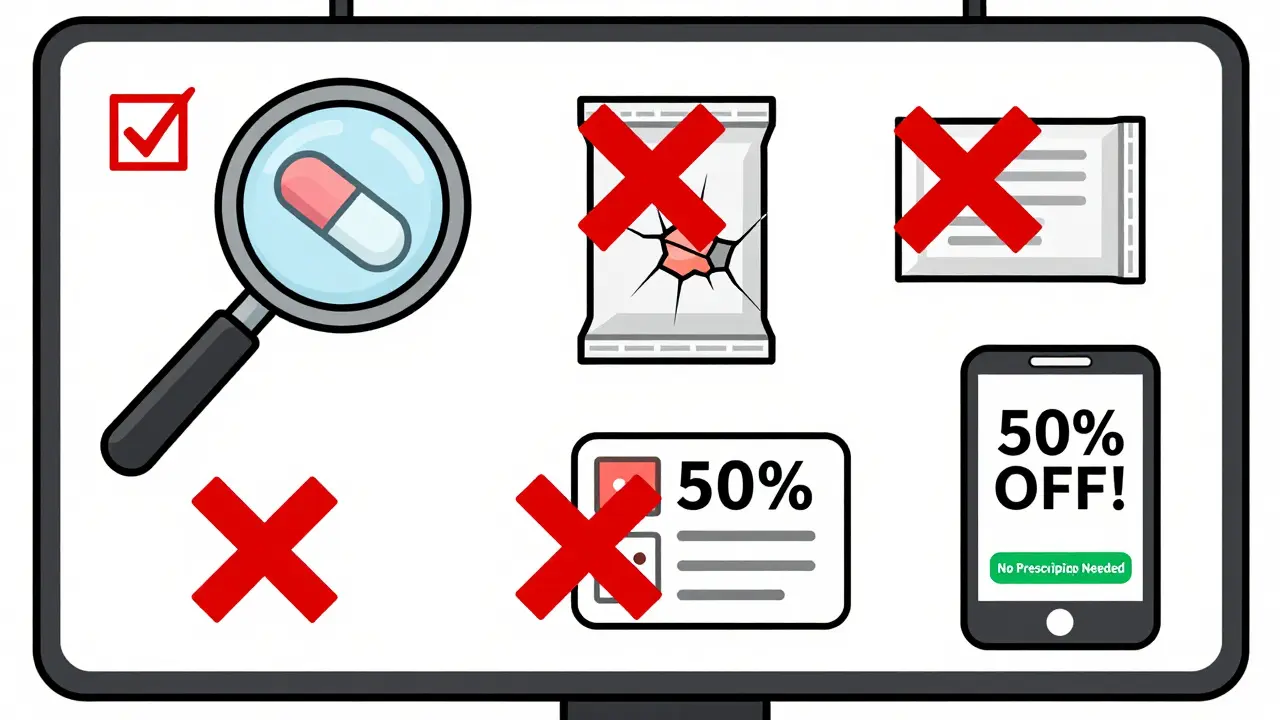
If you somehow end up with a pill you didn’t get from a trusted source, check these things:- Labeling: Is it in the local language? Does it have a batch number and expiration date? Fake pills often have blurry text, misspellings, or no dates at all.
- Packaging: Is it sealed? Is the box cracked or resealed? Legitimate meds come in tamper-evident packaging.
- Appearance: Does the pill look different from your usual brand? Even slight color or shape changes can mean it’s fake.
- Effect: Did it work? If you took a diabetes pill and your blood sugar spiked, or a blood thinner and you started bruising easily-stop taking it. Get it tested.
Why "It’s Cheaper in Canada" Is a Lie
You’ve heard it: "I can get my insulin for $30 in Canada." Sounds great. But here’s what you’re not told:- Canada doesn’t have enough supply to export to the U.S. Most "Canadian" meds sold online are smuggled in from countries with no safety checks.
- Importing drugs from abroad is illegal under U.S. law-even if you’re just bringing back a 30-day supply for yourself.
- When U.S. consumers buy from foreign sources, it creates shortages in the source country. Canada has already warned that this practice harms its own citizens.
- There’s no guarantee you’ll get the same drug twice. One batch might be real. The next might be chalk and caffeine.
What to Do If You’ve Already Bought Something Suspicious
Don’t take it. Don’t throw it away. Don’t give it to someone else.- Call your doctor or pharmacist immediately. Bring the pills with you.
- Report it to your country’s drug safety agency: FDA in the U.S., TGA in Australia, MHRA in the UK, EMA in the EU.
- If you think you’ve been poisoned-go to the ER. Fentanyl poisoning can be reversed if caught early.
- File a report with the DEA or Interpol’s online fraud unit. These sites rely on silence to keep operating.
How to Get Affordable Medications Without Risk
The real problem isn’t that people want cheap drugs. It’s that legitimate systems make them too expensive. But there are safer ways to handle this.- Ask your doctor about generic versions. Most brand-name drugs have cheaper, equally safe generics.
- Use prescription discount cards. Programs like GoodRx often cut prices by 80% for U.S. patients.
- Check patient assistance programs. Most big drugmakers offer free or low-cost meds to qualifying patients.
- Consider mail-order pharmacies through your insurer. They’re regulated and often cheaper than retail.
Final Warning: There Are No Shortcuts
No website, no social media ad, no "limited-time offer" is worth your life. The risk isn’t just getting sick-it’s dying quietly, alone, because you trusted a fake pharmacy. If you’re traveling and need medication, bring enough from home. If you run out, go to a local hospital or licensed pharmacy. Ask for the generic. Show your prescription. Don’t gamble with your health. Counterfeit drugs don’t care if you’re on vacation, broke, or desperate. They only care about your money. And they’ll take it-and your life-without a second thought.Can I legally buy prescription drugs from another country?
Technically, importing prescription drugs from other countries into the U.S., Australia, or the EU is illegal under most circumstances-even for personal use. While enforcement is rare for small personal quantities, the law exists because there’s no way to guarantee safety. Drugs bought abroad aren’t inspected by local regulators, and you have no legal recourse if they’re fake or harmful.
How do I know if an online pharmacy is real?
Look for verified seals: VIPPS in the U.S., the EU’s national pharmacy register, or the TGA’s approved list in Australia. A real pharmacy requires a valid prescription, shows a physical address you can verify, and has a licensed pharmacist available to answer questions. If the site doesn’t display this clearly, it’s not legit.
Are drugs from Canada safer than those from India or Turkey?
Not necessarily. While Canada has strong drug regulations, most websites selling "Canadian" meds don’t source from Canada. A 2024 study found the majority of these drugs come from India, Turkey, or Southeast Asia, where oversight is weak or nonexistent. The "Canada" label is just marketing.
What should I do if I think I took a fake pill?
Stop taking it immediately. Contact your doctor or go to the ER, especially if you feel dizzy, nauseous, have chest pain, or experience sudden changes in your condition. Bring the pill and packaging with you. Report it to your country’s drug safety agency. Fake pills can cause immediate harm-don’t wait for symptoms to get worse.
Can I trust pharmacies I find on Google or Facebook?
No. Google and Facebook have removed millions of illegal pharmacy ads, but new ones pop up every day. Even if the site looks professional, it’s likely fake. Legitimate pharmacies don’t advertise on social media. They’re found through your doctor, insurer, or official government lists.
Why do fake pills often contain fentanyl?
Fentanyl is cheap, powerful, and easy to smuggle. Criminals mix tiny amounts into fake painkillers like oxycodone or Xanax because it makes the pill feel stronger-so people keep buying it. But even a grain of fentanyl can kill someone who’s never used opioids before. It’s not an accident-it’s a deadly business model.
Is it safe to buy over-the-counter meds abroad?
Over-the-counter meds like pain relievers or antihistamines carry less risk than prescription drugs-but not zero. Some countries sell versions with different ingredients or dosages. Always check the label. If you’re unsure, ask a local pharmacist. Stick to well-known brands you recognize.
What’s the difference between gray market and illegal drugs?
Gray market drugs are genuine products bought in one country and resold in another, often at lower prices. They’re not fake-but they’re not approved for sale in your country, so their safety isn’t guaranteed. Illegal drugs are counterfeit or falsified-they’re not the real thing at all. Both are risky, but illegal drugs are far more dangerous.
Milla Masliy
January 14, 2026 AT 06:45Just wanted to say this post saved my life. My mom was about to order "Canadian" insulin from a site that looked legit-same logo, same URL structure. I found this article, checked the VIPPS list, and we called her pharmacist instead. Turns out the site was on the NABP Not Recommended List. She’s on a patient assistance program now, paying $25/month. No more nightmares.
Thank you for being the voice of reason in a world full of snake oil.
Avneet Singh
January 14, 2026 AT 16:40It’s fascinating how neoliberal pharmaceutical monopolies have engineered a crisis of access, only to commodify the resultant desperation through predatory digital pharmaco-capitalism. The structural violence embedded in the U.S. healthcare apparatus is not incidental-it’s systemic. The fact that people are dying because they can’t afford generics while Big Pharma rakes in $200B annually is less a failure of regulation and more a feature of the market logic itself.
Also, VIPPS? Please. That’s just a corporate veneer over a broken system. We need universal pharmacare, not virtue signaling seals.
Damario Brown
January 16, 2026 AT 11:37ok but like… i bought fentanyl pills off a "canadian" site last year and i’m still alive? so maybe the risk is overstated? i mean i took 3 and felt like a god, then got a rash. big deal. also why are you all so scared of opioids? it’s just chemistry. if you can’t handle it, don’t do it. also typo: semaglutide is spelled wrong in the 3rd paragraph. it’s semaglutide. not semaglutide. fix it.
also my cousin died from it but he was a junkie so idk why you’re making this about normal people.
Clay .Haeber
January 17, 2026 AT 05:13Oh wow. A 12-page essay on how to not die from internet pills. Did you write this while sipping your $18 organic turmeric latte and scrolling through your 7th LinkedIn post about "health equity"? Congrats, you’ve turned a life-or-death public health crisis into a clickbait sermon.
Meanwhile, real people are choosing between insulin and rent. You’re giving them a checklist. A checklist. Like they’re assembling IKEA furniture while their kidneys fail.
Also, VIPPS? Only 68 sites? That’s not safety-it’s a cartel. You’re not solving the problem. You’re just policing the symptoms while the system burns.
Also, I’m 23 and I bought metformin from a site that didn’t require a script. It worked. I didn’t die. So your "science" is just fear porn with footnotes.
Lethabo Phalafala
January 18, 2026 AT 16:49I’m from South Africa, and I’ve seen what happens when people can’t afford meds. My cousin took fake ARVs for six months. He didn’t know. He just thought he was getting weaker. By the time he got to a real clinic, his CD4 count was 87. He’s alive now, but he’ll never be the same.
This isn’t about "being careful." It’s about justice. People aren’t buying fake pills because they’re stupid-they’re buying them because they have no choice. The real villain isn’t the website. It’s a system that lets people starve while drug companies profit.
I’m not mad at you for writing this. I’m mad that we need it in the first place.
sam abas
January 19, 2026 AT 12:26Actually, I did a deep dive into this last year because my uncle got scammed. Turns out, the DEA’s Operation Press Your Luck didn’t shut down most of the sites-they just moved them to new domains with different TLDs. The NABP list? It’s outdated by the time it’s published. I found 14 active sites in the "Canada" category that weren’t on the list, all using Cloudflare and fake SSL certs. Also, most of them use AI-generated customer service bots that answer in perfect English but have zero knowledge of pharmacy law.
And here’s the kicker: some of these sites are hosted in the same data centers as legit pharmacies. Same IP range. Same CDN. The only difference? One has a VIPPS seal. The other doesn’t. But they’re run by the same people.
Also, the WHO’s 1 in 10 stat? That’s for low-income countries. In the U.S., it’s more like 1 in 20 for counterfeit meds-but the death rate is higher because people take them with other meds. Polypharmacy + fake pills = perfect storm.
Also, I tried to report one site to the FTC. They told me to contact the domain registrar. The registrar is in Russia. So… good luck with that.
vishnu priyanka
January 19, 2026 AT 13:52Bro, I got my metformin from a "Thai pharmacy" for $5 a month. Worked fine. No side effects. My blood sugar’s stable. I didn’t die. Maybe the fear is overblown? Not everything on the internet is a death trap. Also, I’ve seen real Indian pharmacies with WHO-GMP certification. They’re legit. Just don’t buy from the ones with 50% off and "free shipping to your door in 2 days." That’s sketchy.
But also, why are we blaming the buyer? The system’s broken. If insulin cost $30 here, no one would risk it. We need to fix the root, not the symptom.
Angel Tiestos lopez
January 21, 2026 AT 12:59just… i’m so tired of people acting like buying meds online is some kind of moral failure 😔
it’s not about being dumb. it’s about being broke. and scared. and alone.
i took fake semaglutide last year. didn’t lose weight. but i didn’t die. i just cried in my car after the pharmacy called to say my insurance denied my script again.
we need real change. not a list of seals. not a lecture. we need healthcare that doesn’t make you choose between living and surviving.
💔
Alan Lin
January 23, 2026 AT 08:50While I appreciate the comprehensive nature of this post, I must emphasize that the underlying issue transcends individual responsibility and extends into the domain of systemic public health policy failure. The proliferation of counterfeit pharmaceuticals is not a symptom of consumer negligence but rather a direct consequence of deregulation, profit-driven healthcare models, and the absence of universal access to essential medicines.
It is ethically indefensible to place the burden of verification on individuals who are already economically disenfranchised. The solution is not to educate consumers to navigate a predatory marketplace, but to dismantle that marketplace through policy reform, price controls, and international cooperation on drug supply chain integrity.
I urge all stakeholders-regulators, legislators, and healthcare providers-to redirect resources from consumer awareness campaigns toward structural interventions that guarantee safe, affordable, and equitable access to medications. Lives are not contingent upon the ability to recognize a VIPPS seal.
Adam Vella
January 23, 2026 AT 15:07Interesting how everyone’s talking about fake pills while ignoring the real elephant in the room: the U.S. pharmaceutical industry’s legal monopoly on pricing. You can buy the exact same oxycodone in Canada for $10, but import it here and you’re a criminal. Meanwhile, Purdue Pharma’s shareholders got bailed out while addicts died.
Let’s be clear: the problem isn’t the internet pharmacy. The problem is that the U.S. government lets drug companies charge 10x what they charge everywhere else. People aren’t buying fentanyl-laced pills because they’re reckless-they’re buying them because they’re priced out of the legal market.
This post reads like a corporate compliance pamphlet. It tells people how to avoid danger, but never asks why the danger exists in the first place.
And yes, I’ve read the AMA Journal of Ethics piece. The real ethical failure isn’t the buyer. It’s the system that makes buying illegal the only rational choice.