Chronic Cough Workup: How GERD, Asthma, and Postnasal Drip Cause Persistent Cough
 Mar, 11 2026
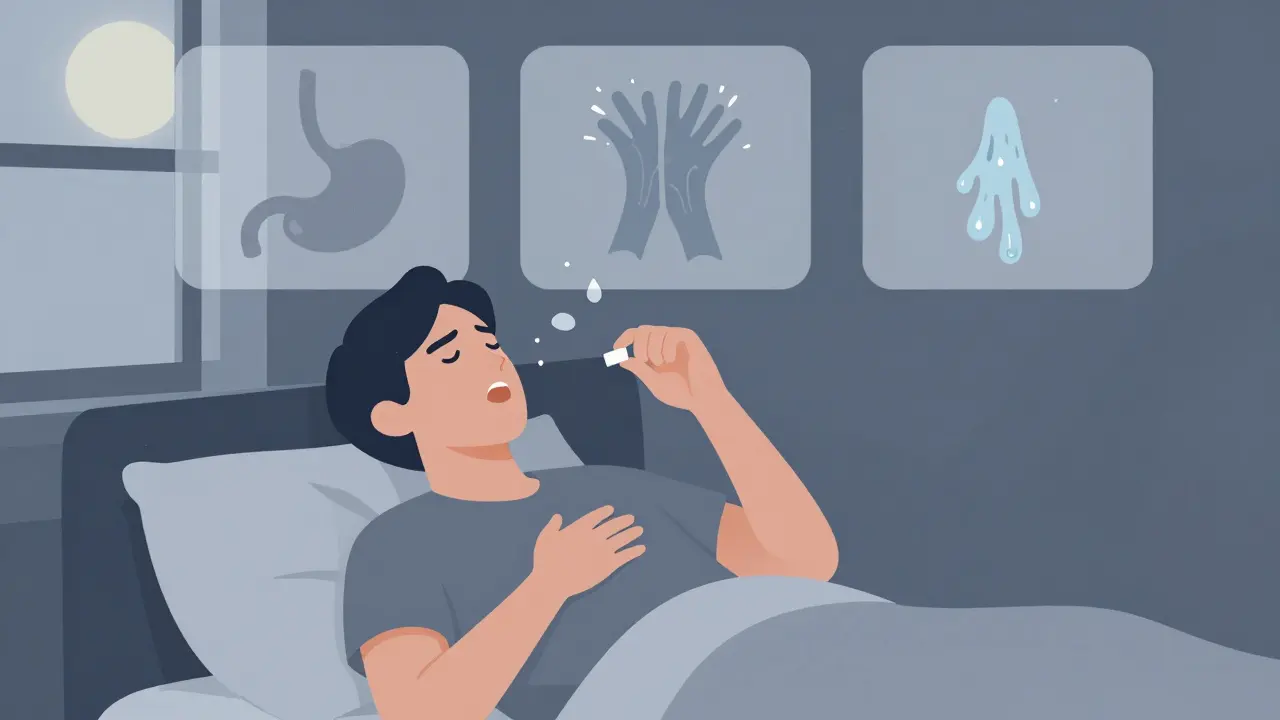
If you’ve been coughing for more than eight weeks, you’re not alone. About 1 in 10 adults deal with a cough that just won’t go away. And most of the time, it’s not because of a cold or the flu. It’s because of three common but often overlooked conditions: GERD, asthma, and postnasal drip-now more accurately called upper airway cough syndrome. These three causes explain 80% to 95% of chronic cough cases in people who don’t smoke or take ACE inhibitors. Yet, many patients go through months-or even years-of misdiagnosis, unnecessary antibiotics, or unhelpful cough syrups before getting the right answer.
What Counts as a Chronic Cough?
A cough that lasts longer than eight weeks is considered chronic. This isn’t just a nuisance-it can disrupt sleep, cause rib pain, lead to urinary leakage, and even make you avoid social situations. The good news? The root causes are usually treatable. The bad news? They don’t always show up the way you’d expect.
For example, you might think GERD means heartburn. But up to half of people with GERD-related cough never feel acid in their chest. Their only symptom is a cough that gets worse after meals, when lying down, or in the morning. Asthma doesn’t always mean wheezing. In fact, 24% to 29% of chronic cough cases are caused by cough variant asthma, where the cough is the only sign. And postnasal drip? It’s not just about mucus dripping down your throat. It’s about nerve sensitivity in the upper airway, triggered by inflammation from allergies, sinus infections, or even cold air.
The Three Big Culprits: A Closer Look
1. Upper Airway Cough Syndrome (Postnasal Drip)
This is the most common cause of chronic cough, responsible for 38% to 62% of cases. The old term “postnasal drip” made it sound like mucus was simply dripping down and irritating the throat. But newer research shows it’s more complex. The real issue is cough reflex hypersensitivity-the nerves in your throat and airway become overly sensitive because of inflammation from allergies, sinusitis, or environmental irritants.
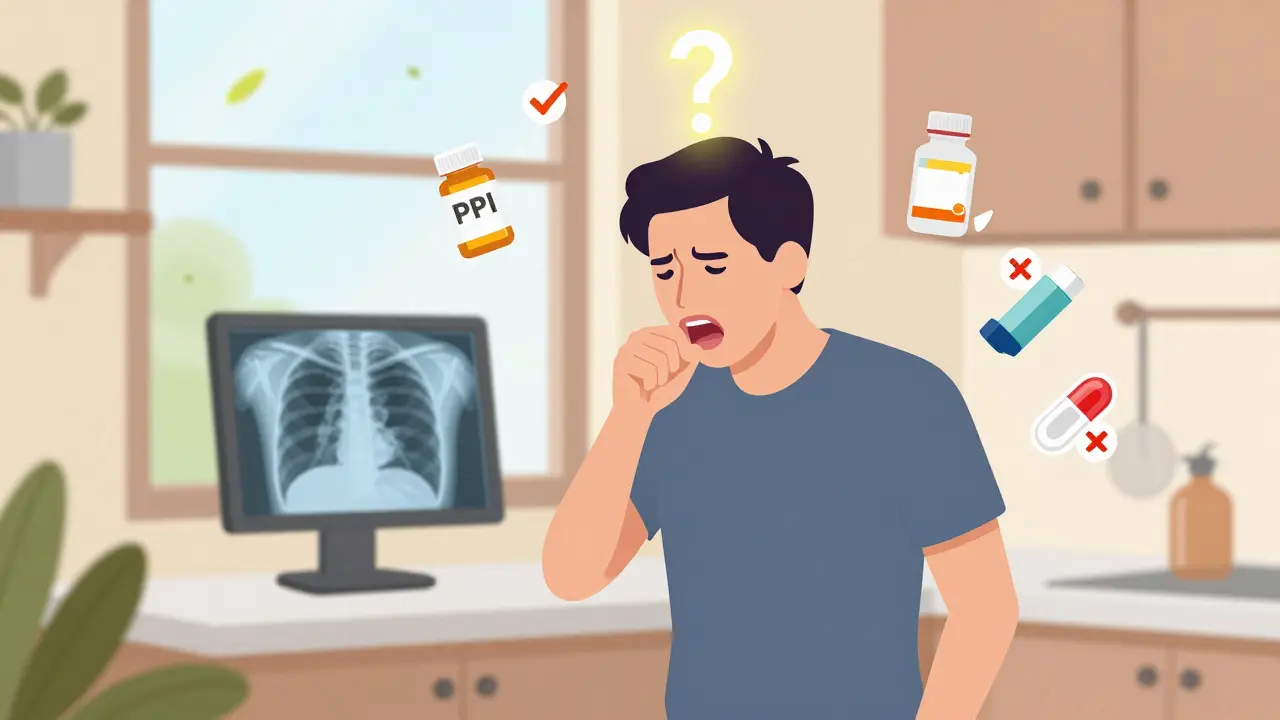
How do you know if this is your problem? Try a simple test. Take a first-generation antihistamine like diphenhydramine (Benadryl) plus a decongestant like pseudoephedrine for two to three weeks. No prescription needed. If your cough improves by 70% to 90%, this was likely the cause. Most people notice a difference within 48 to 72 hours. If not, it’s probably not this.
Important note: Second-generation antihistamines (like loratadine or cetirizine) don’t work as well for this type of cough. They’re great for runny noses, but they don’t calm the nerve sensitivity that triggers chronic cough.
2. Asthma (Especially Cough Variant Asthma)
Asthma doesn’t always come with wheezing or shortness of breath. In cough variant asthma, the only symptom is a dry, hacking cough-often worse at night, after exercise, or when exposed to cold air or strong smells. It accounts for about a quarter of all chronic cough cases.
Diagnosis starts with spirometry. If it’s normal, that doesn’t rule out asthma. The next step is a bronchial challenge test using methacholine. A positive result means your airways are hyperreactive. But here’s the catch: this test isn’t perfect. It has a 95% negative predictive value (if it’s negative, you probably don’t have asthma), but only a 50% positive predictive value (if it’s positive, it might still be something else).
A simpler approach? Try an inhaled bronchodilator (like albuterol) for two weeks. If your cough improves, it’s likely asthma. Some doctors will skip testing and go straight to a low-dose inhaled corticosteroid (like fluticasone) for four weeks. If the cough fades, you’ve got your answer.
3. GERD (Gastroesophageal Reflux Disease)
GERD is responsible for 21% to 41% of chronic cough cases. But here’s the twist: only about half of these patients have heartburn. The rest have “silent reflux”-stomach acid or bile rises into the esophagus and irritates the throat or larynx, triggering a cough reflex. This is especially common after eating, when lying down, or in the early morning.
Traditional treatment used to be high-dose proton pump inhibitors (PPIs) like omeprazole or esomeprazole, taken twice daily for four to eight weeks. But new guidelines from the American College of Gastroenterology (March 2024) warn that this approach is flawed. Why? Because 35% to 40% of people improve on placebo. That means a lot of folks are being treated for GERD when it’s not the real issue.
Now, doctors are moving toward objective testing. A 24-hour pH impedance monitor can track acid and non-acid reflux over a full day. But it’s expensive and not always covered by insurance. A simpler, low-tech option? The Hull Airway Reflux Questionnaire (HARQ). If your score is over 13, there’s an 80% chance laryngopharyngeal reflux is contributing to your cough.
Even if you’re not sure, a two-week trial of PPIs taken before breakfast and dinner is still a reasonable first step. But don’t keep taking them for months without seeing improvement. If no change after four to eight weeks, it’s probably not GERD.
What Comes First? The Diagnostic Algorithm
There’s a smart order to this. You don’t start with a CT scan or an endoscopy. You start with the basics.
- Rule out red flags: Weight loss, coughing up blood, fever, night sweats, or abnormal lung sounds on exam? These need immediate imaging and specialist referral-could be cancer, TB, or another serious condition.
- Stop ACE inhibitors: If you’re on lisinopril, enalapril, or any ACE inhibitor, switch to an ARB (like losartan). Cough from these drugs usually clears up in 1 to 4 weeks.
- Do a chest X-ray: Normal? Good. Abnormal? That changes everything. You might need a CT scan or bronchoscopy.
- Get spirometry: This checks for asthma or COPD. If it’s normal, you still might have cough variant asthma.
- Start therapeutic trials: In order of likelihood and response rate: first UACS (antihistamine + decongestant), then asthma (inhaled corticosteroid or bronchodilator), then GERD (PPI).
Each trial takes time. UACS: 1 to 2 weeks. Asthma: 2 to 4 weeks. GERD: 4 to 8 weeks. Patience matters. Rushing to expensive tests too early leads to false positives and wasted money.

What If Nothing Works?
Even after ruling out the big three, 10% to 30% of people still have a chronic cough. That’s when you look at the less common causes:
- Chronic refractory cough (CRC): A diagnosis of exclusion. The cough reflex is hypersensitive for no clear reason. New drugs like gefapixant (approved in 2022) and camlipixant (under FDA review) target this by blocking nerve signals.
- Pertussis (whooping cough): Rare in adults, but possible. Needs a special nasal swab-regular tests miss it.
- Chronic aspiration: Especially in older adults or those with swallowing issues. Might need a swallowing study.
- Environmental triggers: Dust, mold, perfumes, or even air conditioning can trigger cough in sensitive people.
Artificial intelligence is starting to help here. A 2023 study in Lancet Digital Health showed AI could distinguish asthma-related cough from GERD-related cough by sound alone-with 87% accuracy. While not ready for prime time yet, it’s a sign of where things are headed.
What Not to Do
Don’t take antibiotics unless you have signs of infection. Less than 5% of chronic cough cases are bacterial. Don’t keep buying cough syrup. Most don’t work for chronic cough. Don’t skip the chest X-ray just because you think it’s “just allergies.” And don’t ignore the fact that your cough might be linked to something you eat, breathe, or take as a pill.
When to See a Specialist
You don’t need a pulmonologist for every cough. But if:
- It’s been over 8 weeks with no improvement,
- Standard treatments didn’t help,
- You have red flag symptoms,
- Or you’re on an ACE inhibitor and the cough started after starting it,
then it’s time to see someone who treats chronic cough regularly. Family doctors get it right 80% of the time after 3 to 6 months of experience. But specialists have seen hundreds of cases-and know which tests to order, and which to skip.
Bottom Line
Chronic cough isn’t a mystery. It’s a puzzle with three main pieces: upper airway cough syndrome, asthma, and GERD. The key is not to overtest, but to test smart. Start with history, a chest X-ray, spirometry, and then follow a step-by-step treatment trial. Most people find relief within weeks-not years. And when the usual suspects are ruled out, newer tools and treatments are finally emerging to help those left behind.
Can GERD cause a cough without heartburn?
Yes. Up to half of people with GERD-related cough don’t have classic heartburn. This is called "silent reflux." The acid or bile rises into the throat and irritates the nerves that trigger coughing, without causing burning in the chest. A score above 13 on the Hull Airway Reflux Questionnaire (HARQ) suggests this is likely.
Is a chest X-ray necessary for chronic cough?
Yes, unless there’s a clear cause like recent illness or known asthma. A normal chest X-ray rules out serious conditions like lung cancer, tuberculosis, or bronchiectasis. A CT scan is not needed if the X-ray is normal-it exposes you to radiation without improving diagnosis in most cases.
Why do antihistamines help postnasal drip cough but not all allergies?
Second-generation antihistamines (like Claritin or Zyrtec) help with runny noses and sneezing, but they don’t reduce the nerve sensitivity in the throat that causes chronic cough. First-generation antihistamines (like Benadryl) have stronger drying effects on the upper airway and help calm the cough reflex. That’s why they’re preferred for this specific type of cough.
Can asthma cause cough without wheezing?
Absolutely. This is called cough variant asthma, and it makes up 24% to 29% of chronic cough cases. The airways are inflamed and hyperreactive, but they don’t narrow enough to cause wheezing. The only symptom is a dry, persistent cough-often worse at night or after exercise. A trial of inhaled corticosteroids or bronchodilators can confirm the diagnosis.
How long should I try each treatment before giving up?
For upper airway cough syndrome: 1 to 2 weeks. For asthma: 2 to 4 weeks. For GERD: 4 to 8 weeks. Don’t switch treatments too soon. Improvement is often gradual. If you see no change after the full trial period, move to the next step. If you improve, keep the treatment going and talk to your doctor about long-term management.
Alexander Erb
March 13, 2026 AT 03:56Just wanted to say this post saved my sanity. Had a cough for 14 months, tried every syrup, antibiotic, and home remedy under the sun. Then I tried the Benadryl + pseudoephedrine combo like you said-boom, 80% better in 72 hours. Turns out it was UACS from seasonal allergies I didn’t even know I had. No more midnight coughing fits. Thank you.
Donnie DeMarco
March 14, 2026 AT 10:25bro this is the most useful medical post ive ever read like i thought i was just allergic to everything but turns out i just needed benadryl and a decongestant?? mind blown. also why does no one talk about this??
LiV Beau
March 15, 2026 AT 12:37This is so helpful!! 🙌 I’ve been dealing with this for years and felt so dismissed by doctors. I tried the PPIs for 8 weeks and nothing-then I switched to the antihistamine/decongestant combo and now I can sleep through the night! I’m crying happy tears. Also-can we please make this a viral thread? So many people need this info. 😭❤️
Adam Kleinberg
March 16, 2026 AT 14:08Denise Jordan
March 18, 2026 AT 04:46Gene Forte
March 19, 2026 AT 03:05Thank you for this clear, evidence-based guide. Chronic cough is one of those conditions that falls into the cracks of modern medicine-too vague for specialists, too persistent for primary care. Your step-by-step approach restores dignity to the patient. Patience, logic, and humility are the real treatments here. Well done.
Chris Bird
March 19, 2026 AT 18:33Tom Bolt
March 20, 2026 AT 14:23There is a comma missing after ‘after meals’ in paragraph 3. Also, ‘non-acid reflux’ should be hyphenated as ‘nonacid reflux’ per AMA style. And you say ‘the cough reflex’-technically, it’s ‘the cough reflex arc.’ Precision matters. I’m not trying to be pedantic. I’m trying to save lives.
Shourya Tanay
March 21, 2026 AT 20:03As someone who works in respiratory medicine in Mumbai, I appreciate the structured algorithm. However, in low-resource settings, spirometry and pH impedance are often inaccessible. We rely heavily on clinical history and therapeutic trials-your approach aligns with our pragmatic reality. One addition: in areas with high TB prevalence, a chest X-ray isn’t optional-it’s mandatory before any trial. Thank you for validating our workflow.
Kenneth Zieden-Weber
March 23, 2026 AT 05:48So let me get this straight… you’re telling me that after spending $3,000 on tests, going to three specialists, and trying three different inhalers… the solution was a $5 bottle of Benadryl I had in my medicine cabinet since 2018? Wow. Just… wow. I’m not mad. I’m impressed. And slightly offended that I didn’t think of it. 😏