Asthma and COPD Inhalers: How to Use Them Right for Better Results
 Jan, 14 2026
Why Your Inhaler Isn’t Working (Even If You Think You’re Using It Right)
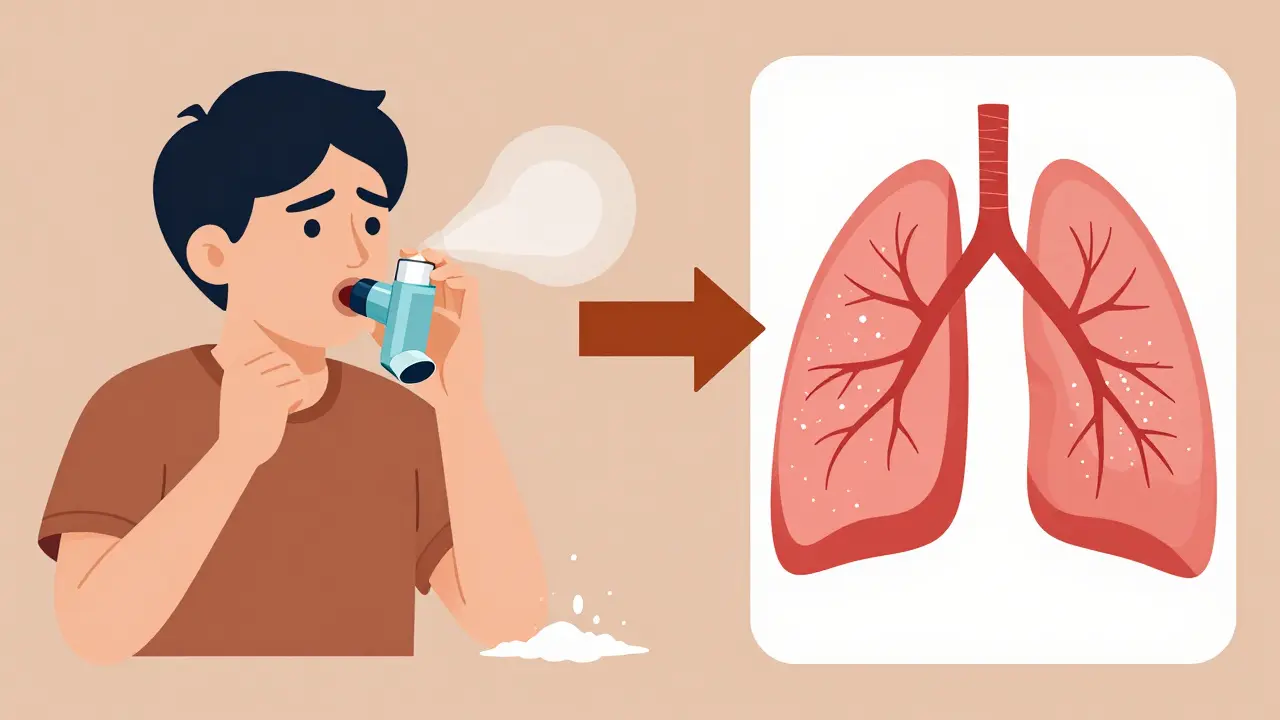
You’ve been using your inhaler for years. You shake it, press it, breathe in - seems simple enough. But if your symptoms aren’t improving, or you’re still wheezing after a puff, the problem might not be your medication. It’s your technique. Studies show that 70 to 90% of people with asthma or COPD use their inhalers incorrectly. That means most of the medicine isn’t even getting into your lungs. Instead, it’s stuck in your mouth, throat, or wasted in the air. The result? Poor control, more flare-ups, and unnecessary trips to the ER.
The good news? Fixing your technique can double or even triple how much medicine reaches your lungs. You don’t need a new device. You don’t need more pills. You just need to learn how to use what you already have - the right way.
The Three Main Types of Inhalers (And How They Work Differently)
Not all inhalers are the same. There are three main types, and each requires a different approach. Using the wrong method for your device can make it useless.
- Metered-Dose Inhalers (MDIs) - These are the most common. They look like small spray cans. You press the top while breathing in. But timing matters: you have to press and inhale at the exact same moment. If you press too early or too late, the medicine shoots into your mouth instead of your lungs. Common brands include ProAir HFA and Ventolin HFA.
- Dry Powder Inhalers (DPIs) - These don’t use spray. Instead, you breathe in hard and fast to pull the powdered medicine into your lungs. Devices like Diskus, Turbuhaler, and Ellipta fall into this category. But if you’re too weak or too slow - common in advanced COPD - the powder won’t get pulled in properly. No puffing required, just strong, fast breaths.
- Soft Mist Inhalers - These are newer and less common. Respimat is the main one. It releases a slow, gentle mist that you breathe in over 1.5 seconds. Easier to coordinate than MDIs, but still requires steady, deep inhalation. No hand-breath timing needed, which helps people with shaky hands or trouble coordinating.
Here’s the catch: you can’t swap techniques between types. Using an MDI breathing technique on a DPI? That won’t work. Trying to puff hard into a Respimat? You’ll waste half the dose. Always check what type you have - the packaging and your doctor should tell you.
How to Use an MDI Correctly (Step-by-Step)
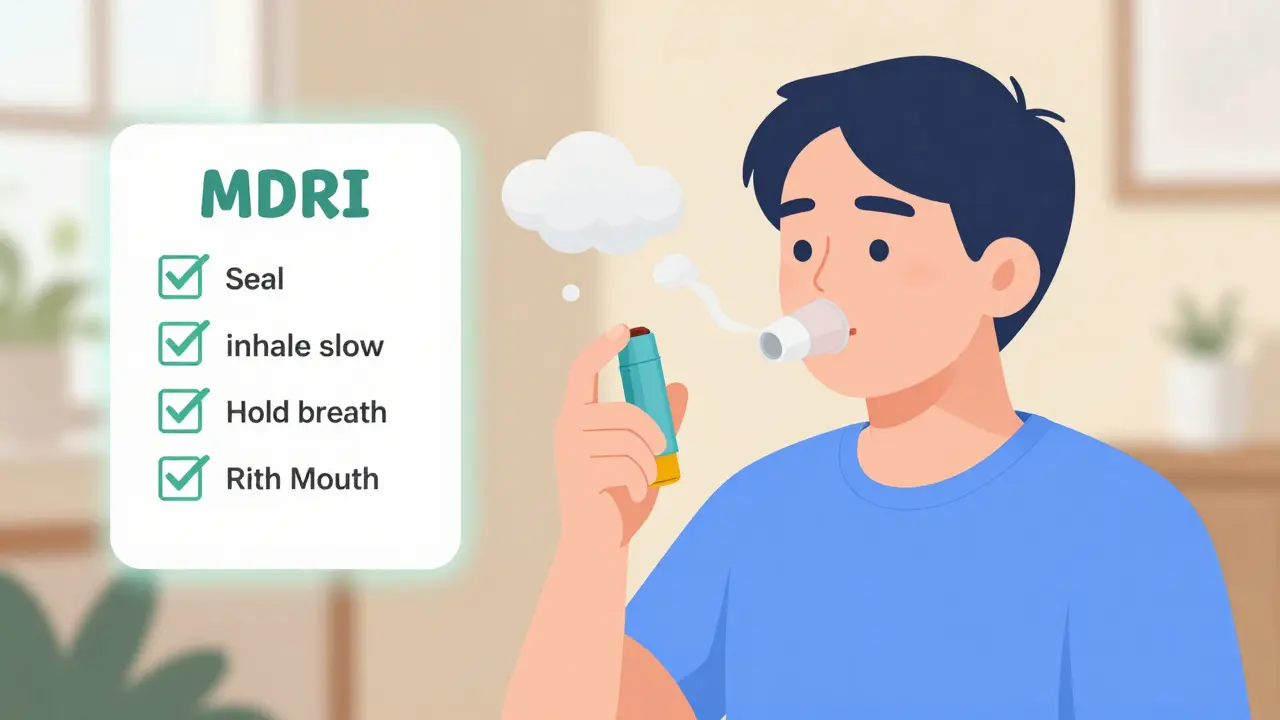
If you’re using a metered-dose inhaler, here’s the correct way - no shortcuts. This method works best with a spacer (more on that later), but even without one, these steps make a big difference.
- Remove the cap and check for anything blocking the mouthpiece.
- Shake the inhaler for 5 seconds. If you skip this, the medicine settles and won’t come out evenly.
- Breathe out fully - not into the inhaler, just away from it. Empty your lungs before you inhale the medicine.
- Place the mouthpiece in your mouth. Seal your lips tightly around it. Don’t bite it or let air leak out.
- Press the canister and inhale slowly for 3 to 5 seconds. This is the key. Pressing and breathing at the same time is hard. If you’re struggling, use a spacer.
- Hold your breath for 10 seconds. This lets the medicine settle in your airways. If you exhale right away, most of it just leaves your body.
- Breathe out slowly through your nose.
- Wait 60 seconds before taking another puff. Rushing puffs means the medicine doesn’t have time to spread properly.
Pro tip: If you hear a whistling sound when you inhale, you’re breathing too fast. Slow it down. If you taste the medicine in your mouth, you’re not inhaling deeply enough.
How to Use a Dry Powder Inhaler (DPI) the Right Way
DPIs are trickier than they look. No shaking. No pressing. Just breathe - but you have to breathe hard.
- Load the dose - Follow your device’s instructions. For Diskus, slide the lever. For Turbuhaler, twist the base. Never remove the capsule - it’s designed to stay inside.
- Breathe out fully - Away from the device. Don’t blow into it.
- Place the mouthpiece in your mouth and seal your lips tightly.
- Inhale quickly and deeply - Like you’re trying to suck a thick milkshake through a straw. This is the most common mistake: people breathe too slowly. You need 60 to 90 liters per minute of airflow to lift the powder.
- Hold your breath for 10 seconds - Same as with MDIs. Let the powder settle.
- Breathe out slowly - Through your nose.
Important: DPIs don’t work well if you’re very weak or have severe COPD. If you’re struggling to inhale hard enough, talk to your doctor. You might need an MDI with a spacer instead.
Why Spacers Are a Game-Changer (Especially for MDIs)
A spacer is a plastic tube that attaches to your MDI. It holds the medicine after you press it, so you don’t have to coordinate pressing and breathing at the same time. You press, then breathe in slowly from the spacer.
Studies show spacers boost lung delivery by 70 to 100%. That’s not a small improvement - it’s the difference between barely working and working well. They also reduce throat irritation and the risk of oral thrush.
Here’s how to use one:
- Attach the spacer to your MDI.
- Shake the inhaler.
- Press the canister once.
- Breathe in slowly through your mouth over 3 to 5 seconds.
- Hold your breath for 10 seconds.
- Breathe out.
Spacers are recommended for everyone using MDIs - especially children, older adults, and anyone who struggles with timing. They’re cheap, reusable, and often covered by insurance. If you’re not using one, ask your doctor for one today.
Big Mistakes Everyone Makes (And How to Avoid Them)
Even after training, people keep making the same errors. Here are the top five:
- Not shaking the inhaler - 45% of users skip this. The medicine settles at the bottom. You get inconsistent doses.
- Exhaling into the device - Blowing air into the mouthpiece before inhaling clogs DPIs and messes up MDI spray patterns.
- Not holding your breath - 63% of people exhale right after inhaling. You lose up to 50% of the medicine.
- Using multiple inhalers without training - Switching between MDIs and DPIs without learning both techniques causes confusion. One study found this cuts effectiveness by 35-50%.
- Forgetting to rinse your mouth - If you use corticosteroids (like fluticasone or budesonide), rinse with water and spit after each use. It cuts the risk of oral thrush by 75%.
One more thing: never store your inhaler in the bathroom or in direct sunlight. Heat above 30°C (86°F) reduces potency by 15-20%. Keep it at room temperature.
What to Do If Your Inhaler Still Doesn’t Work
If you’re doing everything right - shaking, holding your breath, using a spacer - and you’re still having symptoms, it’s time to talk to your doctor. Three things could be going on:
- Your device doesn’t match your needs - If you’re elderly or have weak lungs, a DPI might be too hard to use. Switch to an MDI with a spacer.
- You’re on the wrong medication - Maybe you need a different dose, or a combination inhaler. Don’t adjust it yourself.
- You have another condition - Acid reflux, heart issues, or anxiety can mimic asthma or COPD symptoms. Your doctor should check for these.
Don’t assume it’s just “your lungs getting worse.” Often, it’s just technique. Ask your doctor to watch you use your inhaler - right now, during your visit. Many providers skip this step. But it’s one of the most important parts of your care.
Smart Inhalers Are Coming - But Technique Still Matters
There’s new tech: inhalers with sensors that track when and how you use them. The FDA approved the first one in 2021. These can send alerts to your phone if you miss a dose or inhale too fast. Some even give feedback on your technique.
But here’s the truth: even the smartest inhaler won’t help if you don’t know how to use it. The sensor can tell you you’re breathing wrong - but it can’t fix your technique. That still requires learning, practice, and feedback from a professional.
By 2025, 40% of inhalers may have digital features. But the core rules haven’t changed: shake, breathe slow, hold your breath, rinse your mouth. Technology helps - but it doesn’t replace knowledge.
Final Checklist: Are You Using Your Inhaler Right?
Before your next doctor visit, run through this:
- Do I know what type of inhaler I have? (MDI, DPI, or soft mist?)
- Do I shake my MDI before every puff?
- Do I breathe out fully before inhaling?
- Do I seal my lips tightly around the mouthpiece?
- Do I press and inhale at the same time (for MDIs)?
- Do I breathe in fast and hard (for DPIs)?
- Do I hold my breath for 10 seconds after each puff?
- Do I wait 60 seconds between puffs?
- Do I rinse my mouth after using steroid inhalers?
- Do I store my inhaler at room temperature?
If you answered “no” to any of these, you’re not getting the full benefit. Don’t wait for your next appointment. Watch a video from the American Lung Association or the Global Initiative for Asthma. Practice in front of a mirror. Ask a family member to watch you. You’ve got this.
Can I use a spacer with a dry powder inhaler?
No. Spacers are only for metered-dose inhalers (MDIs). Using a spacer with a dry powder inhaler (DPI) blocks the airflow needed to lift the powder, reducing medicine delivery by 50-70%. Always use the device as designed - spacers and DPIs are not compatible.
Why does my inhaler sometimes taste bitter?
A bitter taste means the medicine is landing in your mouth or throat instead of your lungs. This happens when you don’t inhale deeply enough, breathe too fast, or don’t hold your breath after inhaling. Using a spacer with an MDI can help. Rinsing your mouth after use also reduces bitterness and prevents oral thrush.
Is it okay to use someone else’s inhaler in an emergency?
Only in a life-threatening situation, and only if it’s the same type of medication (like albuterol). But it’s risky. Inhalers are prescribed for specific doses and conditions. Using the wrong one could worsen symptoms or cause side effects. Always carry your own rescue inhaler. If you’re sharing, you’re not prepared.
How often should I clean my inhaler?
Clean the mouthpiece of your MDI at least once a week. Remove the metal canister, rinse the plastic cap and mouthpiece with warm water, and let it air-dry completely. Never wash the metal part or put it in the dishwasher. For DPIs, wipe the mouthpiece with a dry cloth - never use water, as moisture can clump the powder.
Do I still need my inhaler if I feel fine?
Yes - especially if it’s a controller inhaler (like one with corticosteroids). These aren’t for quick relief. They reduce inflammation over time. Skipping doses, even when you feel good, lets inflammation build back up. That’s when flare-ups happen. Use your controller daily, as prescribed, even on symptom-free days.
Next Steps: What to Do Right Now
Don’t wait for your next appointment. Take action today:
- Find out what type of inhaler you’re using - check the label or ask your pharmacist.
- Watch a 3-minute video from the American Lung Association on proper inhaler technique.
- Practice in front of a mirror. Do you see mist in your mouth? You’re not inhaling deep enough.
- If you’re using an MDI, get a spacer - they’re inexpensive and often covered by insurance.
- Ask your doctor to watch you use your inhaler during your next visit. Don’t let them skip this step.
Proper inhaler use isn’t complicated. But it’s easy to get wrong. And the cost of getting it wrong? More hospital visits, more missed work, more lost breath. Fix your technique - and you might just breathe easier for the first time in years.
ellen adamina
January 15, 2026 AT 10:13Diane Hendriks
January 15, 2026 AT 19:29Nishant Garg
January 15, 2026 AT 20:06Tom Doan
January 16, 2026 AT 15:05Sohan Jindal
January 17, 2026 AT 16:33Frank Geurts
January 18, 2026 AT 08:48Annie Choi
January 19, 2026 AT 20:55Arjun Seth
January 19, 2026 AT 21:56Mike Berrange
January 20, 2026 AT 04:47Amy Vickberg
January 21, 2026 AT 10:17Ayush Pareek
January 23, 2026 AT 02:54Nilesh Khedekar
January 23, 2026 AT 13:22Jaspreet Kaur Chana
January 23, 2026 AT 13:58