Asthma Action Plans: How to Build Your Personalized Management Strategy
 Dec, 27 2025
When your asthma feels like a ticking clock, you need more than just an inhaler. You need a clear, step-by-step plan that tells you exactly what to do - before things get dangerous. That’s where an asthma action plan comes in. It’s not a suggestion. It’s a lifeline. And if you or someone you care about has asthma, not having one means flying blind in a storm you can’t see coming.
What Exactly Is an Asthma Action Plan?
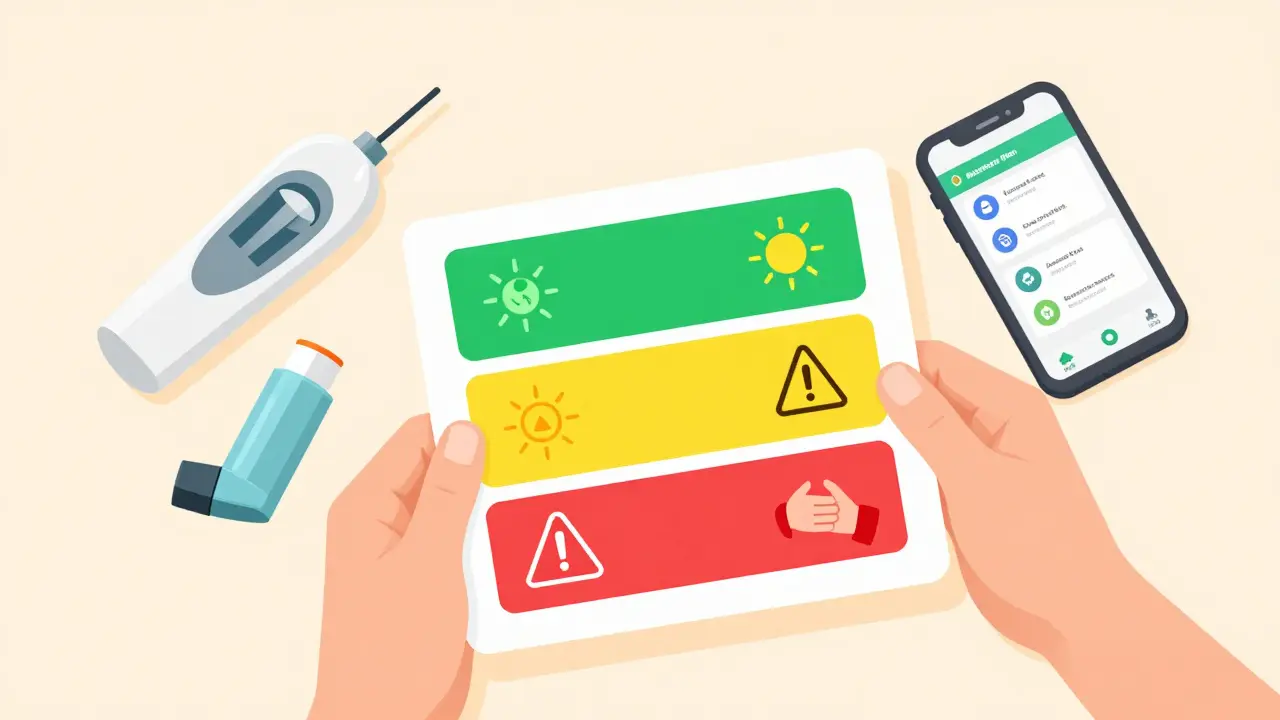
An asthma action plan is a written, personalized guide that turns vague symptoms into clear actions. It doesn’t just say “take your meds.” It tells you: When your breathing feels off, here’s what to do. When it gets worse, here’s what to do next. And when it’s an emergency, here’s how to react. It’s built around three simple zones - green, yellow, and red - like a traffic light for your lungs.This isn’t something your doctor hands you once and forgets. It’s a living document. It changes as your asthma changes. Maybe your triggers shift with the seasons. Maybe your meds need adjusting. Your plan should too.
The National Heart, Lung, and Blood Institute (NHLBI) has been setting the standard since 2007, and their updated 2020 guidelines say it plainly: Every person with asthma should have a written asthma action plan. Yet, only about 30% of people actually use one. That’s not just a gap - it’s a risk.
The Three Zones: Green, Yellow, Red
Think of your asthma like a car’s dashboard. Green means go. Yellow means slow down. Red means stop and call for help. Each zone has specific signs and actions tied to it.Green Zone - “Go”
This is your normal. You’re breathing easy. No coughing, no wheezing, no waking up at night. You can run, laugh, play, and sleep without thinking about your lungs. Your peak flow meter - a small device that measures how fast you can blow air out - reads 80% to 100% of your personal best. That’s the number you and your doctor figured out during a time when you felt completely well.
In the green zone, you don’t change anything. You keep taking your daily controller meds - usually inhaled corticosteroids like fluticasone (Flovent) or budesonide (Pulmicort) - exactly as prescribed. Skipping them because you feel fine is like turning off your smoke detector because there’s no fire right now. The fire might still be smoldering.
Yellow Zone - “Caution”
This is your warning light. You’re not in crisis yet, but your asthma is slipping. You might notice:
- Coughing more than usual, especially at night
- Wheezing when you breathe out
- Chest tightness or shortness of breath during normal activities
- Peak flow readings between 50% and 79% of your personal best
When you hit yellow, you don’t panic. You act. Follow your plan:
- Use your rescue inhaler - usually albuterol (ProAir, Ventolin) - as directed. That’s typically 2-4 puffs every 4-6 hours.
- Keep taking your daily controller meds. Don’t stop them.
- Check your symptoms every hour. If they’re getting worse, don’t wait.
- If you’re not back to green within 24 hours, call your doctor.
Many people ignore yellow. They think, “I’ve felt like this before - it’ll pass.” But that’s how minor flare-ups turn into ER visits. The yellow zone is your chance to stop it before it escalates.
Red Zone - “Danger”
This is a medical emergency. Your lungs are struggling hard. Signs include:
- Severe shortness of breath - you can’t speak in full sentences
- Peak flow below 50% of your personal best
- Lips or fingernails turning blue
- Rescue inhaler isn’t helping after several doses
- Feeling like you’re suffocating
If you’re in the red zone, you don’t wait. You don’t call your doctor first. You call 911 or go to the nearest emergency room. Take your rescue inhaler while you’re waiting for help. But don’t delay. This is when seconds matter.
Your Personal Best: The Key Number You Might Be Missing
Most asthma action plans use peak flow readings to define the zones. But here’s the problem: 41% of people who have a plan still don’t know their personal best. Why? Because their doctor never helped them measure it.
Your personal best isn’t a generic number. It’s the highest peak flow reading you can consistently achieve over 2-4 weeks when your asthma is under control. You measure it twice a day - morning and night - for at least two weeks. Write down every number. Then find the highest one. That’s your baseline.
Without this number, your plan is useless. You can’t tell if you’re in the green, yellow, or red if you don’t know what 80% or 50% looks like for you. If your doctor hasn’t helped you set this, ask for it at your next visit. Bring your peak flow meter. Ask them to watch you use it. Make sure the device is calibrated - they should check it every year.
Why Most People Fail to Use Their Plan
It’s not that people don’t want to manage their asthma. It’s that the plan isn’t practical.
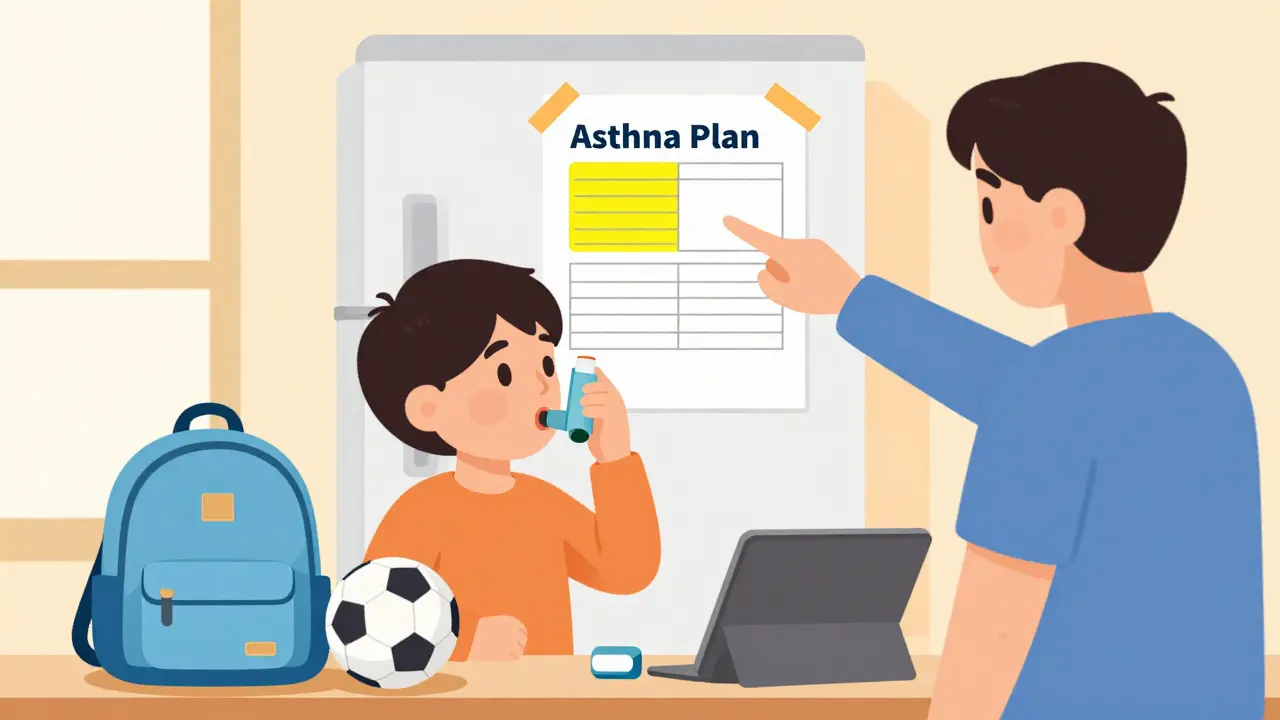
Some forget where they put it. One survey found 41% of people don’t follow their plan because they “can’t find it.” That’s why keeping it visible matters - taped to the fridge, saved on your phone, printed and carried in your wallet.
Others don’t understand it. If your plan is written in medical jargon - “increase in bronchial hyperresponsiveness” - it’s useless. It needs to be plain language. “When you cough at night, take two puffs of your blue inhaler.”
And then there’s the color issue. About 8% of men have trouble distinguishing red and green. If your plan only uses colors, you’re at risk. Ask your doctor for a version with symbols - circles, stars, or numbers - instead of colors. The Allergy Asthma Network offers free templates with this option.
Who Else Needs to Know About Your Plan?
Your asthma doesn’t stop at home. It follows you to school, work, the gym, and your kid’s soccer game.
If you have children with asthma, share their plan with:
- Teachers and school nurses
- Coaches and after-school program staff
- Parents of their friends - especially if they’re staying over
For adults, give a copy to:
- Your workplace HR or safety officer
- Your gym trainer
- Your partner or close family members
Dr. Catherine Fuller, an allergist in California, says: “If your child has asthma, you should share their action plan with their school, coaches, and parents of friends.” That’s not optional. That’s how you prevent a crisis when you’re not there.
Digital Tools Are Making Plans Smarter
Your plan doesn’t have to be on paper. The Asthma and Allergy Foundation of America has a free app that tracks symptoms, reminds you to take meds, and even syncs with smart inhalers like Propeller Health. These devices record when and how you use your inhaler - and send data to your phone.
A 2022 study found that people using smart inhalers with digital plans improved their adherence by 35%. Why? Because it turns guesswork into data. You can see patterns: “Every time I mow the lawn, my peak flow drops 20%.” That’s insight you can’t get from memory alone.
Even better, the NHLBI updated their templates in March 2023 to work with these digital tools. You can now download a plan that automatically updates based on your inhaler use and symptom logs.

When and How to Update Your Plan
Your plan should be reviewed at every doctor’s visit - not just when you’re having problems. Seasonal changes matter. If pollen triggers your asthma, your plan might need tweaks in spring. If cold air is your enemy, adjust it before winter hits.
Also update it if:
- Your symptoms change - you’re coughing more, waking up more often
- Your meds change - new dose, new type, new inhaler
- You’ve had a flare-up that required an ER visit
- You’re not in the green zone for more than a week
Don’t wait for your annual checkup. If something feels off, call your doctor. Your plan is meant to be flexible. It’s not a one-time form you sign and file away.
Real Stories, Real Results
One Reddit user, ‘WheezingWarrior87,’ shared how their daughter’s plan saved them from an ER trip last winter. The girl started coughing at night - yellow zone. They gave her albuterol, followed the plan, and by morning, she was back to green.
Another user, ‘BreathlessInBoston,’ said their plan was useless because they never got their personal best peak flow number. They didn’t know what 50% looked like. They were flying blind.
And Sarah J., 32, realized she’d been living in the yellow zone for months. She thought her wheezing was “normal.” Her plan helped her see the truth: it wasn’t. She got her meds adjusted - and finally breathed easy.
Those aren’t outliers. They’re proof that a plan works - if you use it.
Getting Started: What to Do Today
If you don’t have an asthma action plan:
- Call your doctor. Ask for one. Don’t wait.
- Bring your peak flow meter. Ask them to help you find your personal best.
- Make sure the plan uses simple language and includes clear steps for green, yellow, and red zones.
- Ask for a color-free version if you have trouble seeing red/green.
- Print two copies. Tape one to your fridge. Keep one in your bag.
- Share it with anyone who cares for you - school, work, family.
If you already have one:
- Check if it’s outdated. Has your medication changed?
- Do you know your personal best? If not, measure it now.
- Is it easy to find? If not, move it where you’ll see it daily.
- Have you shared it with your child’s school or your partner?
Asthma doesn’t wait for convenience. Neither should your plan.
What should I do if I don’t have a peak flow meter?
You can still create an effective asthma action plan without one. Your doctor can help you identify symptoms that signal each zone - like nighttime coughing, wheezing, or reduced activity. Focus on how you feel and what triggers your symptoms. But if you can, get a peak flow meter. It’s inexpensive, easy to use, and gives you objective data instead of guesswork. Most pharmacies sell them for under $30.
Can I use my asthma action plan for my child?
Yes - and you should. Children often can’t recognize or describe worsening symptoms. A written plan helps caregivers, teachers, and babysitters respond quickly. Make sure the plan is simple, uses pictures if needed, and includes emergency contacts. Share it with everyone who looks after your child, including school nurses and coaches.
What if my doctor won’t give me a written plan?
You have the right to one. The NHLBI guidelines say every asthma patient should have a written action plan. If your doctor refuses, ask why. If they say it’s not necessary, get a second opinion. You can also download free, official templates from the NHLBI or Asthma and Allergy Foundation of America websites. Print one, fill it out with your symptoms and meds, and bring it to your next appointment to discuss.
How often should I review my asthma action plan?
Review it at every asthma-related visit - that’s usually every 3 to 6 months. Also review it after any flare-up, if your symptoms change, or when seasons shift. If you’ve been in the yellow zone more than once in a month, it’s time to adjust your controller meds. Don’t wait for your yearly checkup. Your plan should evolve as your asthma does.
Are digital asthma plans better than paper ones?
They’re not necessarily better - but they’re more useful for some people. Digital plans with apps and smart inhalers help you track patterns, remind you to take meds, and show you data you might miss. But if you forget your phone or can’t use tech, a printed plan taped to your fridge works just as well. The best plan is the one you’ll actually use. Choose the format that fits your life.
If you’ve been living with asthma and not using a plan, you’re not alone. But you don’t have to stay that way. A simple, personalized action plan can mean the difference between a quiet night’s sleep and a hospital trip. It’s not magic. It’s just clear instructions - written for you, by you, with your doctor. Start today. Your lungs will thank you.
ANA MARIE VALENZUELA
December 28, 2025 AT 01:39And yes, if your doctor won't give you a written plan, fire them. It's not optional. It's standard of care. The NHLBI doesn't play games.
Bradly Draper
December 28, 2025 AT 05:51Thanks for writing this. I wish I'd seen it sooner.
Gran Badshah
December 29, 2025 AT 23:01Also, the color thing? Real problem. My cousin is red-green blind. His plan was useless until we changed it to symbols. Simple fix. Why don't doctors think of this?
Ellen-Cathryn Nash
December 31, 2025 AT 02:29And don’t even get me started on people who say, ‘I don’t need it because I feel fine.’ That’s like saying you don’t need a seatbelt because you haven’t crashed yet. Your lungs don’t care how ‘fine’ you feel. They only care about the numbers. The truth doesn’t care about your comfort zone.
Samantha Hobbs
December 31, 2025 AT 07:19sonam gupta
December 31, 2025 AT 22:17Teresa Marzo Lostalé
January 2, 2026 AT 13:00Also-smart inhalers? Game changer. I got one for my sister. Now she gets a little notification: ‘Hey, you missed your dose. Breathe easy, warrior.’ 😊❤️
Nicole Beasley
January 2, 2026 AT 14:34Julius Hader
January 3, 2026 AT 17:53