Acute Kidney Injury: Sudden Loss of Function and Recovery
 Mar, 4 2026
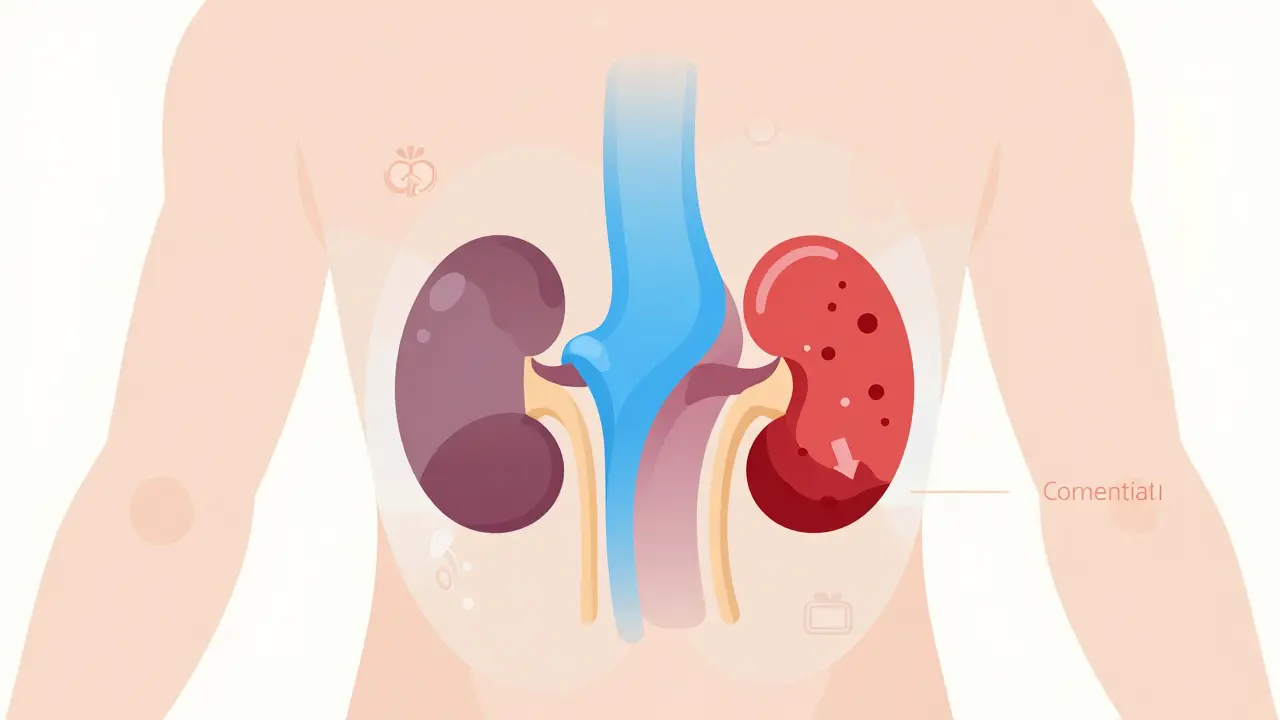
When your kidneys suddenly stop working like they should, it’s not just a lab result-it’s a medical emergency. Acute Kidney Injury (AKI) doesn’t come with warning signs most people recognize. You might feel tired, swollen, or just "off," but often, there’s no pain, no red flag-just a quiet, dangerous drop in function. And by the time you notice something’s wrong, the damage may already be underway. This isn’t rare. Every year, over 13 million people worldwide face AKI. In hospitals, it’s even more common: 1 in 3 ICU patients will develop it. The good news? If caught early, many people recover fully. The bad news? Miss it by a day, and the risks skyrocket.
What Exactly Is Acute Kidney Injury?
AKI used to be called acute renal failure, but that name was misleading. It made people think the kidneys had completely shut down. Now we know better. AKI is a spectrum. It can be a tiny dip in kidney function that’s barely noticeable-or a full-blown collapse that needs dialysis. The official definition? A rise in creatinine by 0.3 mg/dL in 48 hours, or a 50% jump from your baseline within a week. Or, if you’re making less than half a milliliter of urine per kilogram of body weight for six hours straight. These aren’t arbitrary numbers. They’re based on decades of research and real patient outcomes. Even small changes matter. Your kidneys filter about 120-150 quarts of blood every day. When they slow down, toxins build up fast. Fluid piles up. Electrolytes go haywire. And that’s when things turn dangerous.
How Do You Know You Have It?
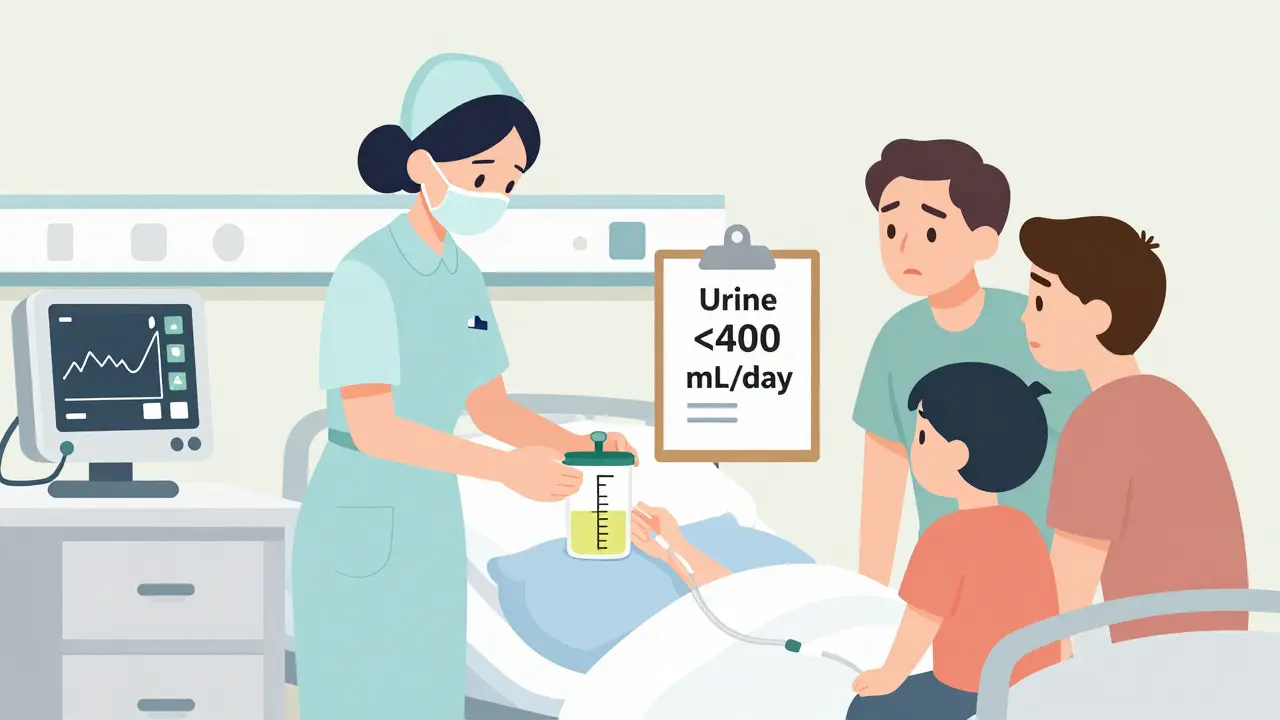
There’s no single symptom that screams "AKI." Some people have no symptoms at all. About 1 in 5 cases are found only because a routine blood test showed a weird creatinine level. But when symptoms do show up, they’re often subtle and easily missed. Reduced urine output is the classic sign-less than 400 mL a day. But here’s the twist: some people with serious kidney injury still pee normally. That’s especially true if there’s a blockage downstream, like a swollen prostate or a kidney stone pinching both ureters. Other signs? Swelling in the legs or ankles (68% of cases), shortness of breath (42% of hospitalized patients), nausea (58%), fatigue (75%), and confusion in older adults (33%). Chest pain? That could mean fluid is building up around the heart. Flank pain? That’s a red flag for internal kidney damage. If you’re in the hospital, especially after surgery or with an infection, doctors should be checking your creatinine and urine output every day. If they’re not, ask.
What Causes It? Three Main Ways
AKI doesn’t happen for no reason. It’s almost always triggered by one of three things:
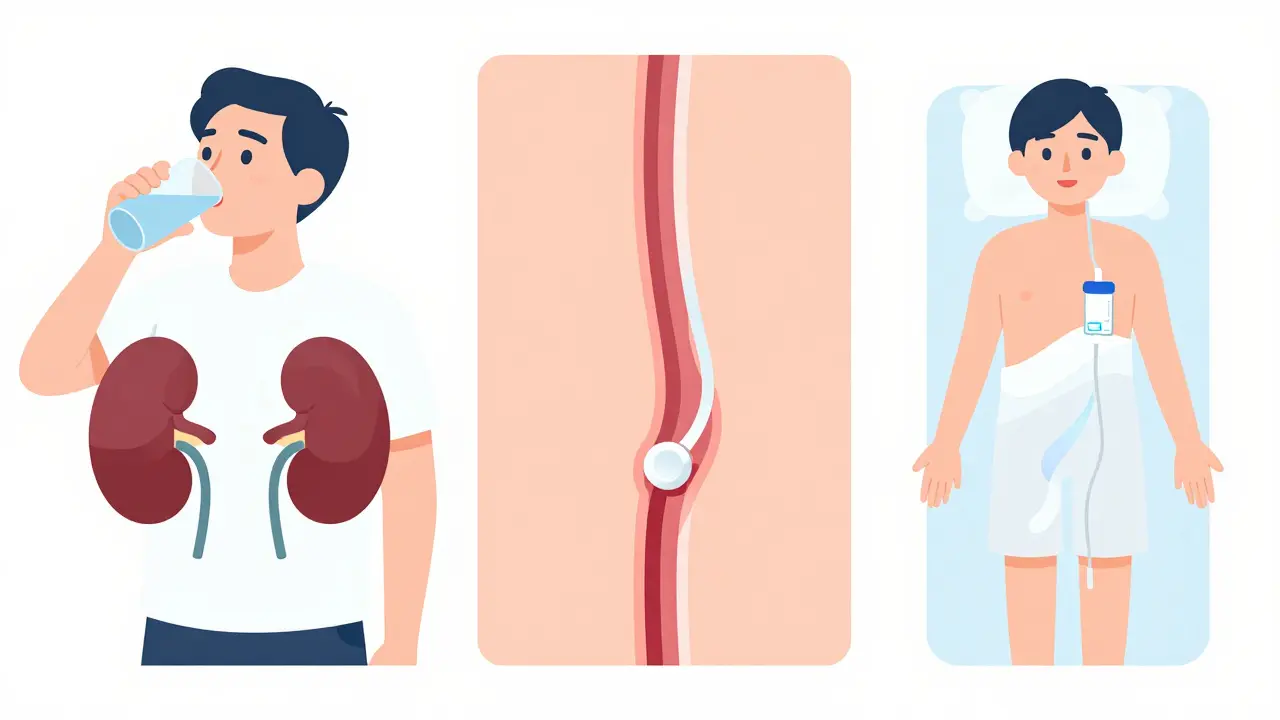
- Prerenal (60-70% of cases): Your kidneys aren’t getting enough blood. This is the most common cause. Think dehydration from vomiting or diarrhea, major blood loss, severe low blood pressure from infection (sepsis), or heart failure. The kidneys aren’t damaged-they’re just starving. Fix the blood flow, and they usually bounce back fast.
- Intrarenal (25-35%): The kidneys themselves are hurt. This is where things get serious. The most common culprit? Acute tubular necrosis (ATN), often from medications like antibiotics (aminoglycosides), contrast dye used in CT scans, or toxins from muscle breakdown after a crush injury. Other causes include glomerulonephritis (inflammation of the filtering units) or autoimmune diseases like lupus. This type takes longer to heal and sometimes leaves lasting damage.
- Postrenal (5-10%): Something is blocking urine from leaving the body. In men over 60, that’s often an enlarged prostate. In others, it’s kidney stones, tumors, or clots in the ureters. If both sides are blocked, urine backs up into the kidneys. Remove the blockage-fast-and kidney function often returns to normal.
Knowing which type you have changes everything. Giving fluids to someone with a blocked ureter? It won’t help-and might make things worse. Giving antibiotics to someone with sepsis? That’s life-saving. Diagnosis isn’t guesswork. Doctors look at your history, check your urine output, run blood tests (creatinine, BUN, sodium), and use a simple test called fractional excretion of sodium (FeNa). If it’s under 1%, it’s likely prerenal. Over 2%, it’s probably intrinsic damage. Ultrasound is almost always used next-it’s non-invasive, quick, and shows if there’s swelling or obstruction.
What Happens If It’s Not Treated?
Left alone, AKI doesn’t just sit there. It spirals. Fluid overload leads to pulmonary edema-fluid in the lungs. That means you can’t breathe. High potassium levels (hyperkalemia) can stop your heart. Acid builds up in your blood, throwing off your whole system. Infection can spread. And if you’re already sick-say, from sepsis or cancer-the stress of AKI can push you into multi-organ failure. Mortality rates are brutal: 24-37% in ICU patients. If you need dialysis, your chance of survival drops to 50%. Even if you survive, you’re not out of the woods. About 1 in 4 people who recover from AKI will develop chronic kidney disease within a year. Each episode increases your risk of needing dialysis later by over 8 times. This isn’t a one-time event. It’s a turning point.
How Is It Treated?
Treatment isn’t one-size-fits-all. It’s all about the cause.
- Prerenal AKI: Fluids. Simple as that. Most people get 500-1000 mL of IV saline right away. If it’s dehydration from vomiting, you’ll get fluids and electrolytes. If it’s low blood pressure from infection, you’ll need antibiotics and pressors. In 70% of cases, kidneys recover within 1-2 days if you act fast.
- Intrarenal AKI: Stop the damage. If a drug caused it, stop it. If it’s glomerulonephritis, you might need steroids or immunosuppressants. For conditions like hemolytic uremic syndrome, plasmapheresis (cleaning the blood) can work if started within 24 hours. Sometimes, you just wait-let the kidneys heal. That can take weeks. No magic pills. Just time and support.
- Postrenal AKI: Unblock it. A stent in the ureter? Done in minutes. Catheter for a swollen prostate? Immediate relief. Surgery for a tumor? Necessary. Once the blockage is gone, kidney function often improves within hours.
For the worst cases-when toxins are flooding the blood, potassium is sky-high, or lungs are filling with fluid-dialysis becomes a lifeline. About 5-10% of hospitalized AKI patients need it. In the ICU, continuous dialysis (CRRT) is common because it’s gentler on unstable patients. Peritoneal dialysis? Rare. Only used if veins are too damaged for a regular line.
Can You Really Recover?
Yes-but it’s not guaranteed. Recovery depends on three things: how bad it was, how fast you got help, and your baseline health.
- Prerenal AKI? 70-80% recover fully in a week if treated early.
- Intrinsic AKI? 40-60% recover partially or fully over 2-6 weeks. If you had prolonged oliguria (no urine for over 14 days), only 20-30% get back to full function.
- If you needed dialysis? Only 25% recover completely by 3 months.
Age matters. If you’re over 65, your recovery rate drops by 35%. If you already had kidney disease before, your chance of full recovery halves. The longer AKI lasts-beyond 7 days-the more likely you are to have lasting damage. And here’s something rarely talked about: even after creatinine levels return to normal, you might still feel wrecked. A 2022 survey of over 1,200 survivors found 68% had "kidney fatigue"-constant exhaustion for months. 42% had anxiety about their kidneys. Many couldn’t walk up stairs without gasping. Recovery isn’t just about labs. It’s about rebuilding your life.
What’s New in Detection and Prevention?
We’re getting better at catching AKI before it hits. New biomarkers like NGAL (neutrophil gelatinase-associated lipocalin) can predict kidney injury 24-48 hours before creatinine rises. That’s huge. Some hospitals are already using these tests in the ER and ICU. In Australia, pilot programs are testing them in high-risk patients after surgery. The goal? To act before the damage is done.
Artificial intelligence is also stepping in. Algorithms are being trained to scan electronic health records for subtle clues-rising creatinine, dropping urine output, sudden changes in meds-and flag patients at risk 12-24 hours before AKI develops. Early trials show this could cut AKI rates by 20-30%. That’s not science fiction. It’s happening now.
And it’s not just about treatment. Prevention is key. If you’re going into the hospital, ask: "Will I get contrast dye?" If yes, make sure they check your kidney function first. If you’re on NSAIDs (like ibuprofen) or certain blood pressure drugs, ask if they’re safe for your kidneys. Stay hydrated. Especially if you’re sick. Dehydration is the silent trigger for so many cases.
What Should You Do If You’re at Risk?
If you’ve had AKI before, you’re at higher risk. Get your kidney function checked every 6-12 months. Avoid NSAIDs. Watch your fluid intake. Don’t skip follow-ups. If you’re hospitalized, ask your nurse to track your urine output. If you’re over 60, have diabetes, or high blood pressure, make sure your doctor checks your creatinine annually-even if you feel fine.
And if you’re caring for someone in the hospital? Pay attention. If they’re not peeing, or they’re swelling up, or they’re unusually tired, speak up. Don’t wait for the doctor to notice. In many cases, early detection is the difference between full recovery and lifelong dialysis.
AKI doesn’t care if you’re young or old, fit or frail. It strikes fast. But it also responds fast-if you act. The window is narrow. Six to twelve hours, experts say. That’s all you get to save a kidney. Don’t wait for the pain. Don’t wait for the swelling. Watch the numbers. Ask the questions. Your kidneys won’t tell you when they’re failing. Someone else has to.
Can acute kidney injury be reversed?
Yes, in many cases. If caught early and the cause is treated-like dehydration, infection, or a blockage-kidneys often recover fully. Prerenal AKI has the best recovery rate, with 70-80% returning to normal function within a week. Intrarenal damage takes longer and may leave some scarring. If dialysis was needed, full recovery is less likely-only about 25% regain complete function within 3 months. Recovery depends on age, pre-existing kidney health, and how long the injury lasted.
What are the first signs of acute kidney injury?
The earliest signs are often subtle: less urine than usual (under 400 mL/day), swelling in the legs or ankles, fatigue, nausea, or shortness of breath. But up to 22% of cases have no symptoms at all. That’s why routine blood tests in hospitalized patients are critical. A sudden rise in creatinine or a drop in urine output-even if you feel fine-is the most reliable early indicator.
Can medications cause acute kidney injury?
Yes. Common offenders include NSAIDs (ibuprofen, naproxen), certain antibiotics (aminoglycosides like gentamicin), contrast dye used in CT scans, and some blood pressure drugs (ACE inhibitors or ARBs) in people with low blood volume. These can reduce kidney blood flow or directly damage kidney cells. Always tell your doctor about all medications you’re taking-especially before a hospital stay or imaging test.
How long does it take to recover from AKI?
Recovery time varies. Prerenal cases often improve in 1-2 days. Intrarenal damage can take 2-6 weeks. If you had prolonged low urine output (over 14 days), recovery may be incomplete. Even after creatinine levels return to normal, many people feel tired for months. Full recovery isn’t guaranteed-especially in older adults or those with prior kidney disease. Long-term follow-up is essential.
Is dialysis always needed for acute kidney injury?
No. Only about 5-10% of hospitalized AKI patients need dialysis. It’s reserved for life-threatening complications: very high potassium, fluid overload causing breathing problems, or severe toxin buildup. Many people recover without it. But if dialysis is started, it doesn’t mean permanent kidney failure. In fact, over half of those who need short-term dialysis for AKI eventually recover kidney function.